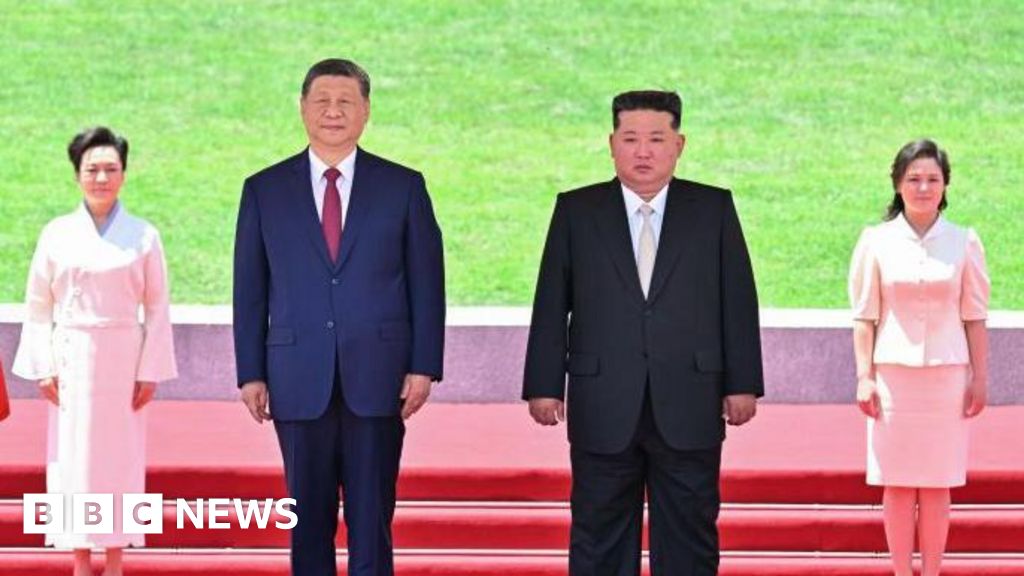
Xi Jinping’s visit to North Korea is aimed at reasserting Chinese leverage as Beijing grows concerned about Pyongyang’s closer military alignment with Moscow. North Korea’s exports to China reached about $2.3bn last year, while Beijing and Moscow previously vetoed a UN sanctions resolution over missile tests. The article signals elevated geopolitical risk for Northeast Asia, with potential implications for US, Japanese and South Korean security postures.
This is less a diplomatic reset than a bid to preserve China’s option value over a volatile buffer state. The second-order issue is that Beijing is trying to prevent Pyongyang from becoming an outsourced security asset for Moscow, because a Russia-backed North Korea would reduce China’s leverage while forcing more US-Japan-Korea coordination — a net negative for Chinese regional coercive power. The market implication is not “peace premium” but a higher floor on Northeast Asia militarization and on sanctions enforcement risk.
The near-term winners are defense primes and missile-defense supply chains in the US, Japan, and South Korea. Even if there is no immediate crisis, the signaling likely supports multi-quarter budget durability for interceptors, sensors, and munitions because planners will treat the China-Russia-North Korea triangle as a structural, not episodic, threat. The quieter loser is anything dependent on smoother China-Korea logistics or on a de-escalation path around sanctions; if Beijing reasserts control, it does so to manage risk, not to relax pressure on military procurement.
The most important tail risk is a visible China-North Korea trade or transport expansion that is interpreted in Washington as enabling sanctions evasion. That would invite tighter secondary-sanctions rhetoric within weeks and could ripple into Chinese banks, freight, and dual-use industrial names if enforcement broadens. Over 3-12 months, the bigger catalyst is whether Ukraine negotiations weaken Russia’s need for North Korean support; if that happens, Kim may lean harder on Beijing, temporarily increasing Chinese leverage but also raising the probability of more provocation to remind all sides of his value.
The consensus may be underpricing how much this dynamic strengthens regional defense spending even without a missile test spike. The right framing is not event-driven geopolitics, but a slow-burn reallocation toward deterrence assets, stockpiles, and supply-chain redundancy. That favors firms with direct exposure to interceptor replenishment and allied rearmament, while punishing companies whose China revenue is most vulnerable to sanctions escalation or border frictions.
AI-powered research, real-time alerts, and portfolio analytics for institutional investors.
Request TrialOverall Sentiment
neutral
Sentiment Score
-0.05
