
Realset AI and Flatkey Raise $10M Series A to Build Real-World Training Data for Frontier Models and Embodied Agents
Source: PR Newswire
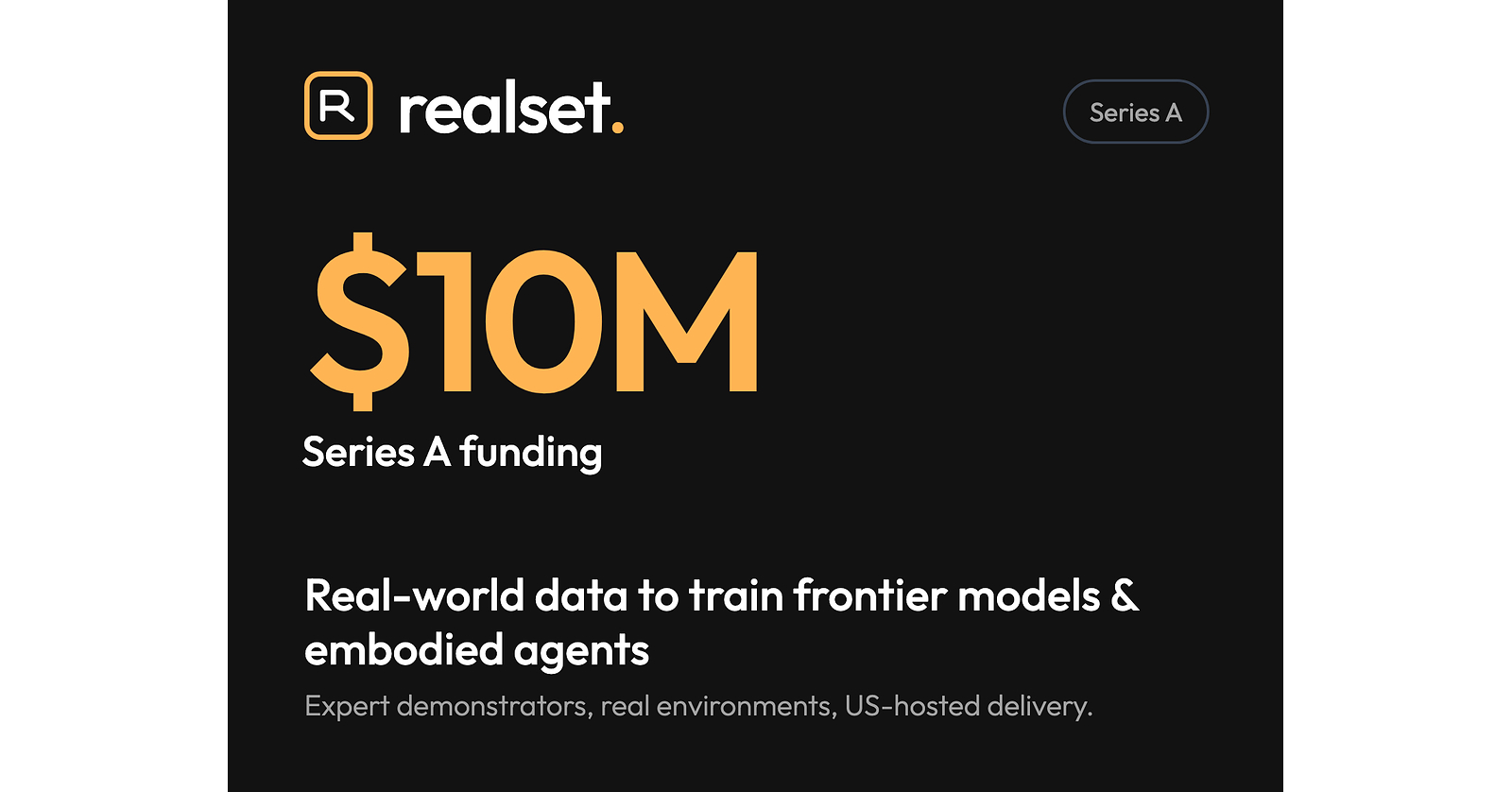
Realset AI and Flatkey raised a $10 million Series A to expand collection of expert-generated real-world training data for LLMs, robotics and embodied AI agents. The company will grow workplace and studio capture networks, expert demonstrator pools, RL environments and agent-evaluation services, positioning physical-world data as a scarce input after internet text data has been largely consumed. Realset also plans to release its Household Manipulation Bench for open-source vision-language-action models in Q4 2026.
Analysis
This is a modest validation of a bottleneck already being priced into robotics and agentic-AI leaders: proprietary, task-specific data and evaluation—not base-model access—will determine deployment readiness. The $10M round itself is immaterial to public valuations, but it reinforces that the data layer is fragmenting into specialized providers, reducing the likelihood that frontier-model training remains a durable advantage for generalized labeling vendors such as APLD or privately held Scale AI. Near term, this is not a standalone trading catalyst.
The more investable read-through is for NVIDIA (NVDA), Tesla (TSLA), Amazon (AMZN), and warehouse-automation suppliers: cheaper and more credible real-world demonstration data could shorten the iteration cycle for vision-language-action systems. However, the limiting factor for commercial robotics remains hardware reliability, integration labor, safety certification, and customer ROI—not merely training data. A favorable Q4 benchmark would be marketing evidence rather than proof of scalable unit economics unless it includes independently reproducible success rates, task variability, intervention frequency, and cost per successful task.
Contrary to the prevailing "physical-world data scarcity" narrative, the data may commoditize once capture protocols, sensor stacks, and synthetic-data augmentation mature. The likely value accrual over 6-18 months could therefore sit with owners of deployment distribution and workflow data—AMZN in fulfillment, TSLA through fleet-scale visual data, and industrial automation incumbents ABB and ROK—rather than standalone data-capture startups. Watch for disclosed robotics pilot conversions and labor-hours saved; absent those, this remains private-market signaling rather than a public-equity catalyst.
AllMind Terminal
AI-powered research, real-time alerts, and portfolio analytics for institutional investors.
Request TrialMarket Sentiment
Overall Sentiment
strongly positive
Sentiment Score
0.58
Key Decisions for Investors
- No direct trade on the financing; treat the planned Q4 2026 benchmark as an information event, not a valuation catalyst, until methodology and third-party reproducibility are disclosed.
- Maintain a 6-18 month preference for long AMZN versus short a broad robotics/AI thematic basket (BOTZ) if warehouse-agent deployment metrics improve: AMZN owns both proprietary workflow data and a large internal deployment surface, while BOTZ contains suppliers with weaker software-data moats.
- Watch NVDA robotics/software attach-rate commentary and Isaac ecosystem adoption over the next two earnings cycles. Add tactical NVDA exposure only if management identifies commercial robotics revenue or recurring software demand; falsify on continued data-center concentration with no robotics monetization disclosure.
- Monitor TSLA autonomy/Optimus milestones, but avoid assigning value to household-robotics claims before externally verified task success and intervention-rate data. A failure to show repeatable demonstrations by mid-2027 would argue against incremental multiple expansion from the embodied-AI narrative.
More News
- China's AI chip blitz arms Xi with a message for Trump: 'You can't choke us off'
- OpenAI’s agent hacked Australia’s Medicare website—the latest rogue AI incident that the company didn’t know about for months
- Meta announces new lightweight virtual reality glasses to one-up Apple’s Vision Pro
- Markets are rapidly coming around to the reality that the Fed has a lot more work to do
- Chinese authorities reportedly in possession of F-35 components in Hong Kong
- SoftBank shares jump over 7% after $11.1 billion bond issuance to fund OpenAI bet
From AllMind Research
- Anthropic IPO Preview: Valuation, Timing, and What to Watch
- Shein After the IPO: Venue, Valuation, and What Must Be Proved
- What AI Research Tools Should a Small Hedge Fund Buy First?
- AI Financial Research Benchmarks: What the Scores Mean
- State of M&A and Private Markets, June 2026: A $4.9 Trillion Rebound, Underwritten on Money That Never Got Cheaper