
There’s a new Wall Street TACO index — and this one is saying it’s time for Trump to strike a deal
Source: MarketWatch
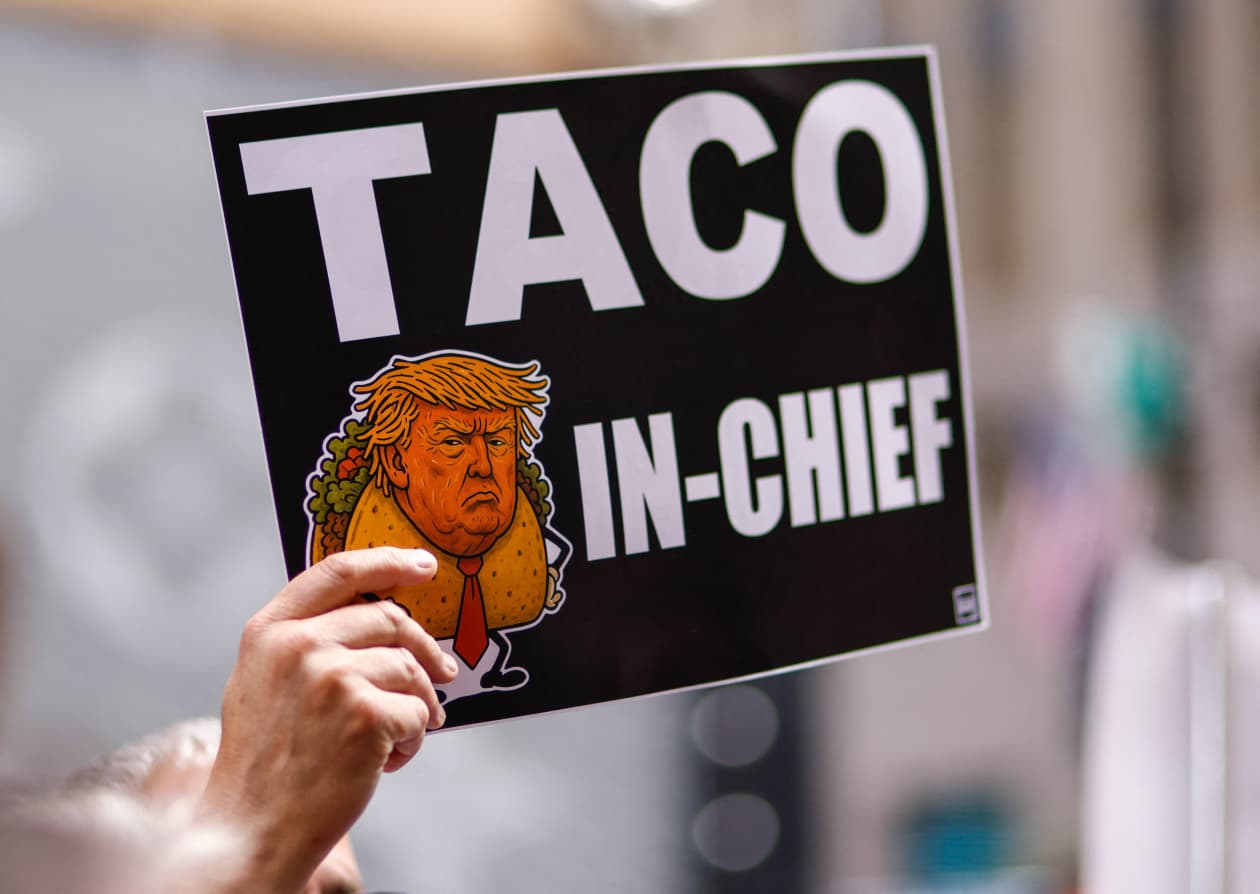
JPMorgan has created a “TACO” barometer to assess when market pressure may push President Trump toward a deal, based on the phrase “Trump Always Chickens Out.” A similar Signum Global Advisers index tracks Brent crude, the 10-year Treasury yield, Hormuz crossings and the S&P 500, highlighting key market and geopolitical variables rather than announcing a specific policy action or forecast.
Analysis
The investable signal is not the index itself but the market's growing tendency to price policy escalation as a short-duration volatility event rather than a durable regime shift. That reflexivity suppresses implied volatility and rewards selling geopolitical hedges after each de-escalation, but leaves markets vulnerable if a policy action becomes irreversible—e.g., sustained shipping disruption, sanctions enforcement that removes physical barrels, or a fiscal/trade measure with a fixed implementation date. JPM has negligible direct earnings sensitivity; its relevance is as a distributor of a narrative that may reinforce positioning rather than create fundamental value.
Near term, the higher-probability expression is mean reversion in oil, rates, and equity-volatility risk premia following perceived de-escalation. Over 1-3 months, however, repeated "buy-the-dip" behavior can create crowded short-vol and long-beta positioning, making the next non-reversible geopolitical shock more convex than headline indices imply. The key falsifier for the complacency thesis is a sustained normalization in energy freight/insurance costs and credit spreads alongside declining oil volatility; absent those confirmations, lower spot oil or a lower VIX alone should not be treated as proof that geopolitical risk has cleared.
Contrarian view: a widely discussed de-escalation framework can become self-defeating if policymakers perceive that markets have pre-priced restraint. That raises the incentive for an action designed to restore credibility, particularly where the immediate economic cost is delayed. The better risk/reward is therefore to monetize relief rallies in the most crowded hedges while retaining inexpensive tail protection, rather than establish a directional bet on JPM or treat the barometer as a trading signal.
AllMind Terminal
AI-powered research, real-time alerts, and portfolio analytics for institutional investors.
Request TrialMarket Sentiment
Overall Sentiment
neutral
Sentiment Score
0.00
Ticker Sentiment
Key Decisions for Investors
- No standalone JPM position on this development; require evidence of incremental trading revenue, client-flow disclosure, or a material change in rates/credit-market activity before attributing earnings impact to the index narrative.
- On a relief rally over the next days to weeks, consider trimming tactical long USO/XLE hedges rather than adding: use Brent and tanker/freight pricing as confirmation, with re-entry if physical-market indicators fail to normalize within 2-4 weeks.
- Maintain 1-3 month convex protection via modest SPY put spreads or VIX call spreads rather than outright long volatility. Target structures with defined premium at risk; the thesis is a positioning shock, not a forecast of continuously rising volatility.
- For a relative-value expression, favor long XLE versus short XLI only if oil volatility and transport/insurance costs remain elevated while broad equities rebound. Exit if Brent volatility compresses materially and industrial PMIs/orders improve, which would remove the margin-pressure leg of the trade.
- Monitor HY credit spreads, 10-year Treasury volatility, and Hormuz/shipping-flow data daily. A simultaneous widening in spreads and disruption in flows would falsify the de-escalation premise and warrants rebuilding energy exposure and increasing equity downside hedges.
More News
- Inflation jumps across euro zone, raising pressure on ECB to hike
- Trump, Musk, AI CEOs Meet; OpenAI Eyes $1.4 Trillion Value
- JPMorgan and Goldman See Mideast Oil Flows Near Pre-War Levels
- Stocks Waver Ahead of PCE, Micron; Mideast Oil Flows Rebound; Trump Backs Outside AI Audits
- Bassiri Tabrizi: US Iran Moving Further Apart in Talks
- Bank of America to pay $39 million to settle customer claims over low interest rates on cash