
Bambace Peterson Team Analysis of 338 Southwest Carmel Sales Finds the Cost of Beach Proximity Is Rising, and Rising Unevenly
Source: PRWeb
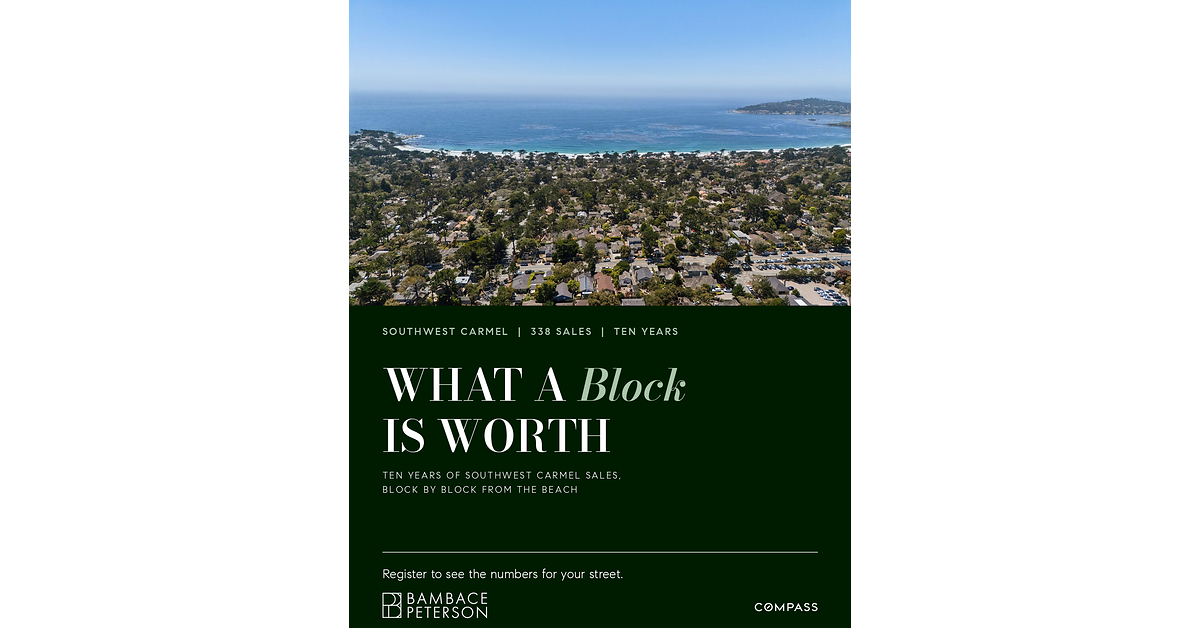
Across 338 Southwest Carmel home sales from 2017 through September 2026, Scenic averaged $4,192 per square foot, a $1,902 premium over the $2,290 benchmark. From 2017–2019 to 2023–2025, Scenic’s premium widened from about $1,746 to $2,383 per square foot, while the benchmark reached $4,818,500 median sale price and $2,821 per square foot through September 2026, about 23% above its ten-year average. Annual sales averaged about 29 over the last three years versus 35 across the full ten-year period.
Analysis
This is evidence of widening scarcity value in a very small luxury submarket, not a clean signal for U.S. housing or brokerage earnings. The investable mechanism is greater price dispersion: scarce beachfront inventory can hold headline values while inland homes face weaker marginal demand, making aggregate median prices increasingly composition-sensitive. That also reduces the reliability of appraisals and comparable sales for lenders and buyers.
The report is promotional and the sample is thin at the street level. In particular, no Scenic sale in 2026 means the latest broad-market strength cannot verify current beachfront clearing prices. Fewer transactions can mechanically widen observed premiums if the homes that sell are atypical; the data do not isolate inventory effects from property mix, renovation, lot size, or views.
Near term, this is not a catalyst for public real-estate securities: one Carmel submarket is too small to move broad housing fundamentals, and no company-level earnings sensitivity is established. Over 1–3 months, monitor transaction counts and like-for-like sales rather than median price. Over 6–18 months, coastal insurance availability and premiums, financing costs, and climate-related disclosure or regulation could challenge the beach premium even as scarcity supports it. The contrarian risk is treating widening historical gaps as durable appreciation: low liquidity can make both premiums and subsequent reversals look sharper than underlying demand.
AllMind Terminal
AI-powered research, real-time alerts, and portfolio analytics for institutional investors.
Request TrialMarket Sentiment
Overall Sentiment
mildly positive
Sentiment Score
0.25
Key Decisions for Investors
- No trade in broad housing, mortgage, or real-estate equities from this report alone; it does not establish a material earnings catalyst for any public company.
- Treat Compass as a watch item, not a recommendation: seek evidence that this local pricing pattern is translating into listing volume, commission revenue, or market-share gains before taking exposure.
- For private-market underwriting, stress-test beachfront exits using lower transaction liquidity and higher insurance costs; do not capitalize the reported premium as a reliable current comparable without recent like-for-like sales.
- Reassess the scarcity thesis if beachfront inventory rises alongside falling matched-sale prices, or if coastal insurance becomes materially less available or more expensive; improving sales volume without premium compression would strengthen it.
More News
- Fannie Mae, Freddie Mac rally as Ackman presses for conservatorship exit
- Fortune Brands Q3 2026 slides reveal turnaround plan amid sales decline
- Statement by the Monetary Policy Board: Monetary Policy Decision
- The next wave of luxury real estate: marina developments with yacht parking
- Australia’s central bank lifts rates to 18-year high, split vote points to pause ahead
- Whitney Warns of Consumer Strain