
New Brattle Report Finds SEC Enforcement Remained Low in FY26 Despite Late-Year Pickup
Source: PR Newswire
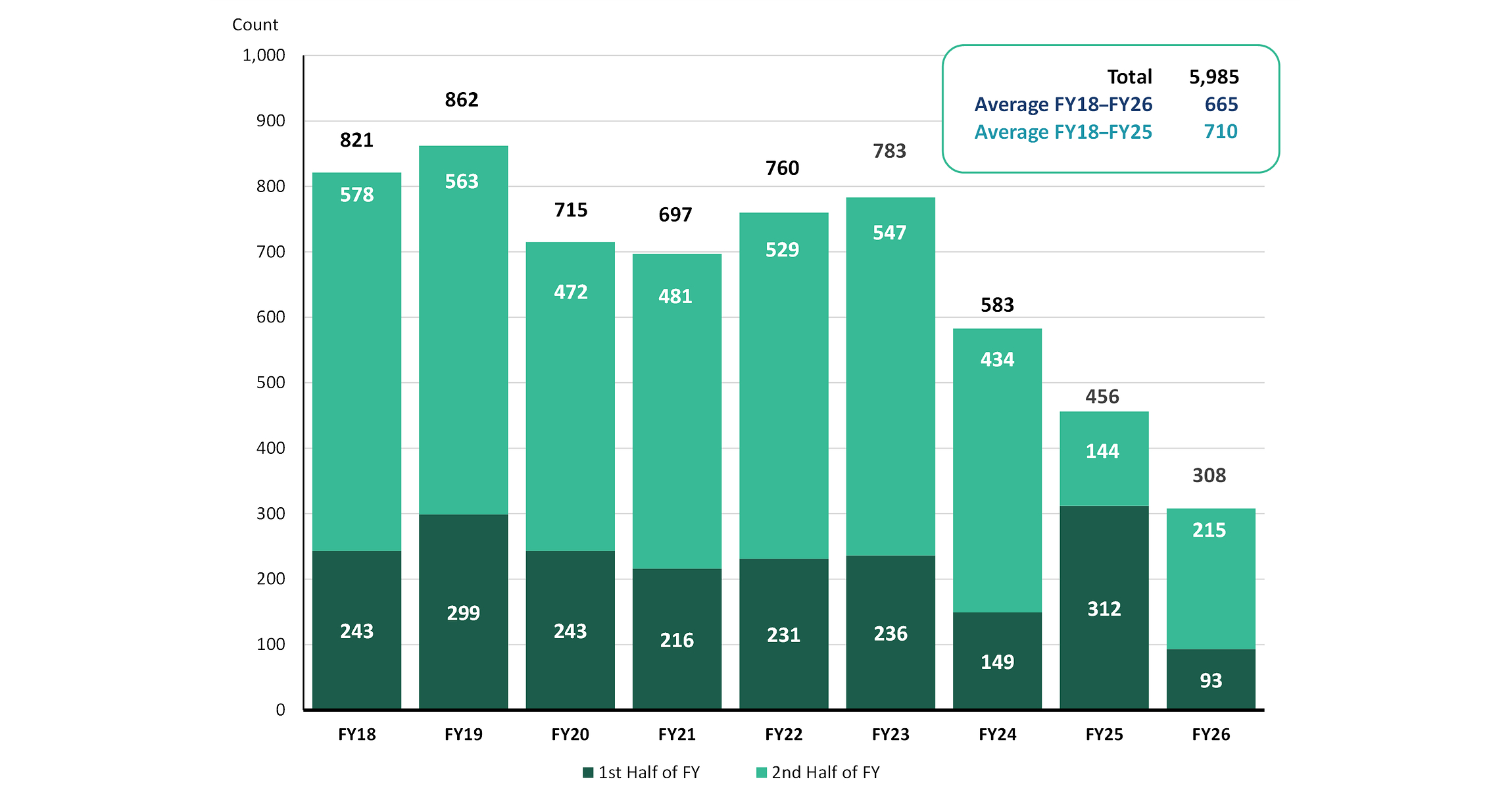
The SEC filed an estimated 308 enforcement actions in FY26, 57% below the FY18–FY25 annual average of 710, despite a second-half pickup to 215 actions, including 99 in September. Brattle expects 350–450 actions in FY27, still well below the historical average. Insider trading accounted for 12.3% of FY26 actions, while the report estimates parallel criminal indictments in 52 actions, or 16.9%.
Analysis
The headline count is a weak proxy for the change in expected regulatory cost: offerings and delinquent-filing cases can move the total without a comparable change in enforcement against economically consequential misconduct. The higher insider-trading share and the gap between SEC announcements and public-record identification of parallel criminal cases argue against reading the slowdown as a clean reduction in deterrence. For brokers, asset managers, and issuers, any near-term benefit is therefore more likely lower perceived enforcement risk than a demonstrable reduction in legal expense or compliance budgets.
Over the next 1–3 months, watch whether September’s pickup persists and whether filings target substantive conduct rather than administrative violations. A continued low run rate could modestly support financial-sector sentiment; a staffing recovery or backlog release could reverse that quickly. Over 6–18 months, inconsistent enforcement may raise policy and reputational risk even while reducing near-term case frequency, especially if high-profile cases cluster. Brattle’s FY27 estimate is a forecast, not an independently established agency plan.
Contrarian read: the market may overvalue the headline slowdown while underweighting both delayed-case risk and criminal referrals. The data do not establish a durable change in enforcement priorities, so a broad long-financials or short-compliance trade has poor signal-to-noise absent confirmation.
AllMind Terminal
AI-powered research, real-time alerts, and portfolio analytics for institutional investors.
Request TrialMarket Sentiment
Overall Sentiment
mildly negative
Sentiment Score
-0.15
Key Decisions for Investors
- No broad sector trade on the action count alone. Treat any near-term relief bid in brokers, asset managers, or issuers as sentiment-sensitive rather than evidence of lower underlying compliance costs.
- Set a 1–3 month alert for sustained monthly filings and case mix. A persistent rebound in substantive allegations would weaken the reduced-enforcement thesis; renewed administrative-heavy filings would be less meaningful for earnings risk.
- Monitor SEC staffing and leadership updates, enforcement disclosures, and parallel criminal proceedings over the next 6–18 months. A backlog release or high-profile insider-trading cases would be a catalyst for renewed legal-risk repricing.
- Falsify the cautious view of limited market impact if company guidance or reported legal/compliance costs materially change, or if enforcement activity and case severity rise together for multiple quarters. Until then, avoid forcing a directional trade.
More News
- Jio’s Record $3.2 Billion IPO Puts India’s Market Muscle to the Test
- Before Tera’s 95% Crash, Punches Were Thrown and Warnings Missed
- UnitedHealthcare and Humana are ending Medicare Advantage plans for nearly 1 million people
- Why is Intuitive Surgical stock sliding today?
- 'Cannot play hide and seek': Singapore minister's warning over haze sends agricultural stocks lower
- Boeing's 737 Max 10 approved for passenger service after years of delays: FAA says
From AllMind Research
- Anthropic IPO Preview: Valuation, Timing, and What to Watch
- Shein After the IPO: Venue, Valuation, and What Must Be Proved
- What AI Research Tools Should a Small Hedge Fund Buy First?
- Weekly Update: Sector Analysis, Improvements on Research Data, and Performance Enhancements
- Choosing an AI Copilot for Equity Research