
Global Camping Equipment Market to Grow at 6.7% CAGR as Outdoor Recreation, Lightweight Gear and Sustainable Camping Solutions Gain Momentum, reports Maximize Market Research
Source: PR Newswire
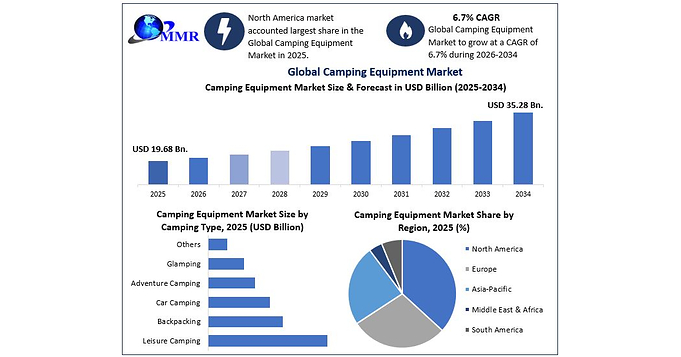
The global camping equipment market is forecast to grow from USD 19.68 billion in 2025 to USD 35.28 billion by 2034, a 6.7% CAGR for 2026–2034, according to Maximize Market Research. The report attributes growth to rising outdoor recreation and demand for lightweight, sustainable and premium gear; North America currently leads, while Asia Pacific is expected to grow faster. It also cites 2026 product launches by companies including NEMO Equipment and The North Face, with no company-specific financial results or market reaction reported.
Analysis
The report is a weak near-term signal: a market-research forecast is not evidence of incremental orders, pricing power, or earnings revisions, and the methodology behind its long-dated market estimate is not independently established here. The investment question is share capture and profit conversion, not category growth.
Exposure is uneven. YETI’s cooler and outdoor-products positioning may offer a more direct read-through than V.F. Corporation, where The North Face is only one part of a broader portfolio, or Newell Brands, where Coleman is one brand among many. Dometic’s camping products and Johnson Outdoors’ outdoor recreation businesses are also relevant, but the article provides no company-level sales or margin contribution. Premium launches could support mix if consumers pay for differentiated products; if shoppers trade down or retailers discount, added assortment may instead raise inventory and marketing costs. Smaller specialists and private-label products could capture growth without improving listed incumbents’ economics.
Time horizon: little reason for an immediate price reaction on this release alone. Over 1–3 months, earnings commentary, sell-through, inventory, and promotional intensity are more useful catalysts than launch announcements. Over 6–18 months, Asia-Pacific participation and sustainable-material claims matter only if distribution and repeatable demand develop. Weather, disposable-income pressure, and travel spending can reverse discretionary demand. The contrarian risk is assuming a growing TAM benefits every supplier; fragmentation and channel competition may dilute returns.
AllMind Terminal
AI-powered research, real-time alerts, and portfolio analytics for institutional investors.
Request TrialMarket Sentiment
Overall Sentiment
mildly positive
Sentiment Score
0.25
Key Decisions for Investors
- No trade on the forecast or product-launch headlines alone. Treat the estimate as a category-level hypothesis, not a company earnings catalyst.
- Put YETI, Johnson Outdoors (JOUT), Newell Brands (NWL), V.F. Corporation (VFC), and Dometic Group (DOM) on an earnings watchlist. Verify outdoor-segment sales, organic growth, gross-margin direction, inventory, and discounting before assigning exposure; segment scope may differ materially from consolidated results.
- Reassess after the next earnings cycle: evidence of sustained sell-through with stable margins would strengthen the demand thesis; inventory building, heavier promotions, or weaker guidance would falsify it. No price target is warranted from the supplied information.
More News
- Former world No. 1 Jon Rahm's lawyer tells court Spaniard is done with LIV Golf after three seasons
- Anthropic will be 'most ridiculous IPO' of year, analyst says
- Levi Strauss hikes profit guidance after tariff refunds, but its sales outlook is less optimistic
- Weston Family, Fairfax Financial’s Watsa Acquire Boots in $8.9 Billion Deal
- Samsung Q3 profit surges to record high, but misses lofty expectations
- Brazil is having its Argentina moment. How to play it
From AllMind Research
- Anthropic IPO Preview: Valuation, Timing, and What to Watch
- Shein After the IPO: Venue, Valuation, and What Must Be Proved
- What AI Research Tools Should a Small Hedge Fund Buy First?
- What Is an AI Investment Research Platform?
- What Exactly Does Post-Training in LLMs and Finance-Focused AI Actually Mean for Asset Managers?