
Going 2026 Holiday Travel Outlook
Source: PR Newswire
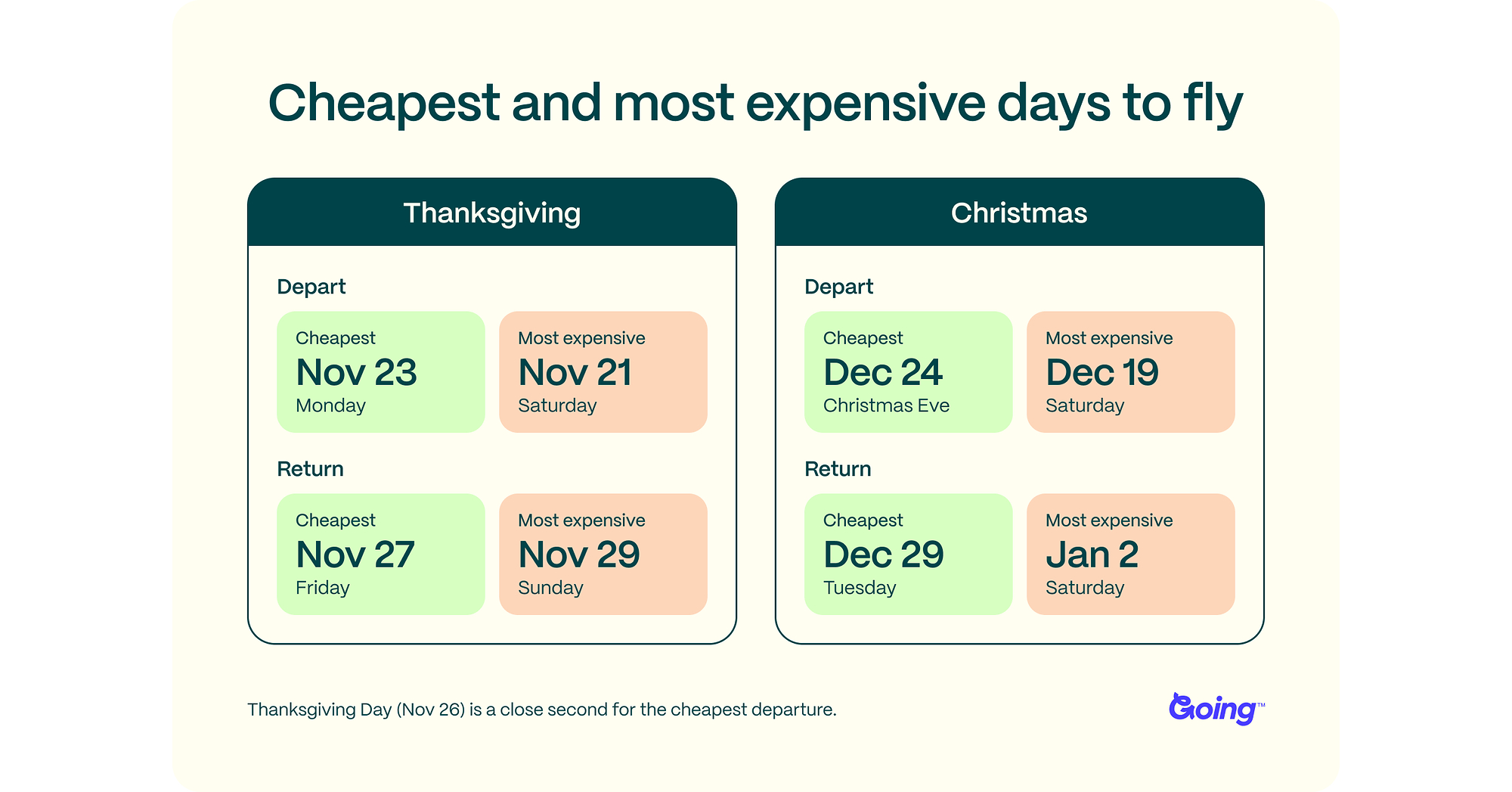
Going reports domestic round-trip holiday fares up 15% year over year for Thanksgiving and 16% for Christmas, while international fares are essentially flat. Regional increases are steeper in the Midwest for Thanksgiving (+28%) and Northeast for Christmas (+34%); the West has the mildest rises (+11% and +14%, respectively). Going attributes fare pressure to rising fuel and labor costs, strong summer demand relative to available seats, and the loss of a major low-cost carrier, while noting Thanksgiving-week international deals and cheaper departure days.
Analysis
The more investable signal is domestic-versus-international pricing divergence, not the headline fare increases. If higher domestic fares persist into booked yields, constrained domestic capacity could support airline revenue per seat; but rising fuel and labor costs may absorb the benefit, while price-sensitive travelers trade down, shift dates, or skip trips. Search-weighted fares are not realized ticket yields, and the quoted holiday deal sample is especially vulnerable to route and availability mix. Treat this as a pricing indicator, not earnings evidence.
Near term (days to weeks), flexible departure dates and international itineraries may capture relative value; the airline-equity read-through needs booking-curve and capacity confirmation. Over 1–3 months, holiday booking trends, carrier guidance, and fuel prices are the key catalysts. Over 6–18 months, any durable capacity discipline would matter more than one holiday fare snapshot. A reversal in booking yields or renewed seat growth would weaken the pricing-power thesis; a fuel-cost spike could erase margin benefits even if fares hold.
Contrarian angle: elevated fares may signal a ceiling on volume rather than stronger underlying demand. The regional dispersion and one-week international deal examples do not establish broad market-wide strength. No clean outright airline trade is justified from this release alone.
AllMind Terminal
AI-powered research, real-time alerts, and portfolio analytics for institutional investors.
Request TrialMarket Sentiment
Overall Sentiment
mildly negative
Sentiment Score
-0.15
Key Decisions for Investors
- Do not initiate a directional airline position on the fare data alone. Track realized passenger yield, load factors, unit revenue, and available-seat growth in upcoming updates; require those metrics to confirm that advertised fare strength converts into revenue.
- Set a conditional relative-value watch: favor carriers whose disclosed capacity and revenue exposure are more domestic over peers with greater international exposure only if booking yields confirm the divergence and fuel does not accelerate. Verify company-level route mix before sizing; the article does not identify winners.
- For consumer-facing exposure, monitor travel-platform conversion and trip volumes rather than assuming higher fares are a tailwind: higher ticket prices can raise nominal transaction values but also suppress bookings. Reassess after holiday booking updates.
- Falsifiers: domestic realized yields roll over, capacity additions outpace demand, or fuel costs rise enough to pressure airline margins. Those developments would argue against treating the fare increases as durable pricing power.
More News
- Trump says he is not keen on a deal with Iran as U.S. reportedly prepares for 'massive bombing'
- Tanker hit by multiple projectiles off north coast of Qatar, UKMTO says
- US stocks slide as oil prices fluctuate over renewed Iran war fears
- Oil, Inflation Fears Derail Record US Stock Rally
- Asia shares subdued, bonds swamped by AI debt wave
- Elon Musk blames Indian 'oligarchs' for stalling Starlink launch
From AllMind Research
- Anthropic IPO Preview: Valuation, Timing, and What to Watch
- Shein After the IPO: Venue, Valuation, and What Must Be Proved
- What AI Research Tools Should a Small Hedge Fund Buy First?
- Run Cost-Controlled Financial Research in AllMind Agent Studio
- State of Public Markets, June 2026: Higher for Longer Meets the AI Supercycle