
Demand for Large, Late-Model Jets Continues as Inventory Levels Remain Lower Than Last Year
Source: PR Newswire
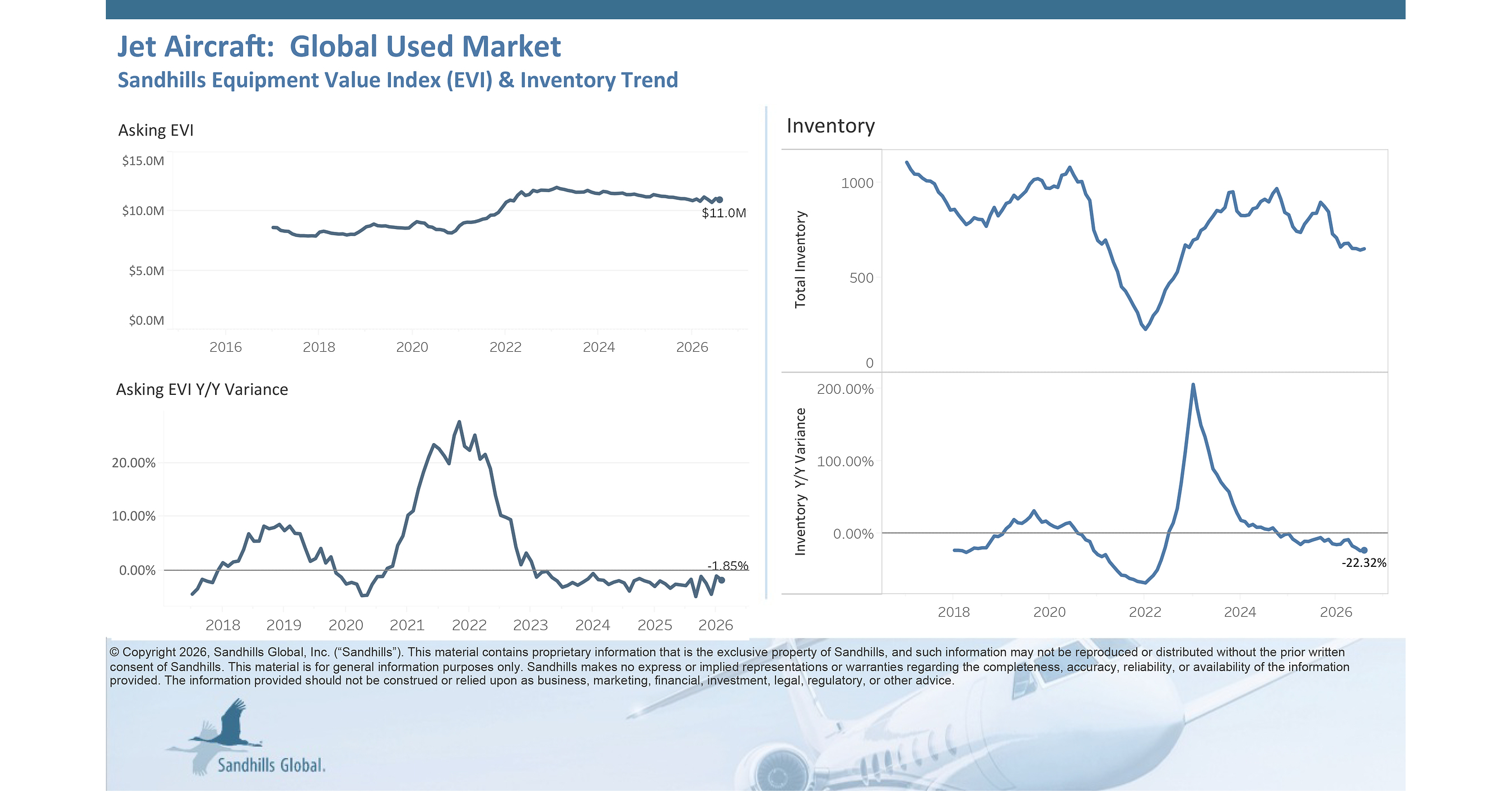
Sandhills’ Global Used Aircraft Market Report shows used jet inventory down 22.32% Y/Y in August (but up 1.09% M/M), while used jet asking prices fell 0.88% M/M and 1.85% Y/Y and are “trending sideways.” In key categories, used piston-single inventory rose 2.8% M/M but declined 11.75% Y/Y with asking values down 0.93% M/M and 1.6% Y/Y, and turboprop inventory rose 4.04% M/M but fell 9.92% Y/Y. Overall, the report points to tighter supply but softer pricing trends, implying a cautious near-term used aircraft market backdrop.
Analysis
The market takeaway is less about supply scarcity and more about residual-value signaling. When asking values soften even as inventory is still trending lower, sellers are likely clearing stock at lower realized spreads rather than enjoying true pricing power; that is a headwind for brokers, dealers, and lessors before it becomes visible in OEM orders. The cleanest beneficiary is the large-cabin end of business aviation, where constrained supply can still support replacement demand, while light jets look more vulnerable to rate sensitivity and corporate capex caution.
The second-order risk is financing. Lower used marks feed directly into loan-to-value, lease-end returns, and collateral haircuts, which can slow upgrade cycles over the next 1-3 months even if utilization holds up. That is the real pressure point for aircraft owners and financiers: not whether planes are available, but whether the bid-ask gap is widening enough to freeze transactions and force markdowns.
Contrarian view: the consensus may read falling inventory as bullish for the whole segment, but that is too coarse. If inventory is declining because owners are waiting for better bids, not because demand is robust, then transaction volume can remain weak and the low-inventory signal will be a false positive. Over 6-18 months, persistent soft used pricing would argue for caution on lower-end business aviation exposure and on any name dependent on strong residual values rather than hard order-book evidence.
AllMind Terminal
AI-powered research, real-time alerts, and portfolio analytics for institutional investors.
Request TrialMarket Sentiment
Overall Sentiment
mildly negative
Sentiment Score
-0.15
Key Decisions for Investors
- Relative value: long GD / short TXT over 1-3 months. The data favors large-cabin replacement demand over light-jet exposure; stop if GD order momentum slows or if large-jet asking values fall another ~3% from here.
- Avoid initiating new longs in AER or AL ahead of the next earnings cycle; used-aircraft softness raises residual-value and collateral-mark risk. If already long, consider short-dated put spreads as a hedge into prints.
- No standalone trade on this report unless we can confirm transaction volume and days-on-market. Treat it as a watch item for a widening bid-ask spread, not a conviction signal.
- If used-jet asking values stabilize for two consecutive monthly prints while inventory remains below prior-year levels, add to GD and revisit TXT hedge; that would indicate the market is shifting from discounting to true scarcity.
- Set an alert on any management commentary about lease-end assumptions or residual-value revisions at AER/AL; that would be the fastest falsifier of the current thesis and the cleanest catalyst for a downside move.
More News
- Indonesian stocks plunge to six-year low as MSCI downgrade fears mount
- Indonesia Said to Meet Monday With MSCI Over Shock Index Threat
- Putin reportedly suggests summit with Trump and Xi to decide fate of Ukraine
- Ukraine launches over 1,000 drones at Russia, setting oil facilities ablaze
- China's CXMT sees shares drop over 6% as investors look past chipmaker's profit turnaround
- Trump defends Russian sanctions relief, lashes out at Zelenskyy