
Supermicro Now Shipping NVIDIA Vera Rubin NVL72 Racks
Source: PR Newswire
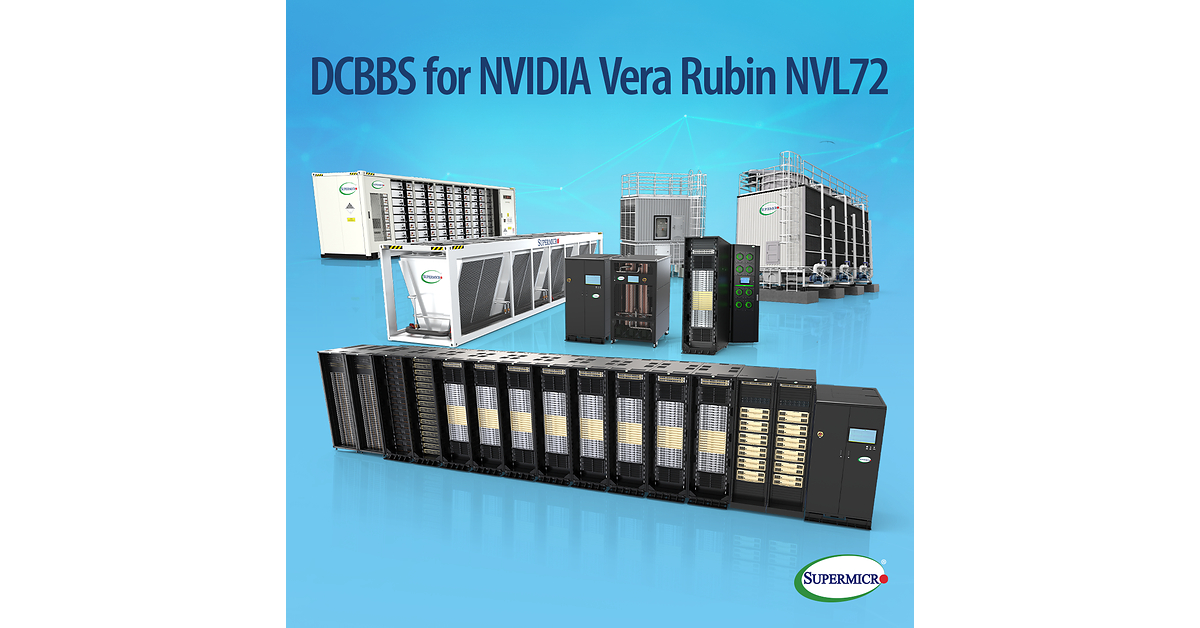
Supermicro has begun shipping NVIDIA Vera Rubin NVL72 liquid-cooled AI racks, expanding its end-to-end data-center deployment offering around NVIDIA's next-generation platform. Each rack integrates 72 Rubin GPUs, 36 Vera CPUs, 20.7TB of HBM4 memory and 216TB/s of NVLink scale-up bandwidth; a 16-rack Scalable Unit provides 1,152 GPUs and 331TB of HBM4. The launch highlights Supermicro's liquid-cooling and deployment capabilities for AI clusters spanning 5MW to gigawatt-scale power envelopes, supporting its positioning in large-scale AI infrastructure.
Analysis
The investable implication is not initial rack availability, but whether SMCI can convert its integration role into a higher-margin, lower-volatility systems business. Owning liquid cooling, power distribution and deployment services raises revenue per GPU versus chassis-only sales, but also shifts execution risk onto SMCI: working-capital intensity, installation acceptance timing and field-service obligations can delay revenue and pressure cash conversion. The key near-term proof point is whether backlog growth is accompanied by stable gross margin and declining days-sales-outstanding rather than a larger receivables build.
NVDA benefits indirectly if turnkey deployment shortens customer commissioning cycles, since faster cluster activation supports follow-on GPU orders and reduces the risk that power/cooling constraints defer Rubin demand. However, SMCI is unlikely to capture a durable technology moat solely through reference-architecture integration; Dell (DELL), HPE and Lenovo (LNVGY) can bundle comparable systems, while Vertiv (VRT), nVent (NVT) and Eaton (ETN) are better positioned to monetize the facility-side electrical and thermal bottlenecks with less GPU allocation risk. The more structural scarcity remains high-voltage power equipment, transformers and cooling infrastructure—not server assembly.
Consensus may over-credit a press release for demand visibility. This is a supply-readiness claim, not evidence of customer purchase orders, delivery acceptance or incremental margin. Over the next 1-3 months, SMCI can outperform on disclosed Rubin backlog or customer deployments; over 6-18 months, its valuation requires evidence that full-stack integration protects gross margin despite competitive bids and that inventory turns remain disciplined. Falsify a constructive SMCI view if gross margin falls below prior guidance, receivables/inventory materially outpace sales for two quarters, or major hyperscalers disclose a shift toward ODM/direct-build designs.
AllMind Terminal
AI-powered research, real-time alerts, and portfolio analytics for institutional investors.
Request TrialMarket Sentiment
Overall Sentiment
strongly positive
Sentiment Score
0.58
Ticker Sentiment
Key Decisions for Investors
- Maintain NVDA as the cleaner 6-18 month core exposure; add on post-earnings volatility only if Rubin supply commentary and hyperscaler capex plans remain intact. Relative to SMCI, NVDA has materially lower project-completion and receivables risk.
- Use a 1-3 month pair trade: long VRT / short SMCI in equal dollar amounts if SMCI rallies materially on the announcement without a concurrent backlog, margin or cash-conversion disclosure. VRT captures cooling/power capex across multiple compute platforms; cover if SMCI reports verified deployment revenue with gross-margin expansion.
- Do not initiate a standalone SMCI long solely on shipping language. Upgrade only after confirming customer-specific Rubin orders, revenue-recognition terms, inventory turns and DSO in the next earnings release; target a position sized for high execution volatility rather than treating it as an NVDA proxy.
- Monitor DELL, HPE, ETN and NVT for incremental AI-infrastructure order commentary. A broadening of orders toward power and thermal suppliers would validate the facility-bottleneck thesis and favor ETN/NVT/VRT over server OEM beta.
More News
- Wall Street falls as oil prices, Treasury yields rise
- OpenAI agents ‘infiltrated Australian government website’
- Why IonQ Stock Is Up Today
- Amazon Blocked Meta's AI Shopping Agent. Shopify Welcomed It -- and Gets Paid on Every Checkout.
- Trump calls AI oversight a ‘globalist scheme’ as Amodei and Altman head to the UN to ask for it
- Meta’s Muse rekindles fears over winners and losers as personal AI agent emerges
From AllMind Research
- Anthropic IPO Preview: Valuation, Timing, and What to Watch
- Shein After the IPO: Venue, Valuation, and What Must Be Proved
- What AI Research Tools Should a Small Hedge Fund Buy First?
- What Is an AI Investment Research Platform?
- What Exactly Does Post-Training in LLMs and Finance-Focused AI Actually Mean for Asset Managers?