
Russia's Oil Exports Slow as Black Sea Loading Takes Longer
Source: Bloomberg
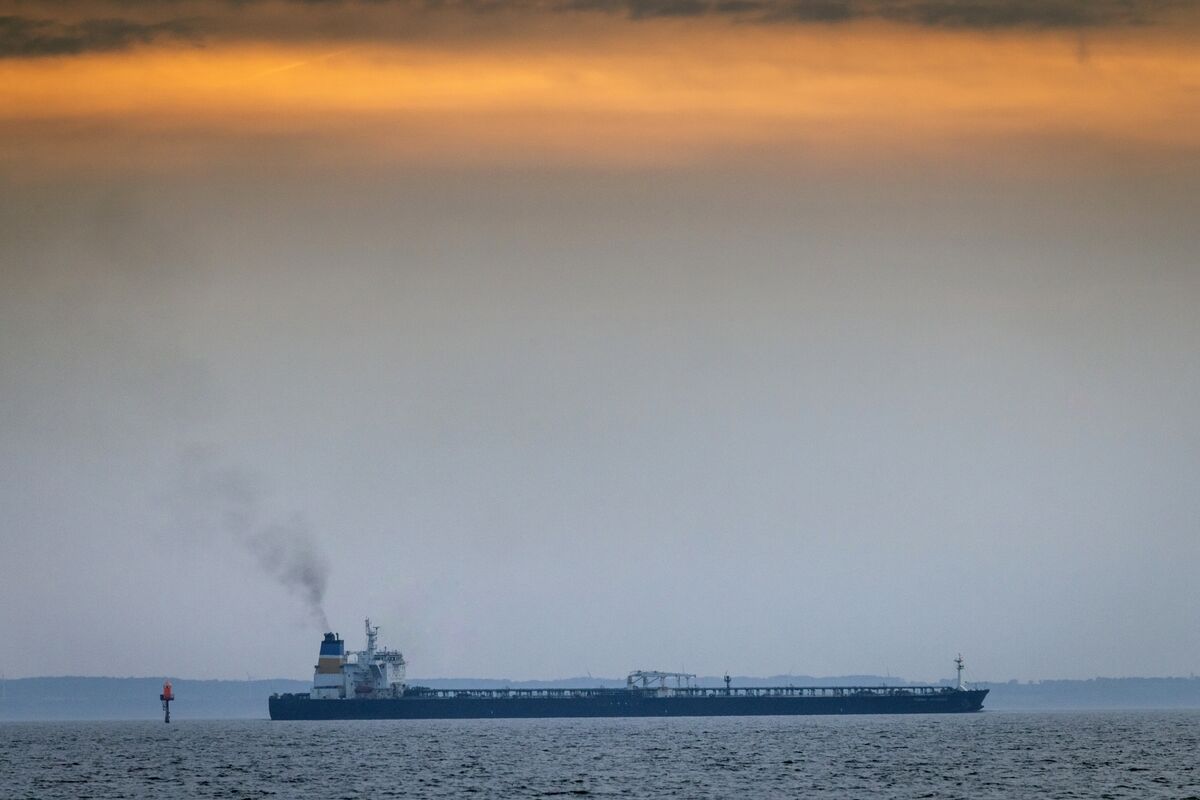
Russia’s overseas crude flows fell to 3.7 million barrels a day in the four weeks through Oct. 11, down 110,000 barrels a day from the revised period through Oct. 4. At Novorossiysk, tankers are spending four days at main crude berths—twice the loading time at comparable Baltic facilities—amid rising security fears after a fully laden tanker was hit by drones after leaving the port.
Analysis
The key market variable is duration, not the reported weekly flow change: longer berth times can tie up scarce compliant or willing tonnage, lift voyage costs, and make Russian barrels less competitive even if production is unchanged. That creates a potential two-step effect—first higher freight and insurance, then wider discounts on Russian grades if buyers demand compensation for delivery uncertainty. Non-Russian crude suppliers may gain at the margin, but the impact on benchmark prices is likely limited unless disruption persists or spreads to other export routes; inventories and rerouting can absorb a short interruption.
Near term, tanker owners with exposure to the relevant routes could see tighter vessel availability, but elevated security and sanctions-related risks make this an asymmetric benefit rather than a clean sector long. Over 1–3 months, watch port dwell times, export volumes across all Russian outlets, tanker rates and insurance costs, and Russian crude differentials. Over 6–18 months, repeated disruptions could accelerate buyers’ and shipowners’ diversification away from Russian flows, while also entrenching a larger discount and less efficient logistics.
The contrarian read: the decline may be cargo timing and port congestion, not lost supply. Without corroboration from production, broader exports, or persistent freight/insurance repricing, a sustained crude-price premium is vulnerable to reversal.
AllMind Terminal
AI-powered research, real-time alerts, and portfolio analytics for institutional investors.
Request TrialMarket Sentiment
Overall Sentiment
mildly negative
Sentiment Score
-0.30
Key Decisions for Investors
- No outright crude trade on this data point alone. Treat it as an alert; consider a defined-risk Brent call spread only if export weakness persists across multiple reporting periods and prompt time spreads begin to strengthen.
- Monitor tanker freight and war-risk insurance pricing before taking directional shipping exposure. A sustained rise could support a selective tanker-freight position, but route exposure and sanctions compliance must be verified first.
- Track Russian crude differentials against comparable grades: continued widening would validate a lasting logistics penalty and could benefit alternative crude suppliers; normalization alongside recovering flows would invalidate the thesis.
- Falsification signals: Novorossiysk dwell times return toward normal, aggregate Russian exports rebound, and freight/insurance costs fail to reprice. In that case, fade any short-lived geopolitical premium rather than extrapolating the disruption.
More News
- Houthis threaten Saudi Arabia’s Aramco facilities and airports
- Just 32 countries are driving 95% of global growth as the IMF warns of an increasingly uneven economy
- Huge profits at tech and energy companies are masking this key trend
- ‘The cost to us, the United States, is high’: Trump’s ‘financial lifeline’ diesel deal with Putin sparks bipartisan backlash in Congress
- Iran threatens Gulf data centres: How exposed is the region’s internet?
- Iran reportedly fortifies nuclear sites as it prepares for possible U.S. strikes after midterms
From AllMind Research
- Anthropic IPO Preview: Valuation, Timing, and What to Watch
- Shein After the IPO: Venue, Valuation, and What Must Be Proved
- What AI Research Tools Should a Small Hedge Fund Buy First?
- The $4.7 Trillion Bet: When Does AI Capex Become AI Revenue?
- Equity Research Automation Statistics: A 2026 Evidence Check