
The $4.7 Trillion Bet: When Does AI Capex Become AI Revenue?
The tech industry is pouring $4.7 trillion into AI infrastructure by 2030. We break down what the latest sell-side research actually says, why the compute demand curve is unlike anything we've seen before, and what it means for portfolio construction right now.

Published February 13, 2026
In this article
Let's talk about a number that keeps coming up in every conversation we're having right now: $4.7 trillion.
That's the cumulative global AI capital expenditure projected between 2026 and 2030, according to every major broker's Year Ahead 2026 outlook. Of that, $2.4 trillion is already committed based on over 40 announcements disclosed in 2025 alone. Spending in 2026 is expected to hit $571 billion, growing at a 25% compound annual rate to reach $1.3 trillion by the end of the decade.
But here's the number that should actually keep you up at night: capex as a percentage of operating cash flows for the largest hyperscalers has surged from roughly 40% in 2023 to nearly 70% in 2025. These companies are spending at a pace that makes previous infrastructure booms look modest, and monetization is still playing catch-up.
That's either terrifying or the most important investment signal of the decade. Probably both.
The Historical Playbook No One Wants to Hear
Every transformational technology has followed the same uncomfortable pattern. Massive upfront investment. A painful lag before revenue materializes. A shakeout that rewards patient capital while punishing the overextended.
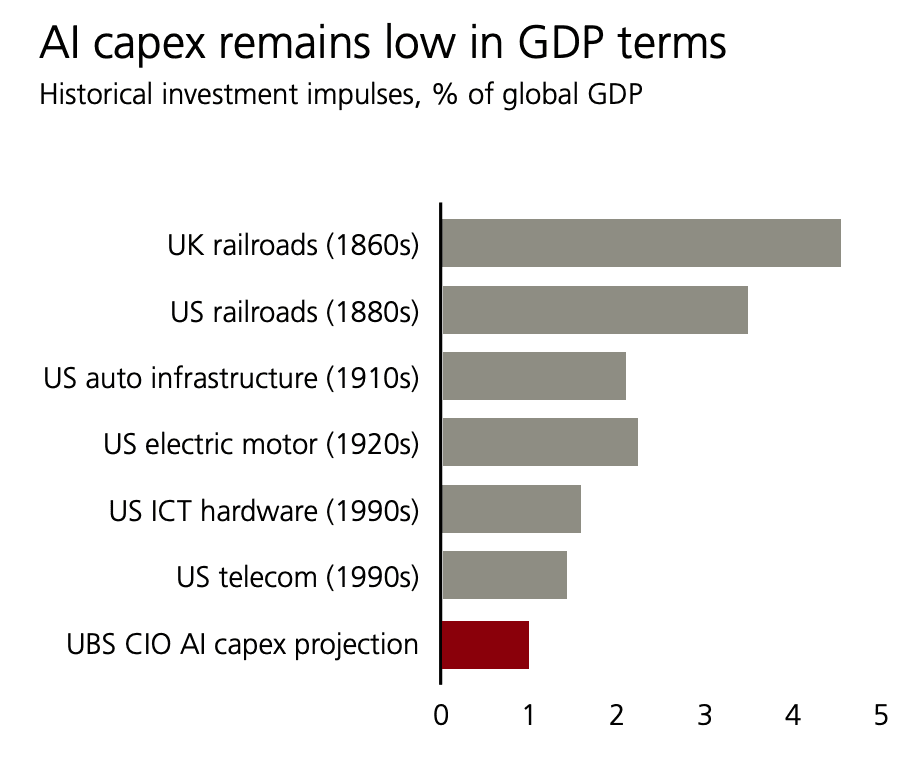
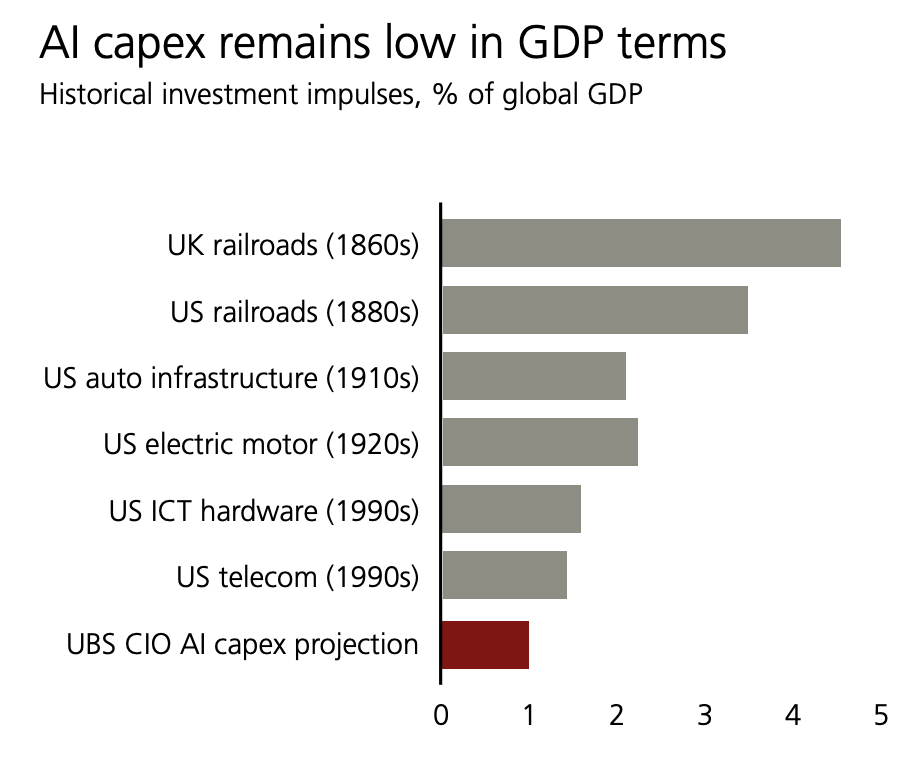
The sell-side has been drawing comparisons to prior infrastructure booms, and the numbers are worth sitting with. A projected $1.3 trillion annually by 2030 would represent roughly 1% of global GDP. That's actually below the historical range of 1.5% to 4.5% seen during the buildout of railroads, automotive infrastructure, computers, and telecom networks over the past 150 years. In relative terms, we're still early.
The more instructive parallel is cloud computing. AWS operated at a loss for years before becoming the most profitable division at Amazon. Social media platforms launched with zero monetization and only later discovered advertising models worth hundreds of billions. The pattern is consistent: adoption first, pricing power later.
About 10% of US businesses are already using AI to produce goods or services, with that figure expected to reach 14% within six months. Broker research suggests adoption tends to accelerate sharply after crossing this threshold. Early adopters are already reporting tangible results, with studies showing average daily time savings of roughly an hour per worker.
That matters. An hour a day across millions of knowledge workers is an enormous amount of recaptured productivity. The question isn't whether value is being created. It's who captures it and when.
The Revenue Potential That Justifies the Bet
Several banks frame the long-term opportunity with a calculation that's worth walking through. Start with a $117 trillion global economy. Assume labor accounts for about half. Then assume AI can automate roughly a third of knowledge tasks, and that technology vendors capture 10% of the resulting value. That yields an estimated $1.5 trillion in annual AI revenues from end-users.
That would make AI one of the largest revenue pools in the history of technology. And it doesn't account for entirely new categories of economic activity that AI might create.
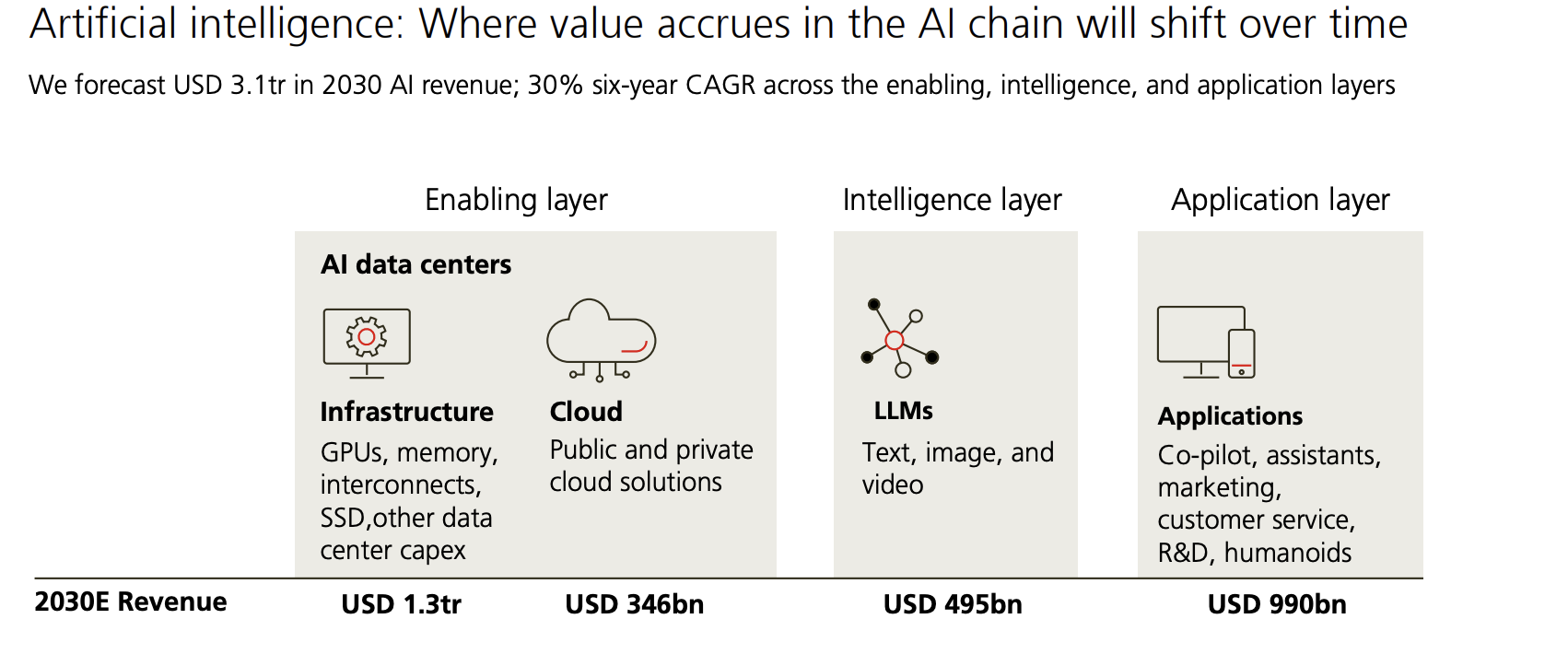
The nearer-term picture is already taking shape. Consensus estimates point to ~$3 trillion in total AI ecosystem revenue by 2030, broken down across three layers:
- Enabling layer ($1.3 trillion): Chips, data centers, cloud infrastructure
- Intelligence layer ($495 billion): Large language models, machine learning platforms
- Application layer ($990 billion): Copilots, assistants, marketing automation, robotics
What's notable is where value is expected to migrate. The enabling layer has captured the lion's share of investor attention so far. The Nasdaq is up 107% over three years. The SOX semiconductor index has more than doubled. But the banks expect the fastest growth to shift toward the application layer over the next three years as AI moves from experimentation to deployment.
If you're still overweight semis and underweight the companies actually embedding AI into workflows, you might want to rethink that.
The Compute Demand Curve Nobody Expected
This is the chart that stopped me when I first saw it.
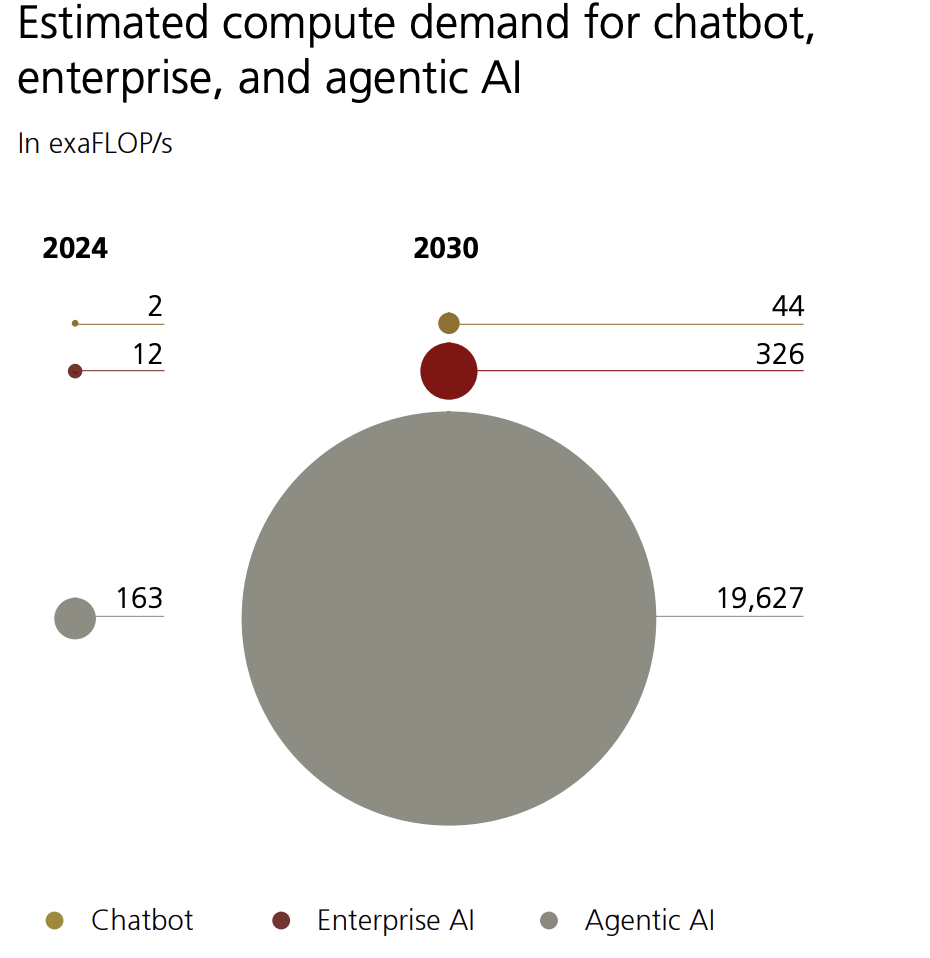
In 2024, total compute demand across chatbot, enterprise, and agentic AI applications sat at roughly 177 exaFLOPs per second. By 2030, analysts project that to explode to nearly 20,000, driven overwhelmingly by agentic AI, where multiple specialized agents collaborate to replicate complex knowledge work.
This isn't a linear extrapolation. Current data center capacity could support a 25-fold increase in chatbot usage alone. But agentic AI, the next frontier, could drive compute demand to five times today's installed base. Add physical AI (robotics, autonomous vehicles) and AI-generated video to the mix, and the demand curve goes almost vertical.
For investors, this reframes the entire capex conversation. What looks like aggressive overbuilding against today's demand might turn out to be insufficient against tomorrow's. That's a very different problem than the one most people are pricing in.
The Uncomfortable Middle
Here's the honest assessment: we're in what you might call the "uncomfortable middle" of the AI investment cycle. The spending is real and accelerating. The adoption metrics are promising but early. The monetization is emerging but hasn't yet validated the scale of investment.
The banks are candid about the risks. No investment boom has ever seen capital spending perfectly match future demand. The AI rally will likely face periods in 2026 where investors worry about excess investment, bottlenecks, or technology obsolescence. If refinancing dries up or cross-investments among the large firms become too circular, financial vulnerabilities could emerge.
The base case across most desks remains constructive. Consensus targets have the S&P 500 reaching 7,700 by year-end 2026, with the Magnificent 7 contributing roughly half of expected earnings growth. The bull scenario pushes to 8,400, driven by a world where AI monetization exceeds expectations and agentic AI applications accelerate adoption.
The bear case at 4,500 would require AI investment to stall or contract due to disappointing returns, technical setbacks, or obsolescence, combined with broader economic weakness.
That's a wide range. And it tells you everything about how much is riding on whether the capex-to-revenue conversion actually happens.
What This Means for Portfolio Construction
The emerging consensus from the major banks is to allocate up to 30% of a diversified equity portfolio toward structural growth themes, with AI as the centerpiece alongside power, resources, and longevity. The recommendation across most desks is to invest across all three layers of the AI stack rather than concentrating in semiconductors or any single segment.
This reflects a key insight: the AI value chain is not static. The winners of the infrastructure buildout phase may not be the winners of the monetization phase. Cloud revenue growth and backlog expansion across leading platforms are encouraging, but the companies that ultimately capture the most value may be those embedding AI into specific workflows and industries. That application layer is only beginning to emerge.
The power and resources angle deserves attention too. Data centers could account for up to 9% of total US electricity consumption by 2035, up from roughly 4% today. Global grid investment is projected to reach around $500 billion in 2026. Copper demand tied to electrification and AI infrastructure could push prices above $13,000 per metric ton. These are real, measurable second-order effects of the AI buildout that most portfolios aren't positioned for.
Bottom Line
The $4.7 trillion being deployed into AI infrastructure is not speculative froth. It's a calculated bet by the world's most profitable companies that artificial intelligence will fundamentally reshape how knowledge work gets done, how businesses operate, and how value is created across the global economy.
Whether that bet pays off will likely be the single most consequential question for equity markets over the rest of this decade. The early evidence suggests the trajectory is intact. But the gap between spending and revenue remains the metric that matters most.
For institutional investors, the practical takeaway is straightforward: the time to build diversified exposure across the AI value chain is before the monetization inflection, not after. History suggests that those who wait for proof of profitability in transformational technologies tend to buy at considerably higher prices.
The money is being spent. The infrastructure is being built. The question now is whether you're positioned for what comes next, or whether you'll be chasing it.
This article draws on analysis from major sell-side Year Ahead 2026 outlooks. AllMind provides institutional investors with AI-powered research terminals to analyze broker research, filings, and alternative data. See it in action.
Disclaimer: This article is for informational purposes only and does not constitute investment advice. Always conduct your own research and consult with a qualified financial advisor before making investment decisions.