
Industry Report Shows 64% of Life Sciences Leaders Taking Action to Establish AI Governance
Source: PR Newswire
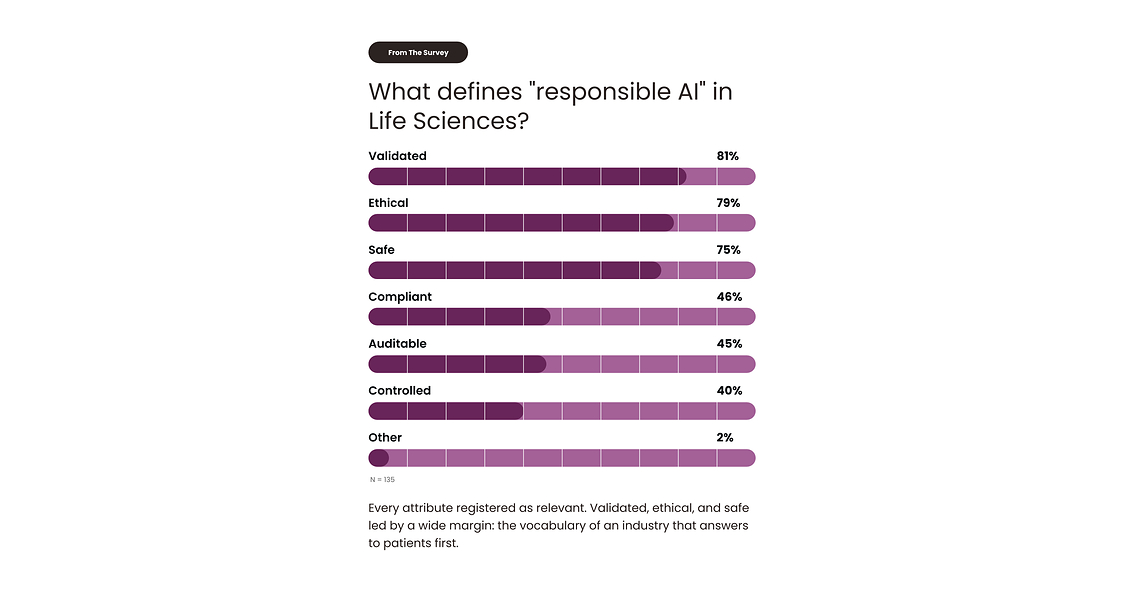
The 2026 Responsible AI in Life Sciences report finds 58% of surveyed leaders say the industry lacks clear standards for responsible AI, while 64% report governance processes established or in development and 36% have no defined process or rely on one-time approval. Regulatory, legal, or compliance hesitation is the most-cited internal scaling barrier (21%); technical readiness ranks near the bottom (9%). ACTO introduced the RAIL Score, a rubric for assessing agentic AI systems across six dimensions, based on roundtables with 80 leaders and a survey of 135 life sciences executives.
Analysis
The investable signal is not near-term AI demand, but a possible shift in bargaining power toward platforms that can document controls, audit trails and human handoffs. That could favor Veeva Systems over standalone agent vendors if life-sciences buyers require agents to work inside validated commercial workflows. ACTO’s Gold Product Partner relationship with Veeva is a potential ecosystem benefit, not evidence of incremental Veeva revenue; the release provides no deployment, contract or monetization data.
The countervailing effect is slower sales conversion: unresolved accountability and validation requirements can add procurement and implementation friction, while agent orchestration across systems may weaken the value of individual application silos over time. The proposed RAIL Score is ACTO’s framework, not an independently established industry standard. Its survey is useful as directional buyer commentary, but self-reported views from a limited executive sample do not establish budget allocation or adoption outcomes.
Days: limited basis for a durable VEEV price reaction. Over 1–3 months, watch whether customers or regulators adopt common requirements and whether Veeva product updates make governance/auditability tangible. Over 6–18 months, the key question is whether governance increases platform stickiness and spend, or raises deployment costs and favors cross-platform orchestration. Thesis weakens if Veeva’s life-sciences customer commentary shows AI pilots failing to convert, implementation timelines expanding, or no willingness to pay for controls.
AllMind Terminal
AI-powered research, real-time alerts, and portfolio analytics for institutional investors.
Request TrialMarket Sentiment
Overall Sentiment
mixed
Sentiment Score
0.05
Key Decisions for Investors
- No trade on the report alone. Treat VEEV as a watchlist beneficiary, not a confirmed earnings catalyst; the article does not quantify financial impact.
- Over the next 1–3 months, monitor Veeva disclosures for AI-related bookings or customer adoption, regulated-workflow integrations, and implementation commentary. Upgrade the thesis only with evidence of paid deployments or faster expansion within existing accounts.
- Track whether regulators or major pharma buyers endorse a common governance standard. If requirements fragment or remain vendor-defined, the compliance-led moat thesis is weaker; if controls become procurement gates, favor scaled life-sciences platforms over unvalidated point solutions.
- For a potential VEEV position, require confirmation from valuation and operating data before entry. Falsifiers include slower subscription growth, rising implementation burden, or evidence that customers use cross-platform agents without expanding Veeva spend.
More News
- Biotechs buck a sluggish IPO market, but investors should tread warily
- What investors need to know about Alphabet's stock-busting earnings report
- Our next steps for Alphabet stock after earnings disappoint at nearly every turn
- Budget 2026 speech
- SK Hynix says the memory-chip shortage will last until 2030—and more than half its production is booked for the next two years
- China’s tech darlings are losing their shine. Here’s what’s behind the sell-off