August 24, 2026·
Research|Perspective

AI in Asset Management and Hedge Funds: The 2026 Statistics, With Sources

Anwaar MalikAnwaar Malik
Printed survey charts, a calculator and a marked-up research report on an analyst's desk

The short answer: 95% of the fund managers AIMA surveyed use generative AI (150 managers, published September 16, 2025), and 55% of asset managers have AI inside at least one investment process (Mercer, 131 managers, February 2026 fieldwork). Only 5% let AI make or share a decision, and 8% can point to a measured return improvement. Permission is broad, process use is shallow, licensing and onboarding gate the largest firms, and analysts still out-score deep-research agents. Every figure below carries its source, sample size and date.

Who this is for: COOs and heads of research budgeting AI seats, allocators writing AI questions into due diligence, analysts reading about their own jobs, and anyone who needs a sourced statistic for a deck.

Published August 24, 2026. Last reviewed August 24, 2026. Written by the AllMind AI research team.

Reviewed by Anwaar Malik, founder of AllMind AI.

Disclosure: AllMind AI builds an AI research platform for institutional investors and appears below in the accuracy section and the pilot example. Every adoption and value figure comes from a third-party survey or paper, and no vendor paid to appear.

Key takeaways

  • Permission is near-universal and process use is thin. 95% of 150 fund managers use generative AI (AIMA, September 16, 2025); 55% of 131 asset managers have it in an investment process (Mercer, May 21, 2026).
  • Decision authority is rare and returns are unproven. 5% of asset managers grant AI decision authority and 8% report a measurable return improvement (Mercer, February 2026 fieldwork).
  • Licensing gates the largest firms. 69% of 35 large buy-side firms cite broker and data licensing as the top barrier, and 37% say onboarding takes 4 to 6 months (Substantive Research and Aiera, July 16, 2026).
  • Agents trail the headlines. 23% of 1,993 organizations are scaling AI agents (McKinsey, November 5, 2025), and 75% of 12 investment banks call this the first or second inning (Rogo, August 13, 2026).
  • Analysts out-score agents and expect to keep their jobs. Analysts scored 2.84 against 2.31 for the best deep-research agent (JPMorganChase, April 22, 2026); 1% of 178 executives expect AI to replace their role (Clearwater Analytics, August 19, 2026).

AI adoption statistics asset management 2026: the numbers, dated

The table holds 29 statistics from 21 surveys and papers published between July 2025 and August 2026, each one sentence with its sample, publication date and a link to the primary document. Copy it whole. Cross-industry samples are marked.

StatisticSourceSamplePublished
95% of fund managers use generative AI, up from 86% in 2023.AIMA150 managers, about $788 billionSep 16, 2025
58% expect to increase generative AI use inside investment processes, against 20% two years earlier.AIMA150 managersSep 16, 2025
60% of investors are more likely to invest in a fund with a meaningful generative AI budget.AIMA18 investorsSep 16, 2025
42% of emerging managers deploy AI across all business functions.AIMA and Marex180 managers, 50 investorsJun 30, 2026
41% of hedge fund managers rank AI integration as their biggest priority; nearly a third report significant integration across research and trading.Hedgeweek100+ managersMar 6, 2026
100% report moderate or large-scale AI use for investment research; 96% plan to raise AI budgets in 2026.Lowenstein Sandler107 PE, hedge fund and VC firmsFeb 19, 2026
54% say their firm has not begun its generative AI journey; stock selection is the top use case at 48%.Bloomberg Research Data Survey150+ quants and analystsJan 22, 2026
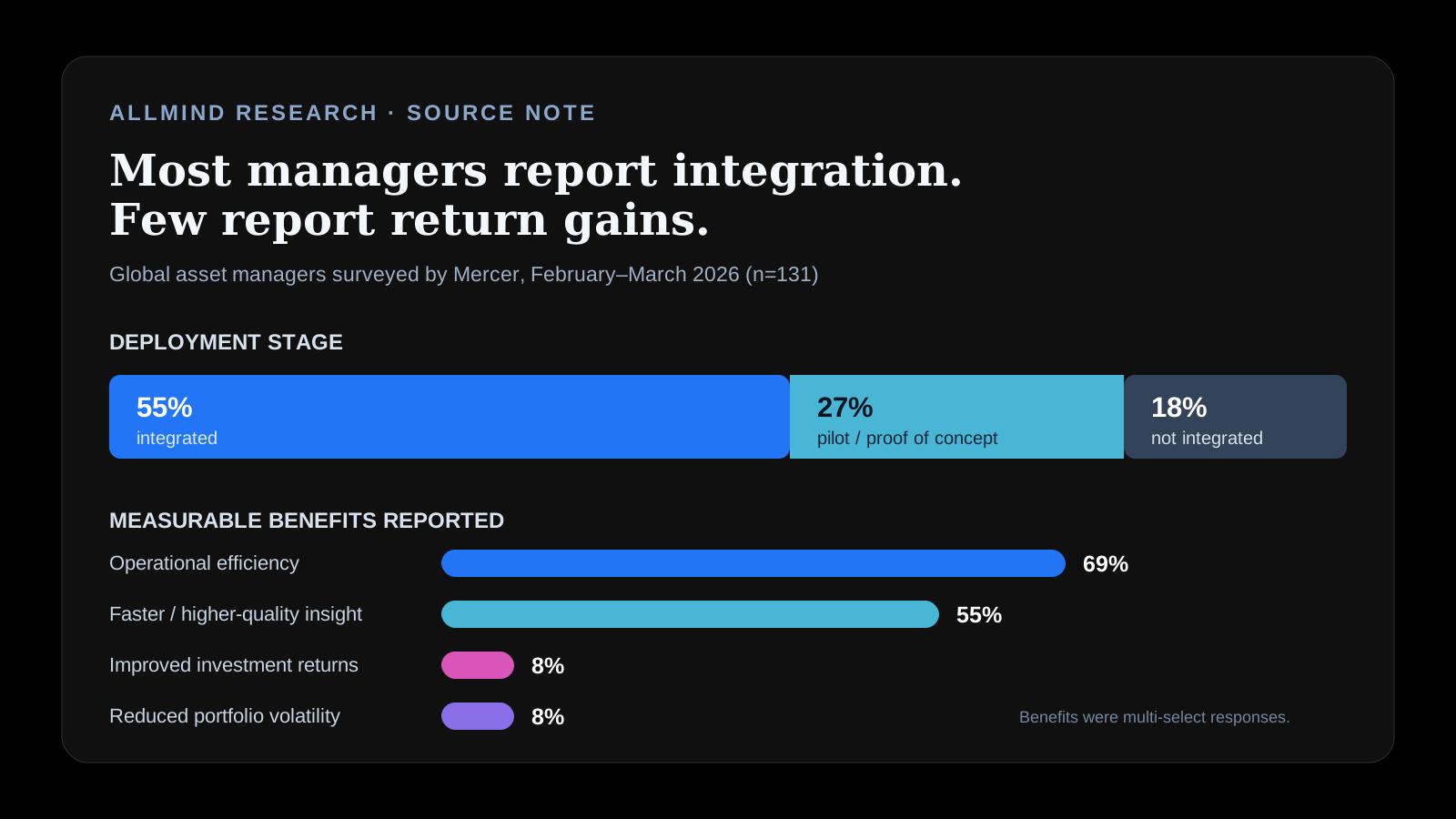
55% of asset managers have integrated AI into at least one investment process; 27% are at pilot stage.Mercer131 asset managers (Feb 2026 fieldwork)May 21, 2026
91% plan to increase AI use within 12 months; 5% grant AI autonomous or semi-autonomous decision authority.Mercer131 asset managersMay 21, 2026
77% of large buy-side firms have organization-wide generative AI deployments.Substantive Research and Aiera35 largest asset managersJul 16, 2026
69% name broker and data licensing restrictions as the biggest barrier to direct feeds; 37% say onboarding takes 4 to 6 months.Substantive Research and Aiera35 largest asset managersJul 16, 2026
44% view specialized finance platforms as potential strategic long-term partners; just over a quarter are evaluating or have implemented one.Substantive Research and Aiera35 largest asset managersJul 16, 2026
95% have scaled generative AI to multiple use cases; 78% are exploring agentic AI; 27% report substantial impact.EY100 wealth and asset managersSep 16, 2025
43% of high-AI-expertise financial services firms give AI access to over 40% of the workforce, against 19% of the rest.DeloitteNot statedNov 4, 2025
63% of buy-side investors plan to increase alternative data spending.Coalition Greenwich56 buy-side firmsDec 17, 2025
15% of buy-side equity desks already use internal AI in execution; 25% plan to add it within 12 months.Coalition GreenwichNot statedJul 8, 2025
8% report a measurable improvement in investment returns from AI; 69% cite operational efficiency.Mercer131 asset managersMay 21, 2026
5% of large asset managers expect AI to materially reduce expenses within three to five years.Bloomberg Intelligence100 CIOs and CTOsFeb 25, 2026
5% of companies achieve AI value at scale; 60% report no material value (cross-industry).BCG1,250+ companiesSep 2025
AI leaders in asset management capture about three times the cost and revenue benefits of laggards.BCGNot statedAug 6, 2026
61% of senior executives say AI increases their job security; 28% expect it to reduce it; 1% expect it to replace their role.Clearwater Analytics178 asset management executives (Mar 2026 fieldwork)Aug 19, 2026
45% say AI saves them one to two hours a week; 16% report three to four hours.Clearwater Analytics178 executivesAug 19, 2026
88% use AI regularly in at least one function; 62% are experimenting with agents; 23% are scaling them (cross-industry).McKinsey1,993 respondentsNov 5, 2025
67% of banks grade their AI transformation a C and none an A; 75% say it is the first or second inning.Rogo12 investment banksAug 13, 2026
64% name internal change management the biggest unsolved issue; about 40% say return on investment is too early to quantify.Rogo12 investment banksAug 13, 2026
Professional analysts scored 2.84 against 2.31 for the best deep-research agent; agent factuality ranged from 53.2% to 86.0%.JPMorganChase AI Research100 reports, 25 S&P 500 companiesApr 22, 2026
AI-assisted sell-side reports cited 40% more distinct sources; forecast error rose by roughly $0.44, 59% of the sample average.Generative AI for Analysts52,428 reports, 24 brokeragesDec 12, 2025
The best model answered 46.8% of expert questions over SEC filings at publication; Claude Opus 4.7 led the June 4, 2026 leaderboard at 64.37%.Vals AI537 questionsAug 2025; Jun 4, 2026
Accuracy falls 18.60% and 14.35% moving from single-document to longitudinal and cross-entity analysis.Fin-RATE17 modelsFeb 7, 2026

How we chose these statistics, and what we left out

Every figure comes from a named survey or paper, opened and checked on August 24, 2026; nothing here is an observation from AllMind AI deployments. Survey figures are self-reported and benchmark figures are measured by the papers' authors, so the two are labeled and never averaged. Small samples are stated inline: AIMA's 18 investors, Rogo's 12 banks, Substantive Research's 35 firms.

Five figures readers ask about are left out on purpose.

  • JPMorgan's 46% of hedge funds actively using AI, up from 18%: the primary document could not be retrieved, so it has no sample size or fieldwork date.
  • BNY's 67% using machine learning or AI: the release date could not be verified.
  • CFA Institute's daily and weekly AI-use percentages: February 2024 fieldwork, two model generations ago.
  • 47% in production and 3 to 5% higher returns: a consultant blog with no source.
  • A widely quoted 2024 paper on LLM financial statement analysis: withdrawn in February 2025 after a co-author identified inconsistencies in the data and analyses.

A vendor can also leave the market outright: Fintool did when Microsoft acquired it in April 2026, and the replacements are compared here. Vendor customer counts stay out of the adoption rows because they count one product's customers: Hebbia's over 40% of the largest asset managers by AUM (company-stated, October 2025), Rogo's 50,000+ professionals at 350+ institutions (rogo.com, August 2026), and AlphaSense's 7,000+ enterprise customers (June 3, 2026 funding release).

What percentage of hedge funds use AI?

Between 42% and 100%, depending on what counts as use; 95% is the figure most people mean, the share of 150 fund managers using generative AI in AIMA's survey, up from 86% in 2023 (AIMA, September 16, 2025). Use inside the investment process runs behind: 58% of the same managers expected to increase generative AI use in investment processes, against 20% two years earlier. The spread across surveys is a definition problem.

Almost every fund has someone using a general assistant, about a third have AI wired into research and trading, and a quant desk is as likely as not to have no program. 60% of the 18 investors on AIMA's panel were more likely to back a fund with a meaningful generative AI budget, a small sample worth stating as such. Firm-type detail is in how hedge funds and asset managers are using AI in 2026; the stacks funds run are in the best AI research systems for hedge funds.

How many asset managers use AI in 2026, and for what?

55% of asset managers have AI in at least one investment process, 27% are piloting it, and 5% let it make or share a decision (Mercer, 131 managers, February 2026 fieldwork). At the largest firms, 77% of 35 global asset managers have organization-wide generative AI deployments (Substantive Research and Aiera, July 16, 2026). The "for what" is mostly operations and research support: 69% of Mercer's respondents cite operational efficiency, 55% faster or higher-quality insights, and 8% a measured return improvement.

Where the AI goes, by survey.

  • Research feeds. 77% of the largest firms called broker research the most valuable machine-readable input, and 69% name licensing the top barrier (Substantive Research and Aiera, July 16, 2026).
  • Alternative data. 63% of 56 buy-side firms plan to spend more (Coalition Greenwich, December 17, 2025).
  • Agents. 78% of 100 wealth and asset managers are exploring agentic AI (EY, September 16, 2025).

Which platforms they buy has its own page, top AI platforms for asset managers in 2026. The survey signal on platforms is early: just over a quarter of the largest firms are evaluating or have implemented a vertically integrated finance AI platform, and 44% see such platforms as potential long-term partners. A procurement view is in AI vendors for institutional investment teams.

What the accuracy benchmarks say

Professional analysts still out-score deep-research agents, and agent factuality varies by a third from product to product. In JPMorganChase's Deep FinResearch Bench, analysts scored 2.84 against 2.31 for the best agent, with factuality from 86.0% for OpenAI to 53.2% for Grok (arXiv 2604.21006, April 22, 2026). On the Vals Finance Agent leaderboard the best model answered 64.37% of 537 expert questions over SEC filings on June 4, 2026, leaving roughly one answer in three to check.

BenchmarkWhat it gradesHeadline resultDateHonest limitation
Deep FinResearch Bench (JPMorganChase AI Research, arXiv 2604.21006)OpenAI, Gemini, Grok and Perplexity deep-research agents against 100 professional reports on 25 S&P 500 companiesAnalysts 2.84, best agent 2.31; forecast SMAPE 17.14% analysts, 17.49% Grok, 21.52% OpenAI; factuality 53.2% to 86.0%Apr 22, 202625 companies in three sectors, FY2025 Q1 to Q2; four consumer products, no finance-specific platform
Generative AI for Analysts (arXiv 2512.19705)52,428 US sell-side reports before and after the FactSet Mercury launch of December 14, 202340% more distinct sources, 34% broader coverage, 25% more advanced methods; forecast error up roughly $0.44, 59% of the sample averageDec 12, 2025Observational, one tool, reports through October 2024; measures analysts using AI, not AI alone
Vals AI Finance Agent (arXiv 2508.00828, live leaderboard)537 expert questions over SEC filingso3 46.8% at $3.79 per query at publication; Claude Opus 4.7 64.37%, Claude Sonnet 4.6 63.33%, DeepSeek V4 60.39% on Jun 4, 2026Aug 2025; Jun 4, 2026Question answering only, no memo or model graded; scores change as models ship
BigFinanceBench (arXiv 2606.03829)928 expert tasks on 36,241 rubric pointsBest system 58.8%Jun 2, 2026Rubric grading; released three months before this page
Fin-RATE (arXiv 2602.07294)17 models across single-document, longitudinal and cross-entity tiersAccuracy falls 18.60% and 14.35% on the harder tiersFeb 7, 2026; v4 Jun 10, 2026Grades models, so it says nothing about a product's retrieval or verification layer
FinanceBench (arXiv 2311.11944)150-case sample, GPT-4-Turbo with retrievalIncorrectly answered or refused 81% of questionsNov 20, 2023Three model generations old; a 2023 floor

Three findings recur: report quality trails analysts even for the best agent, factuality is the widest spread in the set, and accuracy drops hardest when work crosses entities or periods. The Mercury study found forecast errors rose most for analysts covering more firms or integrating more distinct sources, which is the work an analyst is paid for.

AllMind AI, read against the benchmarks

AllMind AI is an AI research system for institutional investors, launched publicly on July 13, 2025, a financial ontology with agents on top, and the one product on this page we make.

Where it wins: on the two failure modes above. Against the factuality spread, each figure in an output opens the passage of the filing, transcript or broker note it came from, with the calculation behind a derived number shown line by line. A verification pass re-checks each figure against its source before a report goes out.

Against the cross-entity drop, the ontology holds companies, suppliers, customers, estimates, filings and the firm's own research as linked entities. An agent walks from a supplier's guidance to a customer's estimate revision along maintained relationships for as long as the workflow runs, minutes or days. Expert-call transcripts come through Expert Insights, which is included in the subscription; broker research needs the firm's own entitlement while it is embargoed and arrives on a delay after that. Agents inherit each user's entitlements and cannot widen them, and the log records each question and each export, the audit trail the 69% licensing figure implies.

Where it falls short: none of the six benchmarks graded AllMind AI, so there is no published score to set beside the 64.37% or the 2.31, and the only test that counts is a pilot on the firm's own questions. Depth has a setup cost too: the internal half of the system means connecting warehouses, dashboards and document stores, which starts with a scoping call about permissions and cannot be done from a signup page. That fits the 37% of large firms reporting 4 to 6 months to onboard.

Is AI paying off for asset managers yet?

As hours, yes; as returns, rarely, and the two should be tracked separately. 8% of 131 asset managers report a measurable improvement in investment returns from AI (Mercer, May 21, 2026). 5% of 100 CIOs and CTOs at large managers expect AI to materially reduce expenses within three to five years (Bloomberg Intelligence, February 25, 2026). Across industries, 5% of 1,250+ companies achieve AI value at scale and 60% report no material value (BCG, September 2025).

The hours are real and modest: 45% of 178 senior asset management executives say AI saves them one to two hours a week and 16% say three to four (Clearwater Analytics, March 2026 fieldwork, published August 19, 2026). Agents explain part of the gap: 62% of 1,993 organizations are experimenting with AI agents and 23% are scaling them (McKinsey, November 5, 2025).

Of the 12 investment banks in Rogo's survey, 67% graded their own AI transformation a C, 64% named change management the biggest unsolved issue, and about 40% said return on investment was too early to quantify (Rogo, August 13, 2026). Value shows up when an agent finishes a workflow that used to take a person a day, with an audit trail a reviewer can open; that layer is described in AI agents for investment research.

A 30-person asset manager's 90-day pilot, worked through

The question asked: a long-only manager with 30 investment professionals wants to know how many seats to put into a 90-day pilot of an AI research platform, and what to measure so the renewal is decided on evidence. Three statistics settle it and a fourth sets the calendar.

Seats: 12 of 30. Deloitte separates firms by whether AI reaches over 40% of the workforce, a bar 43% of high-expertise financial services firms clear against 19% of the rest (Deloitte, November 4, 2025). 40% of 30 is 12 seats, including at least two portfolio managers.

Hours: set the bar at 18 a week. 45% of Clearwater's 178 executives saved one to two hours a week, 16% saved three to four, and about a third saved 31 to 59 minutes (Clearwater Analytics, August 19, 2026). At the midpoints (0.45 times 1.5 hours, 0.16 times 3.5, 0.33 times 0.75) that is about 1.5 hours per seat, or 18 hours a week across 12 seats, roughly half an analyst; a cohort below 18 at day 90 is underperforming the survey.

Process, and no return attribution. 55% of Mercer's 131 managers have AI in at least one investment process and 8% can measure a return improvement (Mercer, May 21, 2026). Leave returns out of a 90-day scorecard; measure whether AI sits inside a recurring process step, an earnings review the day after the close or a model update on filing day, for at least 6 of the 12 seats.

The calendar: start the data connection in week one. 37% of the 35 largest firms say approving and onboarding a platform takes 4 to 6 months (Substantive Research and Aiera, July 16, 2026). So pick one deep workflow for the pilot: a quarterly review that joins the firm's own model and last memo, read from the warehouse where they already sit, to the filing, the transcript and the broker notes.

That workflow is the reason to buy a research system over a chat seat, and it is where AllMind AI runs an agent for hours across internal and external data. Score it on traceability, the share of figures that open a source passage and the count the verification pass corrected, against the 53.2% to 86.0% factuality range above.

MetricSurvey baseline90-day target, 12 seatsSource
Seats in pilotAI reaching over 40% of staff: 43% of high-expertise firms against 19%12 of 30Deloitte, Nov 4, 2025
Hours saved per week, whole cohort45% save 1 to 2 hours; 16% save 3 to 418 or more, logged weeklyClearwater Analytics, Aug 19, 2026
Seats with AI in a recurring process step55% of managers6 of 12 by day 90Mercer, May 21, 2026
Return attribution8% can measure itOut of scopeMercer, May 21, 2026
Traceability of the deep workflowAgent factuality 53.2% to 86.0%100% of figures open a passage; corrections countedJPMorganChase AI Research, Apr 22, 2026
Internal data connection37% report 4 to 6 monthsPermissions scoped in week 1Substantive Research and Aiera, Jul 16, 2026

Pricing is by quote for AllMind AI, AlphaSense and Hebbia alike, so the cost side of the case is the seats and subscriptions the pilot displaces; third-party estimates are collected in the 2026 pricing guide to AI research tools.

Will AI replace equity research analysts?

Not on the 2026 evidence, and the people in the seats expect the opposite. 61% of 178 senior asset management executives said AI increases their job security, 28% expected it to reduce it, and 1% expected it to replace their role (Clearwater Analytics, March 2026 fieldwork, published August 19, 2026). What is changing is the task content of the job and the error profile of the output.

The JPMorganChase benchmark put analysts at 2.84 against 2.31 for the best deep-research agent across 100 reports, and its authors called for finance-specialized agents (arXiv 2604.21006, April 22, 2026). The Mercury study is the uncomfortable one. Across 52,428 US reports from 409 analyst teams at 24 brokerages, reports written with AI assistance cited 40% more distinct sources and covered 34% more topics, and their forecast errors rose by roughly $0.44, 59% of the sample average (arXiv 2512.19705, December 12, 2025). Errors rose most for analysts covering more firms or integrating more sources.

Read together, the replacement question inverts: AI widened what analysts read and, unsupervised, worsened what they forecast, so the analyst's judgment became the limit on quality. A widely read CFA Institute post by Michael Schopf, CFA, reached a similar conclusion from six models and three companies' SWOT analyses: AI will displace analysts who do not adapt (CFA Institute, June 23, 2025). The 2026 data adds the sample size and one specific: the displacement risk sits with the analyst who stops checking.

Can AI (ChatGPT, Claude, etc.) replace junior analysts?

For the extraction share of a junior analyst's week, partly, and it already does; for the seat, no.

  • The best model on the Vals Finance Agent leaderboard answered 64.37% of 537 expert questions over SEC filings (Claude Opus 4.7, June 4, 2026), up from 46.8% in August 2025.
  • The best system on BigFinanceBench scored 58.8% across 928 expert tasks (arXiv 2606.03829, June 2, 2026).
  • In Rogo's survey of 12 investment banks, about 40% of firms anchor their AI return on junior time savings, and the work still flows down the hierarchy (August 13, 2026).
  • OpenAI's listing for an investment-banking subject-matter expert, at up to $205,000, was reported by The Register on July 8, 2026; Anthropic shipped ten finance agent templates for Claude, an earnings reviewer and a model builder among them, on May 5, 2026.

What the junior does that none of these grade: reconciling a filing figure to the firm's own model, noticing the footnote that moved, and chasing the answer investor relations would not put in writing. That is where the role moves over the next 12 to 18 months.

When a general assistant is the right answer: junior work that never touches entitled content or the firm's own systems, such as summarizing public filings for an internal note, is served by an enterprise assistant seat. Perplexity's Enterprise Pro is $40 per seat per month by third-party reports of vendor pricing as of July 2026. The line moves the day a compliance reviewer, entitled content or a client report enters the workflow, as worked through in ChatGPT, Claude and Perplexity against institutional research platforms.

Three predictions, dated August 24, 2026

  1. Process use passes 70% by the 2027 surveys. Mercer's 55% with AI in at least one investment process crosses 70%, while decision authority stays under 15%, from 5% today.
  2. Measured return improvement stays under 20%. The 8% who can show it (Mercer, May 2026) does not reach 20% in 2027, because the first gains land as hours and coverage breadth.
  3. Replacement expectation stays in single digits while the job description moves. Clearwater's 1% stays under 10% in 2027, and junior postings shift toward verification and model ownership within 12 to 18 months.

Frequently Asked Questions

Can AI (ChatGPT, Claude, etc.) replace junior analysts?

Not the seat, on the 2026 evidence, but a growing share of the extraction and formatting inside it. The best model answered 64.37% of 537 expert questions over SEC filings on the Vals leaderboard of June 4, 2026, against a November 2023 FinanceBench run where GPT-4-Turbo with retrieval got 81% of 150 questions wrong or refused. In Rogo's August 2026 survey of 12 investment banks, about 40% of firms anchor their AI return on junior time savings, and junior roles are shifting from extraction toward verification.

How many asset managers use AI in their investment process in 2026?

55% of the 131 asset managers Mercer surveyed in February 2026 had integrated AI into at least one investment process, and 27% were running pilots. 91% planned to increase AI use within 12 months, while 5% granted AI autonomous or semi-autonomous decision authority. Among the 35 largest buy-side firms polled by Substantive Research and Aiera in July 2026, 77% had organization-wide generative AI deployments. EY's September 2025 survey of 100 wealth and asset managers put the share with generative AI scaled to multiple use cases at 95%.

Do asset managers see measurable returns from AI yet?

Rarely, as of mid-2026. 8% of asset managers in Mercer's May 2026 report saw a measurable improvement in investment returns, while 69% cited operational efficiency gains. 5% of 100 large-manager CIOs and CTOs surveyed by Bloomberg Intelligence in February 2026 expected AI to materially reduce expenses within three to five years. The measurable gain today is time: 45% of 178 executives told Clearwater Analytics in March 2026 that AI saves them one to two hours a week, and 27% of the 100 firms EY surveyed in 2025 reported substantial impact.

How accurate is AI at equity research compared with human analysts?

Below analysts on report quality, and uneven on facts. In JPMorganChase's Deep FinResearch Bench of April 2026, professional analysts scored 2.84 against 2.31 for the best deep-research agent, and agent factuality ranged from 53.2% to 86.0%. A study of 52,428 sell-side reports found analysts writing with AI assistance cited 40% more sources and raised forecast error by roughly $0.44, about 59% of the sample average. Accuracy also falls 18.60% and 14.35% when tasks move from one document to longitudinal and cross-entity analysis (Fin-RATE, 2026).

Which AI adoption statistics should you not cite?

Several widely repeated figures have no usable source: the CFA Institute daily and weekly AI-use percentages come from February 2024 fieldwork. The BNY figure of 67% using machine learning has no verifiable release date, and the JPMorgan figure of 46% of hedge funds using AI has no retrievable primary document. The 47% in production and 3 to 5% higher returns figures trace to a consultant blog with no source. Use the AIMA, Mercer, Substantive Research and Clearwater Analytics surveys instead, which publish sample sizes and dates.


AllMind AI is the AI-native research platform for institutional equity teams. If you want proof on your own work, send us the workflow you want tested.