
Global Bioinformatics Market to Reach USD 64.60 Billion by 2034, Driven by AI, Genomics, Next-Generation Sequencing, and Precision Medicine Report Maximize Market Research
Source: PR Newswire
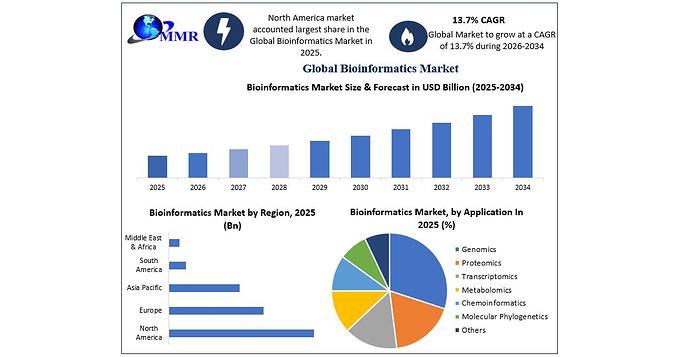
Maximize Market Research forecasts the global bioinformatics market to grow from $20.34 billion in 2025 to $64.60 billion by 2034, a 13.7% CAGR. Growth is expected to be driven by next-generation sequencing, genomic-data generation, precision medicine, and AI-, machine-learning-, and cloud-enabled analytical platforms. North America led the market in 2025, while Asia-Pacific is projected to grow fastest; high infrastructure costs, cybersecurity and data-privacy risks, interoperability issues, and shortages of specialized talent remain constraints.
Analysis
This is not an earnings-relevant datapoint by itself; the forecast is vendor-sponsored, long-dated, and too broad to justify a sector rerating. The investable question is whether sequencing volumes convert into recurring, high-margin analysis revenue rather than being absorbed by hyperscaler compute and open-source workflows. That distinction favors QIAGEN (QGEN), SOPHiA GENETICS (SOPH), and selected laboratory-information vendors over instrument-heavy TMO, A, ILMN, and BIO, whose bioinformatics exposure is fragmented within much larger revenue bases.
The key competitive shift over the next 6-18 months is likely value migration from raw-data generation toward validated clinical interpretation, workflow integration, and compliant data management. SOPH has the clearest pure-play operating leverage if test volumes and platform utilization accelerate, but it also faces the greatest risk that hospital systems standardize on internally built pipelines or cloud-native tools. QGEN is better positioned to monetize regulated sample-to-insight workflows, while DSY's BIOVIA exposure offers a less appreciated route to computational drug-discovery spend; its group-level valuation makes this theme immaterial absent disclosed bookings acceleration.
Near term, AI enthusiasm is more likely to pressure standalone software pricing than expand it: lower-cost models and cloud tooling reduce barriers to basic sequence analysis. The defensible vendors will be those with proprietary clinical datasets, regulatory validation, and embedded laboratory distribution. A reversal signal would be sequencing vendors reporting volume growth without consumables pull-through, or SOPH failing to show sustained double-digit platform revenue growth and improving gross-margin/EBITDA trajectory over the next two quarterly reports.
Contrarian view: the market may be over-crediting AI as a direct revenue catalyst for public bioinformatics names. Privacy rules, hospital procurement cycles, interoperability requirements, and reimbursement validation create a multi-year adoption lag; in the next 1-3 months, company-specific guidance, genomics funding, and capital-equipment demand matter materially more than market-size forecasts.
AllMind Terminal
AI-powered research, real-time alerts, and portfolio analytics for institutional investors.
Request TrialMarket Sentiment
Overall Sentiment
moderately positive
Sentiment Score
0.48
Ticker Sentiment
Key Decisions for Investors
- No directional trade solely on this release; treat it as a thematic watch item rather than a catalyst, given the low immediate impact and absence of company-specific bookings, pricing, or guidance data.
- Build a 6-12 month relative-value watchlist: long QGEN versus short ILMN in equal dollar size if QGEN sustains mid-single-digit-plus organic growth and ILMN fails to demonstrate consumables-volume reacceleration. The thesis captures workflow/interpretation value migration; exit if ILMN's consumables growth exceeds QGEN growth for two consecutive quarters.
- For higher-risk growth exposure, consider a small SOPH long only after the next earnings report confirms accelerating platform revenue, stable net retention, and a credible path to cash-burn reduction. Target 2:1 upside/downside; avoid pre-earnings entry because execution and customer-concentration risk dominate the industry narrative.
- Monitor TMO, A, and BIO for sequencing or clinical-genomics order commentary rather than assuming broad bioinformatics growth lifts results. A confirmed increase in genomics-related consumables and software attach rates would support adding exposure; weak instrument utilization would falsify the demand-throughput thesis.
More News
- Rainbow Rare Earths names Neo Performance Materials as new technology partner
- SEBI Allows Portfolio Managers to Invest Overseas, Short Equity Options
- Trump, Xi Address AI, Taiwan During State Visit
- Oracle Japan shares surge 7% after record fiscal first quarter, bucking selloff of U.S. parent
- China's Xi urges U.S. to cooperate on AI
- Trump Hosts China’s Xi With Trade, AI, Taiwan in Focus
From AllMind Research
- Anthropic IPO Preview: Valuation, Timing, and What to Watch
- Shein After the IPO: Venue, Valuation, and What Must Be Proved
- What AI Research Tools Should a Small Hedge Fund Buy First?
- Automating Financial Model Updates: A Source-Controlled Workflow
- Weekly Update: Live Event Center, In-App Documents, and Faster Transcripts