
Trump, Xi Address AI, Taiwan During State Visit
Source: Bloomberg
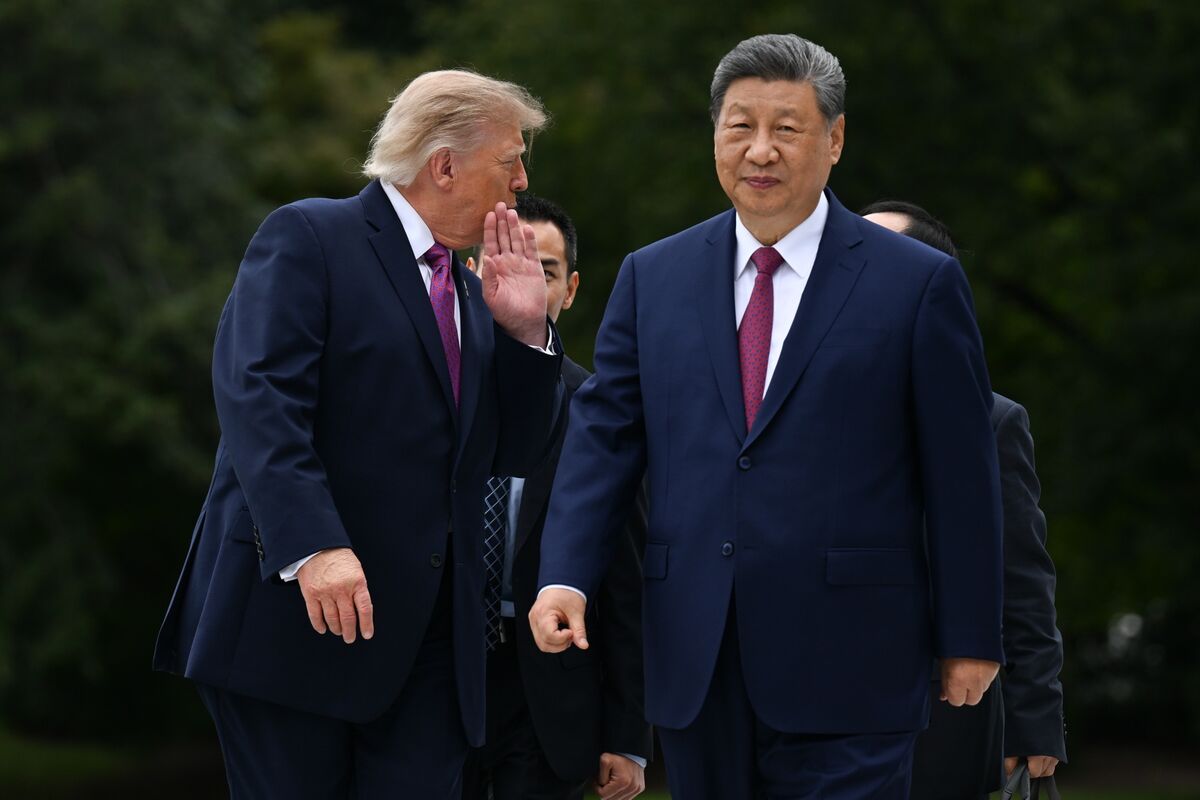
Donald Trump and Xi Jinping opened their White House summit by addressing AI competition and Taiwan, two areas with significant implications for US-China relations and technology policy. Trump reiterated opposition to AI guardrails, while Xi expressed some willingness to consider limits; Xi also pressed the US to formally oppose Taiwan independence, underscoring persistent geopolitical risk.
Analysis
The market-relevant outcome is not the diplomatic optics but whether Taiwan language shifts the probability distribution of export controls, defense procurement, and semiconductor supply-chain disruption. Any perceived reduction in near-term cross-strait escalation should compress the geopolitical discount embedded in TSM, UMC, ASX and Taiwan-exposed hardware suppliers; conversely, formal US concessions would be politically difficult to sustain and could trigger bipartisan pushback, making an initial risk-on move vulnerable within days. The more durable beneficiary of elevated uncertainty remains defense electronics and naval exposure, including LMT, NOC, RTX and HII.
A permissive US posture toward AI regulation marginally favors capex-heavy platform owners and infrastructure suppliers because it reduces the probability of near-term compliance friction, liability costs, and deployment delays. The cleaner expression is likely the compute stack—NVDA, AVGO, VRT and ETN—rather than software beneficiaries whose monetization still depends on enterprise adoption. However, summit-level rhetoric is not independently measurable policy: absent changes in chip-export licensing, federal procurement, power-grid permitting, or hyperscaler capex guidance, this should not justify chasing AI beta after a headline move.
The contrarian read is that bilateral discussion of AI boundaries can raise, not lower, fragmentation risk over 6-18 months. Even limited agreement on safety principles does little to reconcile US national-security concerns around advanced compute; firms with China revenue or China-dependent manufacturing could face a renewed valuation discount if implementation details harden. HSBC has no clear transmission mechanism from the reported themes beyond broad Hong Kong/China risk sentiment, so the signal is insufficient for a standalone position.
AllMind Terminal
AI-powered research, real-time alerts, and portfolio analytics for institutional investors.
Request TrialMarket Sentiment
Overall Sentiment
mixed
Sentiment Score
-0.05
Ticker Sentiment
Key Decisions for Investors
- Maintain a 1-3 month relative-value hedge: long ITA or XAR versus a basket of Taiwan-sensitive semiconductors (TSM, UMC, ASX). Defense earnings are supported by a persistent deterrence cycle, while the semiconductor leg is vulnerable to any deterioration in Taiwan rhetoric; reassess if US-China policy language remains stable for 30 days and the pair fails to widen.
- Do not chase a same-day AI rally. Add selectively to NVDA/VRT only if hyperscaler earnings or procurement data confirm sustained 2027 capex growth; use a 7-10% stop from entry because export-control tightening would hit both demand visibility and valuation multiples.
- For existing TSM exposure, buy 3-6 month downside protection or pair against LMT/NOC rather than reduce core holdings solely on summit headlines. The hedge is most valuable if subsequent US statements, arms-sales actions, or Chinese military activity reintroduce a near-term blockade/tail-risk premium.
- Keep HSBC on watch rather than trade. A short case requires evidence of renewed Hong Kong commercial-property losses, higher China credit costs, or capital-market activity deterioration; without those data, the geopolitical linkage is too indirect.
More News
- France faces a fresh budget battle that threatens to topple another government as debt costs spiral
- US 30-Year Yield Hits Highest Since 2004
- Trump Hosts China’s Xi With Trade, AI, Taiwan in Focus
- Surging Treasury yields are posing a brand new problem for Kevin Warsh and the Fed
- Akamai secures $11.6B cloud deal with Anthropic for AI workloads
- New York sues Polymarket over allegations of illegal gambling operations
From AllMind Research
- Anthropic IPO Preview: Valuation, Timing, and What to Watch
- Shein After the IPO: Venue, Valuation, and What Must Be Proved
- What AI Research Tools Should a Small Hedge Fund Buy First?
- Document Search Enhancements, AI Enhancements, AI Actions, & Chat Export
- AI Vendor Landscape for Institutional Investment Teams