
Pusan National University Develops Injectable Microgels for Targeted Keloid Radiotherapy
Source: PR Newswire
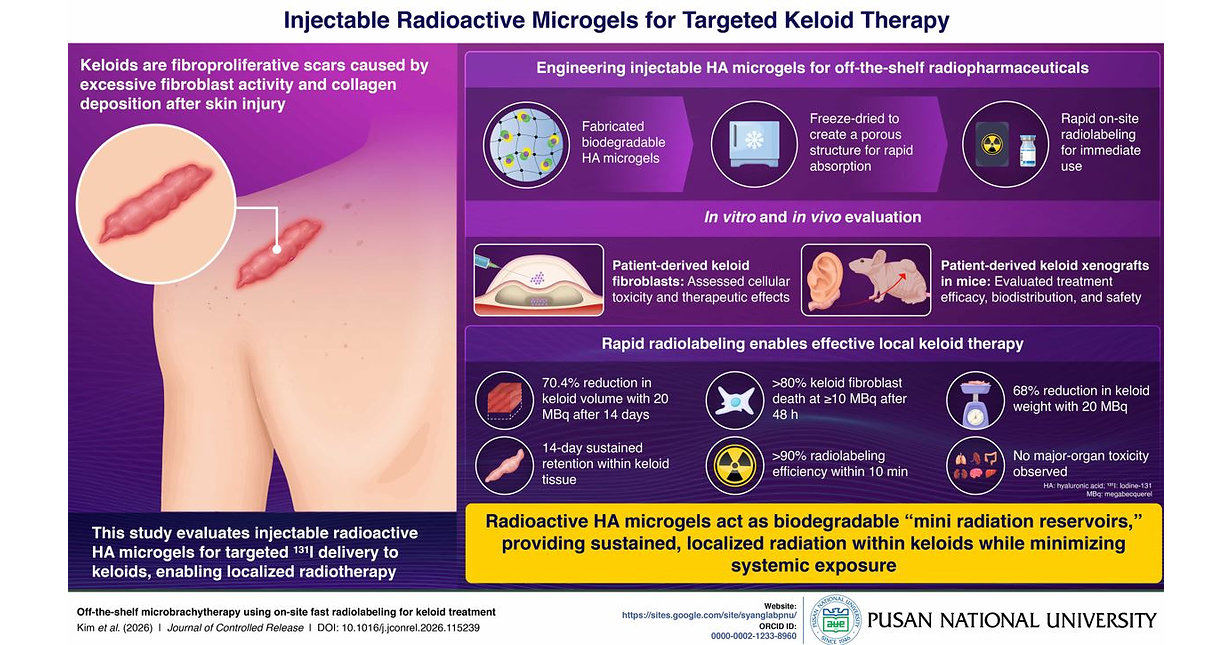
Pusan National University researchers developed injectable, biodegradable hyaluronic-acid microgels for on-site ¹³¹I brachytherapy for keloids, achieving >90% iodine-131 labeling efficiency in <10 minutes. In preclinical tests, microgels localized in keloid tissue for up to 14 days and at doses ≥10 MBq drove >80% keloid fibroblast death (within 48 hours) and ~70% keloid size reduction after 2 weeks, without off-target biodistribution or observed toxicity to thyroid/blood/major organs in mice.
Analysis
Near term, this is not a tradable event for large-cap healthcare: the work is preclinical, the addressable indication is niche, and the market has no reason to re-rate any public name on a mouse study. The only real public-market readthrough is incremental validation of a broader theme: localized radiopharma delivery can move treatment out of the hospital corridor and into smaller procedural settings, which is mildly supportive for companies built around radiotracer logistics, isotope handling, and outpatient oncology infrastructure.
The second-order winner, if this ever translates, is not the scar-treatment market itself but the enabling stack: isotope suppliers, contract radiopharmacies, and microfluidics/manufacturing tooling that can support fast on-site labeling. However, the commercialization path is long; the key gating items are human biodistribution, recurrence durability, workflow compatibility, and regulatory comfort with handling beta/γ emitters in non-oncology settings. Any thesis here is months-to-years, not days.
Contrarian view: investors may overread platform optionality. Keloid disease is small, reimbursement is uncertain, and dermatology practices are generally not set up for radiation safety, isotope storage, or QA burdens, which can kill otherwise elegant lab science. What would falsify the broader microbrachytherapy thesis is any clinical signal of thyroid uptake, off-target exposure, or recurrence that converges back toward standard intralesional steroid/laser pathways; absent human data, this stays a scientific curiosity, not a portfolio factor.
AllMind Terminal
AI-powered research, real-time alerts, and portfolio analytics for institutional investors.
Request TrialMarket Sentiment
Overall Sentiment
mildly positive
Sentiment Score
0.20
Key Decisions for Investors
- No direct trade in TGT or broad healthcare indices; the signal is too remote and preclinical to justify portfolio turnover.
- Watchlist only: follow public names with radiopharmaceutical logistics or isotope exposure (e.g., Lantheus, Cardinal Health’s nuclear pharmacy footprint, Telix-adjacent supply chain) for any human data that expands localized radiolabeling beyond keloids.
- If a differentiated human study appears, consider a small tactical long in radiopharma enablers versus a broad healthcare short only on confirmation of outpatient workflow adoption; until then, stay flat.
- Set a catalyst alert for the first Phase I/II human readout and specifically for recurrence at 3-6 months, thyroid labs, and off-target dosimetry; without those, there is no investable edge.
More News
- Cata-Kor Enters Physical Retail with Target Launch, Bringing Its NAD⁺ Longevity Line to Stores Nationwide
- Musk says Terrafab chip factory could outperform rivals despite challenges
- Stocks saw new highs and big declines: How the volatile AI trade moved last week's market
- Will Warner Bros. kill Skydance — or will David Ellison kill Warner Bros?
- Nvidia GPUs are everywhere. Here are the ways companies are accessing them
- How U.S. know-how is fracking Australia into a gas boom, from Texas oilmen to Trump’s energy secretary
From AllMind Research
- Anthropic IPO Preview: Valuation, Timing, and What to Watch
- Shein After the IPO: Venue, Valuation, and What Must Be Proved
- What AI Research Tools Should a Small Hedge Fund Buy First?
- State of Public Markets, June 2026: Higher for Longer Meets the AI Supercycle
- AI Research Tools With Exact Source Citations