
European Union Asks Canada to Join the Bloc as Associate Member
Source: Bloomberg
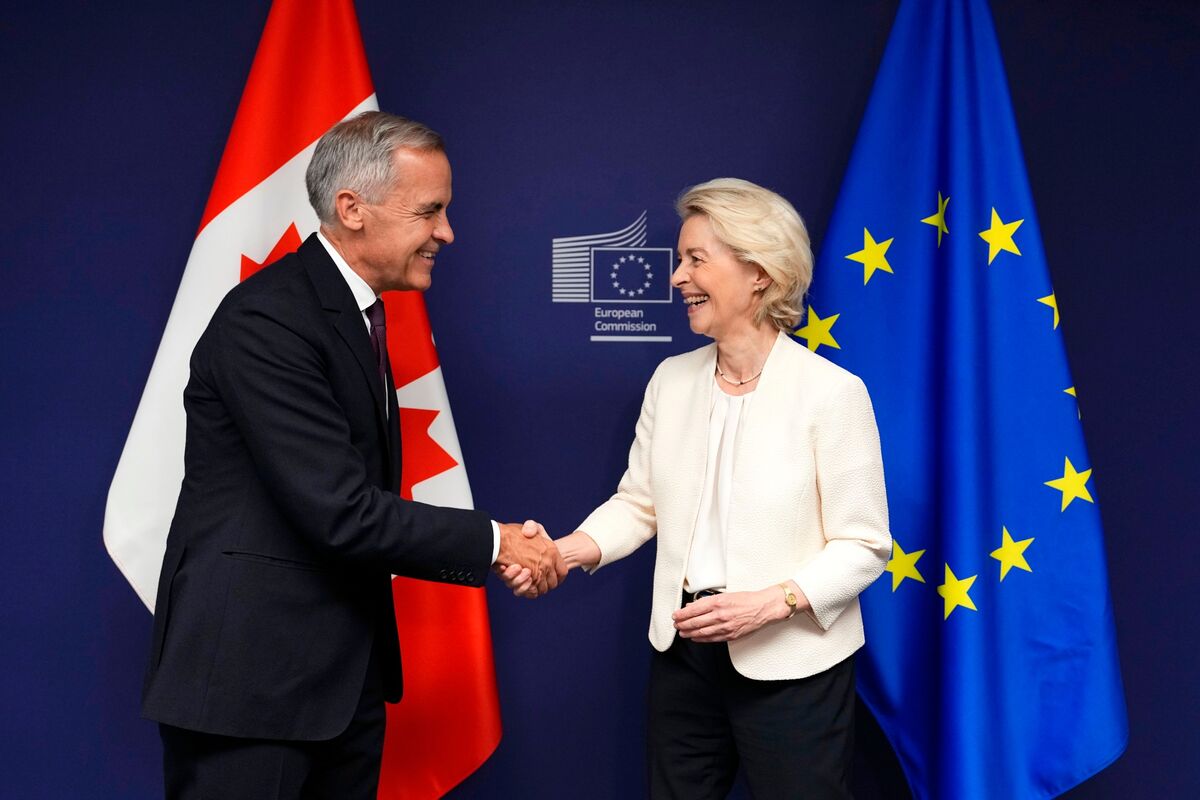
European Commission President Ursula von der Leyen proposed making Canada the EU's first associate member, creating a new status not currently defined in EU treaties. The initiative signals deeper EU-Canada economic and political ties as both face US tariffs, with Canadian Prime Minister Mark Carney expected to provide further details in an address to the European Parliament. The proposal also revives debate over the UK's frozen relationship with Brussels and potential future changes to Labour's European policy.
Analysis
This is primarily an option-value signal rather than an earnings event: a bespoke EU-Canada framework could reduce policy uncertainty for transatlantic supply chains and create a template for deeper regulatory alignment in strategic sectors. The most exposed beneficiaries would be Canadian exporters with European distribution and certification costs—especially aerospace (CAE), rail/industrial equipment (WSP.TO, SNC.TO), clean power infrastructure (NFI.TO), and critical-minerals developers—if associate status ultimately expands beyond the existing CETA trade architecture. Near-term valuation impact should be limited until the proposal defines market-access, procurement, defense-industrial, and regulatory-recognition provisions.
The second-order effect is geopolitical: Brussels is seeking resilient non-US inputs and partners, which raises the strategic premium on Canadian uranium, potash, nickel, copper and defense capacity. That could incrementally divert European procurement away from higher-risk sources, but it also makes Canadian capacity a bottleneck; established producers should benefit more than early-stage resource equities. For EU industrials, better Canadian access may modestly lower raw-material and energy-security risk, favoring diversified manufacturers over UK-centric exporters facing comparatively weaker institutional access to Europe.
The UK angle is more politically salient than investable today. A formal Canada arrangement would sharpen the relative cost of UK-EU friction and could revive expectations of gradual UK regulatory rapprochement, supporting UK domestic cyclicals and transport only if Labour changes its red lines after an election. The contrarian view is that this remains branding without treaty authority: Canada already has broad CETA access, and meaningful gains require politically difficult concessions on mobility, standards, procurement, agriculture, and possibly defense. Treat any immediate move in Canadian trade-sensitive names as headline-driven unless negotiations produce binding sector annexes within 1-3 months.
AllMind Terminal
AI-powered research, real-time alerts, and portfolio analytics for institutional investors.
Request TrialMarket Sentiment
Overall Sentiment
mildly positive
Sentiment Score
0.20
Key Decisions for Investors
- No immediate directional trade on the announcement; set a 1-3 month policy alert for a Canada-EU roadmap covering defense procurement, mutual recognition of standards, critical minerals, or energy. Those provisions—not the associate-member label—would justify earnings-model changes.
- Watch-list long Cameco (CCJ) and Nutrien (NTR) versus broad Canada ETF exposure: a formal EU strategic-supply commitment would support contract duration and valuation multiples, while broad Canadian equities have limited direct sensitivity. Reassess after details on procurement volumes or offtake mechanisms; thesis is falsified if language remains nonbinding.
- For a European implementation signal, prefer a basket of EU electrification/industrial names over UK-exposed cyclicals: long Schneider Electric (SU.PA) or ABB (ABBN.SW) versus short UK mid-cap exposure (MIDD.L proxy) only after evidence of Canadian critical-mineral or clean-power supply agreements. Target a 3-6 month horizon; stop if UK-EU talks materially reopen or EU industrial PMIs deteriorate.
- Avoid treating this as a broad CAD catalyst. Monitor CAD/EUR only for a sustained move after binding commercial provisions emerge; near-term FX remains dominated by Bank of Canada policy, commodity prices, and US tariff developments.
More News
- Oil extends losses as Saudi Arabia reportedly offers ship-to-ship crude transfers after pipeline hit
- 'Hostile act': Trump threatens EU with tariffs over Canada associate-membership proposal
- US military claims Strait of Hormuz remains open amid ongoing blockade
- Oil prices extend losses as fears of Middle East supply disruptions ease
- Congress passes sweeping US sanctions bill targeting Russia
- 'Science fiction': Transport companies — the backbone of economy — are sounding alarm on fuel prices