
AI Is Starting to Pay Off. Almost 50% of Companies Now Generate Value with It.
Source: PR Newswire
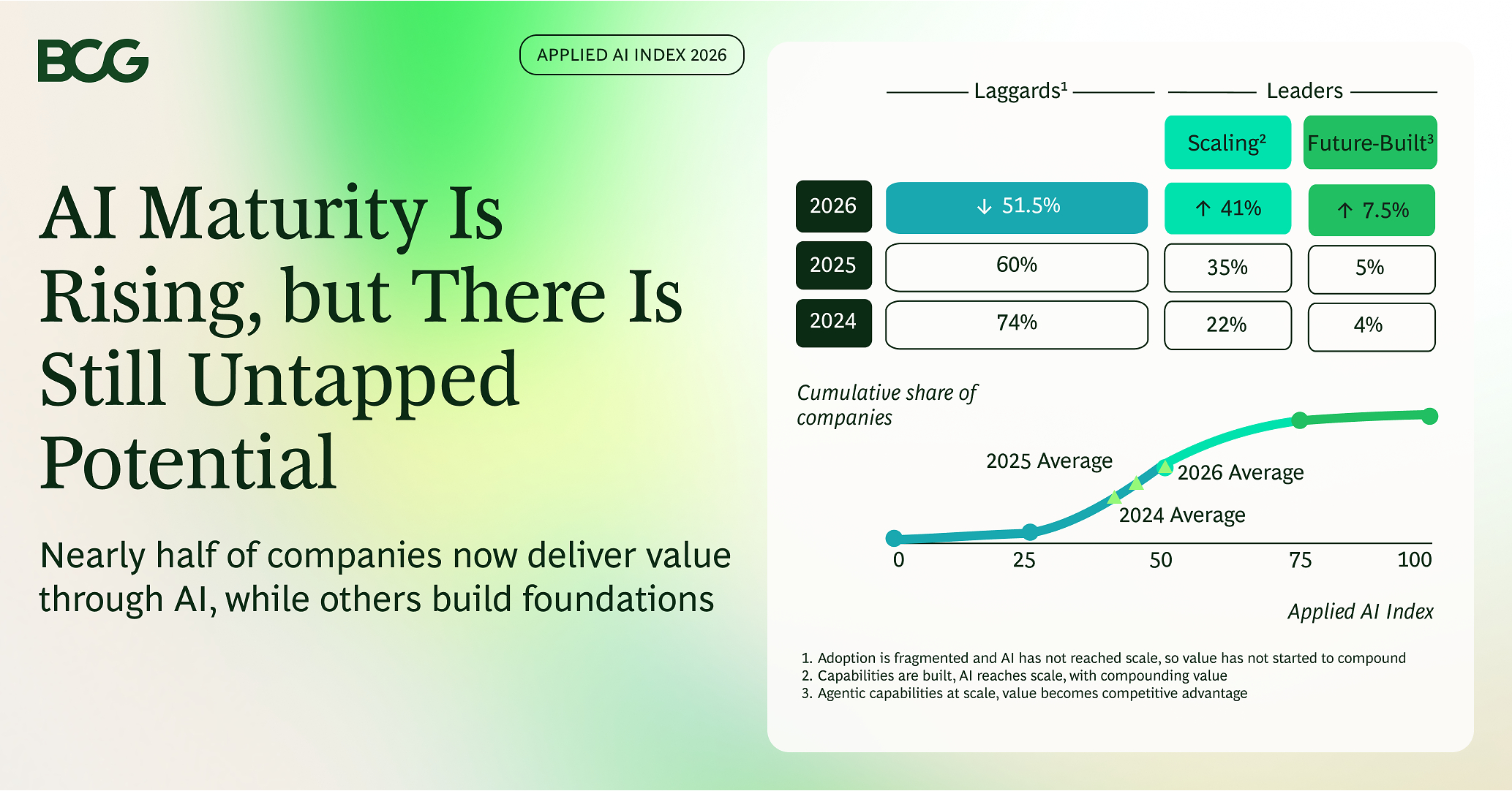
BCG's survey of 1,330 senior executives finds AI spending doubled to 3.3% of revenue from 1.7% in late 2025, while nearly half of companies are now either scaling AI successfully or are classified as AI leaders. The 7.5% of "future-built" firms delivered 2.3x laggards' shareholder returns, 2.4x their revenue growth and 2.8x their EBITDA growth; an additional 41% of scaling companies generated 1.8x laggards' shareholder returns. The principal risk is governance: 42% expect AI agents to gain decision-making authority by 2030, but only 5% currently have full controls, while companies anticipate 10%-15% workforce reductions and AI-specific roles rising from 7% to 22% of employees.
Analysis
The investable read-through is a rotation within AI rather than a broad rerating of compute suppliers. As deployment shifts into business-unit budgets, Microsoft (MSFT), ServiceNow (NOW), Salesforce (CRM), Palantir (PLTR), and workflow-specific software vendors gain a larger addressable spend pool; the near-term offset is that customers may fund adoption by trimming discretionary SaaS seats and consulting spend. The critical earnings question over the next 1-3 quarters is whether AI revenue is incremental to existing budgets or merely converts high-margin seat licenses into lower-margin usage-based consumption.
The underappreciated bottleneck is controls, identity, observability, and auditability for autonomous workflows. Palo Alto Networks (PANW), CrowdStrike (CRWD), Okta (OKTA), and Microsoft can monetize governance requirements through security-platform consolidation, while ServiceNow is positioned to become the approval, incident-routing, and human-in-the-loop system of record. This is structurally more durable than a generic model-capacity trade because governance spend is tied to risk ownership and compliance rather than experimental ROI; the 6-18 month risk is hyperscalers bundling these functions and compressing standalone-vendor pricing.
Consensus may be too focused on eventual labor savings. The nearer P&L effect is likely margin dilution: duplicated software, cloud inference, data-cleaning, retraining, and control costs arrive before organizational redesign produces payroll savings. Companies that explicitly quantify workflow-level cost removal and sustain gross-margin expansion should earn multiple support, while firms discussing AI adoption without disclosed unit economics face a 1-3 quarter credibility test. This survey is directional and self-reported, not independent evidence of realized cash returns, so it is insufficient alone to justify a broad AI-beta addition.
AllMind Terminal
AI-powered research, real-time alerts, and portfolio analytics for institutional investors.
Request TrialMarket Sentiment
Overall Sentiment
moderately positive
Sentiment Score
0.42
Key Decisions for Investors
- Initiate a 6-12 month basket long PANW, CRWD, and NOW versus short IGV: governance and workflow-control monetization should be less sensitive to whether enterprise AI pilots convert into net-new software budgets. Reassess if platform vendors disclose material bundled-control pricing or if net retention decelerates by more than 300 bps.
- Maintain MSFT as the highest-quality large-cap AI exposure, but add only on post-earnings evidence that Copilot/agent revenue exceeds cloud-inference and sales-and-marketing investment. A sub-20% annualized Azure growth print or worsening cloud gross-margin commentary would falsify the near-term operating-leverage case.
- Avoid chasing PLTR on survey-driven sentiment; use it as a watch item for government/commercial agent deployments with disclosed contract value and contribution margins. Upgrade only if commercial growth accelerates without material services intensity; otherwise its valuation leaves little room for deployment delays.
- Screen labor-intensive business-services and BPO exposures for downside over 6-18 months, particularly firms unable to pass through automation savings to clients. The actionable short catalyst is contract repricing or headcount-guidance cuts, not broad workforce forecasts.
More News
- Asian stocks dip, bonds in focus after torrid September
- Tencent leases 100,000 chips from Oracle for $7 bln- FT
- California Gov. Gavin Newsom bans AI 'robo bosses' in landmark state law, reversing his earlier veto
- The new and huger Paramount has a new co-CEO
- RAM supply set to worsen, says Micron, as CEO celebrates ‘much higher’ prices
- US judge approves settlement allowing Paramount to acquire Warner Bros