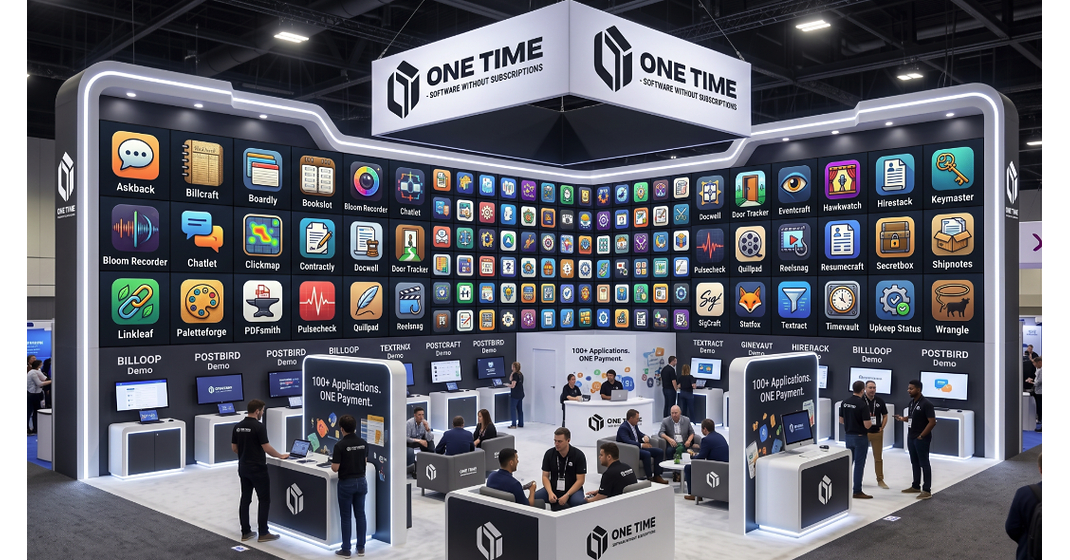
OneTime Suite launched a public “100 Apps in 100 Days” challenge offering open-source apps as free alternatives to subscription tools, with an optional one-time lifetime license (e.g., LinkLeaf $50 one-time vs ~$540 over three years for Linktree; BloomRecorder $20 vs ~$540 for Loom Business). The company built 102 planned app MVPs in seven days using Claude Code and will add paid-only features daily, alongside a 30-day money-back guarantee. This is primarily a product/pricing-model initiative and is unlikely to move public markets.
This is not a near-term revenue event, but it is a useful signal that pricing pressure at the low end of SaaS can now be manufactured cheaply, not just discovered by the market. The vulnerable cohort is point-solution software sold to creators and SMBs where product differentiation is thin and switching costs are low; in those categories, a credible free/open-source substitute can cap net retention and force promotional spend even if outright churn stays modest.
The more durable winners are suite and platform vendors with workflow lock-in, compliance, and distribution leverage, because they can bundle adjacent features and absorb commoditization better than standalone apps. That argues for relative resilience in names like MSFT and TEAM versus a basket of smaller, higher-multiple software names. Second-order, the real pressure may show up first in valuation multiples: if investors start treating "good enough" software as a commodity, unprofitable SaaS gets hit on duration before earnings actually break.
Consensus will likely dismiss this as a niche launch, and that is probably correct for the next few weeks. The contrarian risk is that AI makes clone production and feature parity fast enough that low-ACV SaaS gets structurally harder to defend; if the next 1-3 earnings cycles show weaker pricing or slower NRR in SMB software, this becomes more than a curiosity. Falsifier: stable retention, no discounting, and no commentary about open-source or AI-driven substitution from management teams.
AI-powered research, real-time alerts, and portfolio analytics for institutional investors.
Overall Sentiment
mildly positive
Sentiment Score
0.12
