
Huawei bringt die Fintelligent AI Solution auf den Markt, um Finanzinstituten weltweit dabei zu helfen, das Motto „Own Your AI, Own Your Intelligence" zu verwirklichen
Source: PR Newswire
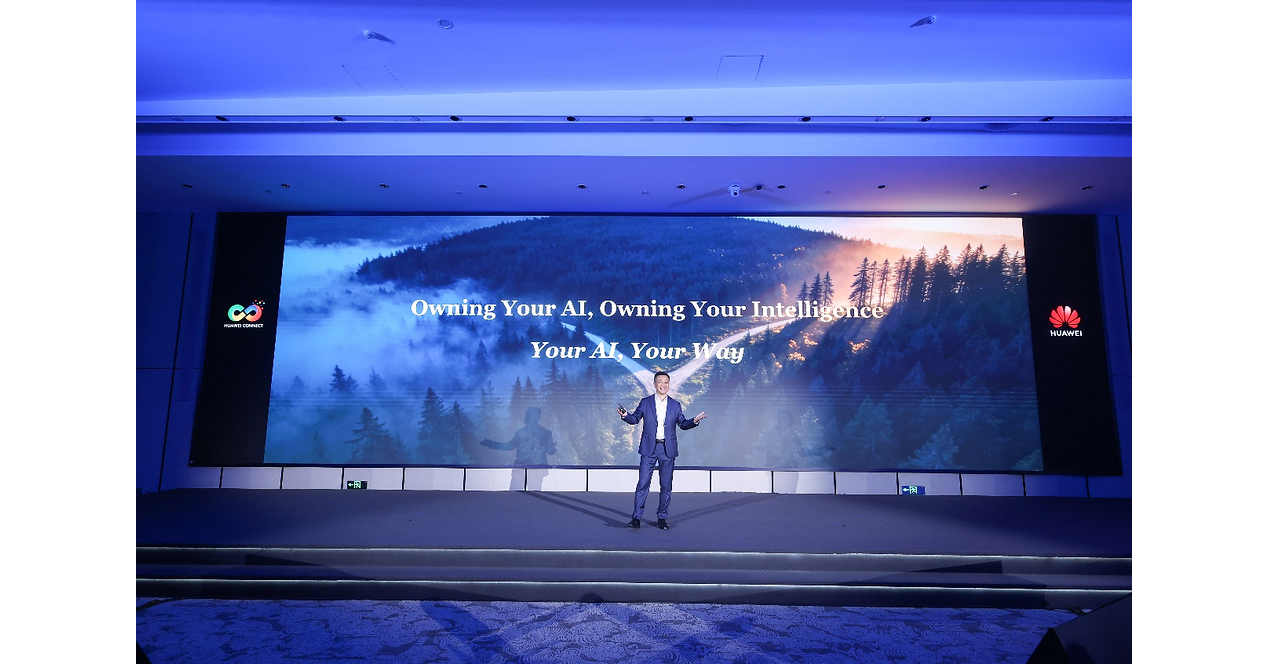
Huawei launched its Fintelligent AI Solution globally at HUAWEI CONNECT 2026, targeting financial institutions’ needs for secure, scalable and sustainable deployment of agentic AI. The offering combines an Agent Factory, Token Factory and Data-Knowledge Factory, built on the open-source openJiuwen agent platform and TokeNexus token-lifecycle management solution. Huawei said it has served more than 7,100 financial-sector customers across 80+ countries, including 54 of the world’s top 100 banks, although the announcement included no disclosed revenue, contracts or financial targets.
Analysis
This is strategically more relevant to private-cloud AI spending than to a near-term Huawei revenue inflection. Financial institutions that cannot place sensitive data or model workflows on U.S. hyperscalers gain an additional sovereign-stack option, potentially diverting incremental infrastructure budgets from AWS (AMZN), Azure (MSFT), and Google Cloud (GOOGL) in China, sanctioned markets, and selected emerging economies. The second-order pressure falls on global systems integrators and core-banking vendors whose legacy modernization revenue depends on proprietary implementation layers; an open agent framework can commoditize portions of integration work while increasing demand for local deployment, governance, and data-engineering services.
The investable read-through is strongest for China’s domestic AI hardware and enterprise software ecosystem, but the release itself supplies no disclosed bookings, customer commitments, compute volumes, or pricing. Over the next 1-3 months, monitor Chinese bank IT tenders, procurement references to openJiuwen, and evidence of Huawei accelerator deployments; these are the only credible catalysts for revenue-estimate revisions. Over 6-18 months, successful deployment would reinforce a bifurcated financial-AI market: U.S. cloud/model providers dominate externally facing and global institutions, while sovereign stacks win regulated, localized workloads.
Consensus may overstate the immediate threat to U.S. hyperscalers: their financial-services AI economics are driven primarily by North American and multinational clients, where model quality, existing data estates, and compliance tooling remain substantial switching barriers. Conversely, the underappreciated risk to Huawei is token-cost economics: agentic workloads can produce sharply rising inference demand, and any shortage or inferior performance of domestic accelerators turns a claimed cost-control feature into a margin and adoption constraint. Treat this as a procurement-signal watch item, not a stand-alone trading catalyst.
AllMind Terminal
AI-powered research, real-time alerts, and portfolio analytics for institutional investors.
Request TrialMarket Sentiment
Overall Sentiment
mildly positive
Sentiment Score
0.38
Key Decisions for Investors
- No directional position on the announcement alone; establish a 1-3 month alert for disclosed bank deployments, paid contract values, and domestic accelerator volumes. Upgrade only if multiple tier-one financial institutions identify production usage and procurement timing.
- For China-tech exposure, prefer a basket approach via KWEB rather than attempting to express Huawei directly; add only following verifiable domestic financial-sector AI capex acceleration. Falsifier: bank IT budgets remain focused on compliance/core maintenance rather than AI infrastructure through the next reporting cycle.
- Maintain AMZN/MSFT/GOOGL financial-services cloud estimates absent evidence that deployments are displacing, rather than complementing, hyperscaler workloads outside China. A meaningful risk signal would be sovereign-cloud wins at multinational banks or explicit loss of regulated-workload share.
- Watch Chinese AI infrastructure suppliers and data-center power demand for second-order confirmation, but require accelerator availability and utilization disclosure before positioning. The key downside trigger is evidence that inference cost per production workflow remains uneconomic relative to human operations or conventional automation.
More News
- Taiwan benchmark Taiex rises to record intraday high as tech stocks advance
- AMD joins the $1 trillion club as chip rally surges - our AI Strategy saw it early
- Jamie Dimon says hyperscaler AI spending could hit $1 trillion next year
- Factbox-Key issues for this week’s Trump-Xi summit in Washington
- Here's who we know is going to the Trump-Xi dinner so far
- +17% in a single session: This AI-picked stock catches a data-center breakout
From AllMind Research
- Anthropic IPO Preview: Valuation, Timing, and What to Watch
- Shein After the IPO: Venue, Valuation, and What Must Be Proved
- What AI Research Tools Should a Small Hedge Fund Buy First?
- What Exactly Does Post-Training in LLMs and Finance-Focused AI Actually Mean for Asset Managers?
- What Is a Financial Ontology?