
Northern Sun Begins Construction on 11.5 MW Solar + 10 MWh Storage Portfolio for GeoFire Solar
Source: PR Newswire
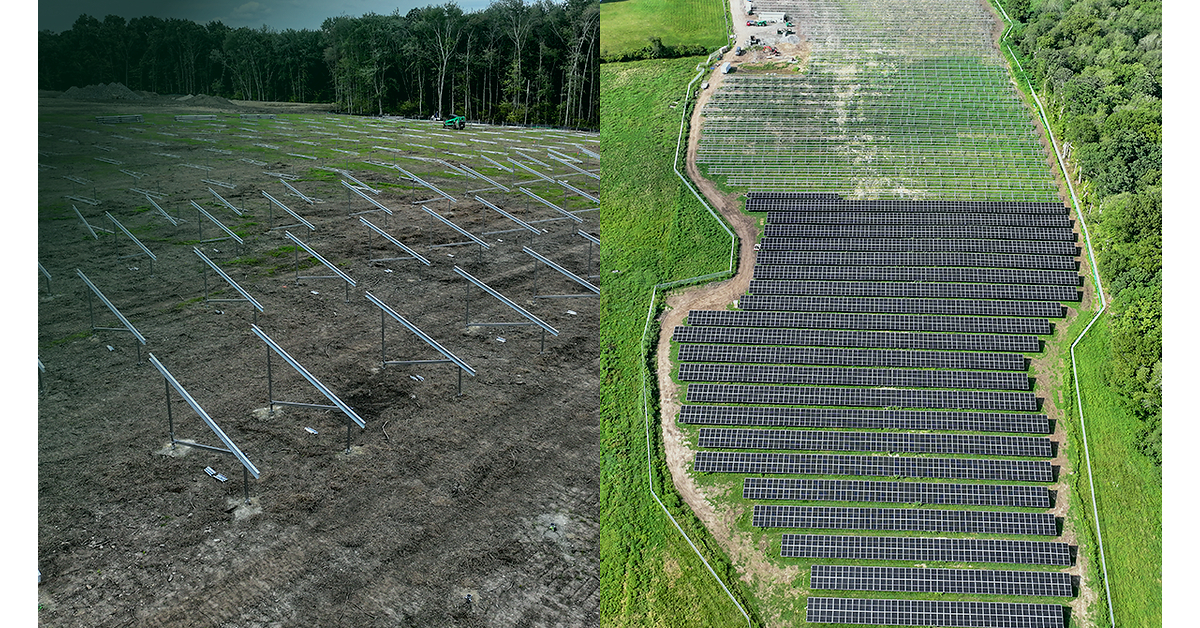
Northern Sun Energy began construction on two Swansea, Massachusetts community-solar projects for GeoFire Solar totaling 11.5 MWdc of generation and 10 MWh of battery storage. The projects will participate in Massachusetts' SMART 3.0 incentive program and use DC-coupled Jinko battery systems designed to reduce conversion losses versus AC-coupled storage. The announcement is a positive execution milestone for the companies but is unlikely to have broad market impact.
Analysis
The direct financial read-through for JKS is immaterial: a 10 MWh deployment is too small to move module or storage revenue, and the project uses a multi-vendor architecture that limits any inference about share gains. The more relevant signal is that DC-coupled storage is becoming executable in a tightly regulated Northeast market, potentially expanding the addressable market for integrated solar-storage equipment where curtailed generation and interconnection constraints make delivered-energy economics—not panel nameplate cost—the purchasing criterion.
For JKS, DC coupling is not automatically margin-accretive. It can favor suppliers able to package modules, storage controls and system-level warranties, while increasing developer dependence on inverter/integration compatibility; SMA Solar (S92.DE) and Fluence (FLNC) may be better public proxies for a broader shift toward storage-heavy project design. Massachusetts community-solar economics remain policy-dependent, so the portfolio is principally a validation of permitting process rather than evidence of durable volume demand.
Over the next 1-3 months, monitor SMART 3.0 capacity awards, Massachusetts interconnection queue timelines, and announced DC-coupled project pipelines rather than this individual construction milestone. Over 6-18 months, rising fire-code and third-party-review requirements could consolidate EPC work toward experienced integrators and lengthen development cycles, offsetting some efficiency gains. The bullish interpretation is falsified if DC-coupled projects face materially higher insurance, commissioning delays, or warranty exclusions that erase incremental energy-capture benefits.
Consensus may overread any storage attachment as a demand catalyst for commoditized Chinese module vendors. In constrained New England markets, the economic value is more likely captured by project owners with incentive allocations and by controls/integration providers; module pricing remains governed by global oversupply. This is a watch item, not a standalone JKS trading catalyst.
AllMind Terminal
AI-powered research, real-time alerts, and portfolio analytics for institutional investors.
Request TrialMarket Sentiment
Overall Sentiment
mildly positive
Sentiment Score
0.38
Ticker Sentiment
Key Decisions for Investors
- No directional JKS trade on this announcement; require evidence of a multi-project U.S. DC-coupled order pipeline or a measurable U.S. shipment/revenue guidance revision before upgrading the thesis.
- Add an alert on FLNC and S92.DE for 1-3 month follow-through: initiate only if disclosed Northeast DC-coupled backlog or orders accelerate while gross-margin guidance holds; execution and warranty provisions are the key risk.
- For renewable exposure, prefer a 6-18 month long FLNC / short JKS relative-value watchlist rather than an active position: it expresses potential value capture in controls/integration versus module commoditization, but should not be initiated without valuation, backlog, and liquidity confirmation.
- Track SMART 3.0 award cadence and Massachusetts battery-fire-code guidance. A material permitting slowdown or higher insurance requirements would be a negative signal for distributed storage developers and EPCs, and would invalidate the deployment-led demand thesis.
More News
- 'Hostile act': Trump threatens EU with tariffs over Canada associate-membership proposal
- US military claims Strait of Hormuz remains open amid ongoing blockade
- US official says upcoming spectrum auctions could generate more than $100 billion
- Investors react to Fed hike and market sell-off: Brace for 'higher for longer' rates
- AI Buildout Hits Inflation as Fed Hikes Rates
- Iran war has cost the US $38bn: How will it impact US economy, politics?
From AllMind Research
- Anthropic IPO Preview: Valuation, Timing, and What to Watch
- Shein After the IPO: Venue, Valuation, and What Must Be Proved
- What AI Research Tools Should a Small Hedge Fund Buy First?
- State of Public Markets, June 2026: Higher for Longer Meets the AI Supercycle
- AI Research Tools With Exact Source Citations