
VZMORE stellt V-Cooling™-Kühlarchitektur mit Dampfkammer für Mini-PCs vor
Source: PR Newswire
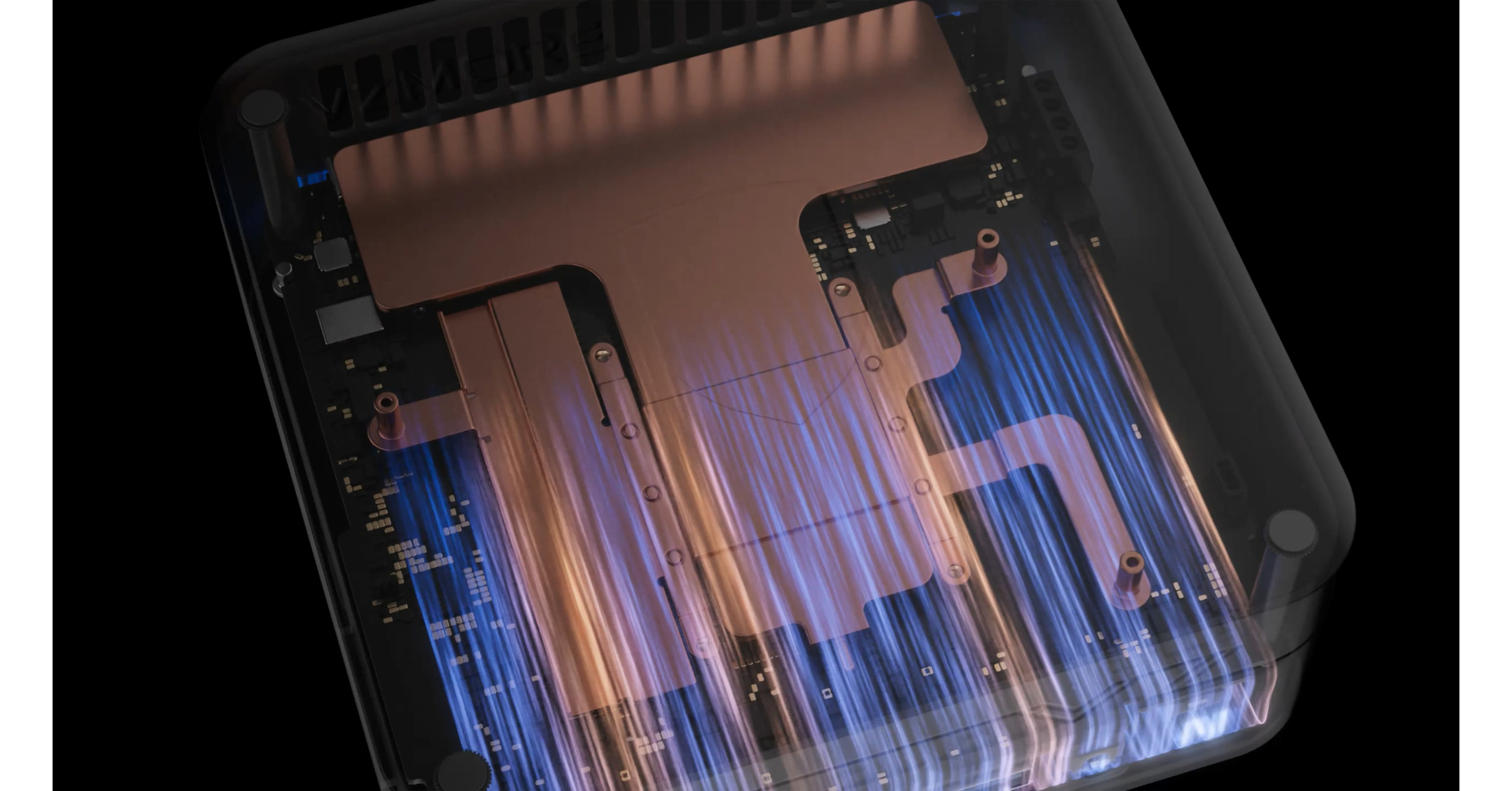
VZMORE introduced its V-Cooling™ vapor-chamber architecture for mini PCs, claiming a roughly 40% larger heat-dissipation area and about 50% higher heat-transfer efficiency than conventional dual-heatpipe designs. The company says its systems sustain up to 80W output while operating at approximately 38 dB under heavy load, around 12 dB below some conventional mini PCs. The announcement is a product-technology update with limited broader market significance; VZMORE notes the cooling module costs about three times as much as a standard two-heatpipe solution.
Analysis
This is not directly investable and the disclosed performance claims lack independent benchmarking, bill-of-material detail, or evidence that customers will pay enough to offset the substantially higher cooling-module cost. In the sub-$1,000 mini-PC category, thermal engineering is more likely to be a margin trade-off than a demand unlock: unless improved sustained performance permits a meaningful ASP premium or reduces warranty returns, gross-margin dilution is the base case. The relevant competitive benchmark is Intel NUC-style systems, ASUS (2357 TT), MSI (2377 TT), and Lenovo (0992 HK), where established channel access and scale purchasing limit a smaller vendor’s ability to monetize component differentiation.
The second-order read-through is modestly constructive for vapor-chamber and advanced thermal-material suppliers if compact AI-PC workloads raise sustained power draw rather than merely peak benchmarks. However, mini-PC unit volumes remain too small to move broad semiconductor or thermal suppliers absent adoption by larger OEMs. Over the next 1-3 months, monitor independent reviews for sustained-clock performance, acoustic measurements, and street pricing versus comparable AMD Ryzen and Intel Core Ultra systems; a price premium above roughly 10-15% without a measurable productivity advantage would falsify the commercial case. Over 6-18 months, the more material beneficiary is likely the x86 mini-PC ecosystem only if local inference, edge deployment, and enterprise desk consolidation make continuous 60-80W operation a mainstream requirement.
AllMind Terminal
AI-powered research, real-time alerts, and portfolio analytics for institutional investors.
Request TrialMarket Sentiment
Overall Sentiment
mildly positive
Sentiment Score
0.30
Key Decisions for Investors
- No position in response to this release; VZMORE appears non-listed and the stated technical advantages are not yet independently verified.
- Set an alert on ASUS (2357 TT) and MSI (2377 TT) product launches and quarterly PC gross margin: initiate a relative long only if they adopt comparable thermal designs without margin erosion, indicating that higher-performance compact PCs are supporting ASP expansion rather than niche share transfer.
- Watch Intel (INTC) and AMD (AMD) mini-PC design wins over the next 2-3 quarters, but do not trade on this announcement alone. A sustained increase in AI-PC/edge-client attach rates and OEM guidance for higher-power compact designs would favor AMD on performance-per-watt positioning; weak consumer PC sell-through or rising OEM inventory would invalidate the thesis.
- For thermal-component exposure, treat any move in broad suppliers as an opportunity only after identifying the actual vapor-chamber manufacturer and verifying multi-OEM contracts. A single small-brand design win has insufficient volume to support an earnings estimate revision.
More News
- Taiwan benchmark Taiex rises to record intraday high as tech stocks advance
- AMD joins the $1 trillion club as chip rally surges - our AI Strategy saw it early
- Here's who we know is going to the Trump-Xi dinner so far
- +17% in a single session: This AI-picked stock catches a data-center breakout
- Asia stocks rise tracking U.S. tech rally; Trump-Xi meeting eyed
- Perpetual underdog AMD nips at Nvidia's heels as it joins the $1T club
From AllMind Research
- Anthropic IPO Preview: Valuation, Timing, and What to Watch
- Shein After the IPO: Venue, Valuation, and What Must Be Proved
- What AI Research Tools Should a Small Hedge Fund Buy First?
- What Is an AI Investment Research Platform?
- What Exactly Does Post-Training in LLMs and Finance-Focused AI Actually Mean for Asset Managers?