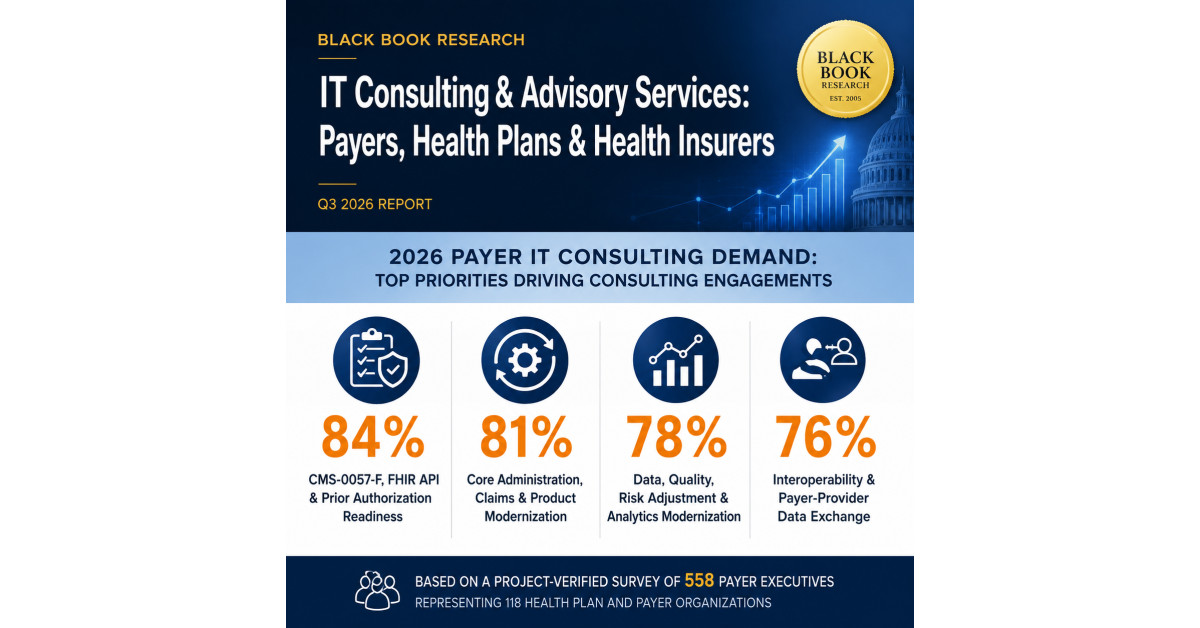
Black Book Research’s Q3 2026 payer IT consulting study names UST HealthProof/HealthEdge the top-performing firm among 20 vendors, scoring 9.40/10 overall satisfaction and leading in 10 of 18 payer-specific KPIs (based on 558 payer executives across 118 organizations). Demand is strongest for CMS-0057-F readiness, FHIR API and prior authorization readiness (84% of respondents), plus core administration/claims modernization (81%) and analytics/risk-adjustment modernization (78%), with the Jan. 1, 2027 API compliance deadline cited as the near-term pressure point. The article is largely competitive benchmarking with limited direct financial implications, but it supports positive market positioning for UST HealthProof/HealthEdge in payer IT modernization and regulatory compliance work.
This is less a sentiment event than a confirmation that payer modernization has shifted from optional transformation to compliance-driven spending. The economic winner is the vendor set that can absorb messy core-admin dependencies and ship end-to-end implementations, which favors large-services platforms like ACN and EPAM over generic strategy shops and small specialists. The loser set is the payer cohort with fragmented legacy stacks, because every incremental API, identity, consent, and prior-auth fix adds near-term opex before any automation savings show up.
The second-order impact is margin pressure for mid-tier and government-heavy managed care names over the next 2-4 quarters: they will spend now to avoid regulatory friction, but the benefit curve is delayed and uncertain. This also creates a hidden beneficiary in the data/security/integration layer, where demand should tilt toward repeatable software and managed services rather than one-off advisory hours. The read-through only becomes durable if bookings and backlog convert; otherwise this is a project-cycle bump, not a multi-year re-rating.
Consensus may be overestimating the breadth of the spend and underestimating how much payers try to internalize the work once the minimum compliant architecture is in place. The key contrarian risk is a CMS timing slip or watered-down enforcement on prior auth for drugs, which would compress the urgency window and cap consulting intensity. The thesis is falsified if the next two earnings cycles do not show healthcare-services backlog inflection or if payer admin expense guidance fails to tick up versus current run-rates.
AI-powered research, real-time alerts, and portfolio analytics for institutional investors.
Request TrialOverall Sentiment
mildly positive
Sentiment Score
0.25
