
Kroger Q2 Earnings Beat on Cost Savings, Sales Outlook Cut
Source: zacks.com
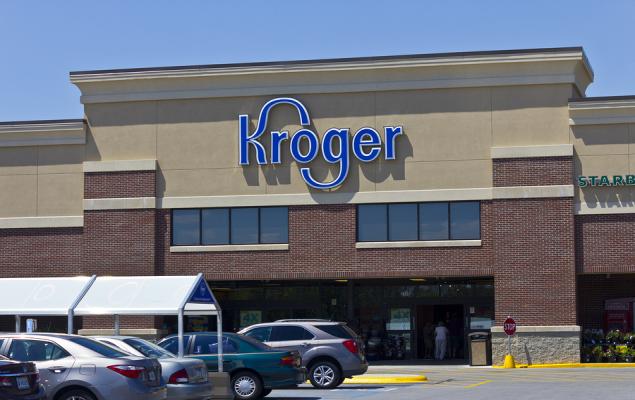
Kroger reported fiscal Q2 adjusted EPS of $1.09, up 4.8% year over year and above the $1.05 consensus, but revenue of $34.62 billion missed the $34.69 billion estimate and identical sales excluding fuel rose only 0.2%. The company cut fiscal 2026 identical-sales guidance to 0.2%-0.8% from 1%-2%, citing an approximately 140bp Inflation Reduction Act headwind, while maintaining EPS guidance of $5.10-$5.30 and adjusted FIFO operating-profit guidance of $5.0-$5.2 billion. E-commerce sales grew 20% and Kroger repurchased $1.0 billion of stock in the quarter, but adjusted FIFO operating profit fell 1.4% to $1.08 billion amid wage, healthcare and sales-deleverage pressures.
Analysis
KR’s maintained profit framework is increasingly dependent on mix and cost offsets rather than underlying food demand. That is a lower-quality earnings setup: sales deleverage, wage/healthcare inflation and elevated capex leave little room for an execution miss, while the remaining buyback authorization provides only limited incremental support. Over the next 1-3 months, investors should focus on whether traffic converts into units and whether the implied second-half operating-profit recovery is achievable without further price investment.
The more important competitive read-through is that profitable rapid delivery and retail-media monetization raise the bar for regional grocers, while also make KR a less pure grocery-margin story. WMT and COST have greater scale to fund value investments, and ACI remains more exposed to price competition without equivalent digital/media scale. Conversely, national CPG vendors face a tougher negotiating environment as private-label penetration rises; branded food companies with weak differentiation may need incremental trade spending, pressuring gross margins over the next 6-18 months.
The contrarian case is that reported sales weakness overstates consumer deterioration because several disclosed drags are mechanical or mix-related, while pharmacy, media and digital profits can sustain EPS. But that only merits a tactical long if management demonstrates that these profit pools are recurring rather than temporary offsets such as refunds, fuel volatility, and generic-drug mix. A sustained decline in grocery units or another reduction to identical-sales guidance would force a multiple reset despite the EPS defense.
AllMind Terminal
AI-powered research, real-time alerts, and portfolio analytics for institutional investors.
Request TrialMarket Sentiment
Overall Sentiment
mildly negative
Sentiment Score
-0.18
Ticker Sentiment
Key Decisions for Investors
- Maintain an underweight/short bias in KR versus WMT over the next 1-3 months; use a long WMT / short KR pair to isolate the risk that value investment and sales deleverage pressure KR’s earnings quality. Cover if KR reiterates profit guidance after Q3 while identical-sales growth accelerates above 1% excluding fuel.
- Do not chase an earnings-beat bounce in KR. Consider a tactical long only after evidence that Q3 unit growth is improving and FIFO operating-profit guidance is reaffirmed; target a 8-12% rebound from a post-results dislocation, with a 5% stop or exit on a second sales-guide cut.
- Watch ACI as the higher-beta negative read-through: retail-media and delivery profitability at KR increase the required technology spend for smaller peers. ACI is a potential short if its next report shows gross-margin compression or incremental digital investment without matching sales productivity.
- For branded-food exposure, screen long positions for private-label vulnerability and reduce names with weak volume momentum and high grocery-channel concentration. The relevant 6-18 month risk is not KR’s revenue loss but supplier-funded promotions and shelf-space displacement; validate through CPG commentary on trade spending and net pricing.
More News
- FTC demands Walmart, Uber, Delta and others hand over data on personalized pricing: Reuters
- Is Costco the next healthcare disrupter?
- How a grocery merger could expand a surveillance network
- The FTC asks companies from Uber to Walmart about how they personalize the prices you pay
- What investors need to know about Alphabet's stock-busting earnings report
- Our next steps for Alphabet stock after earnings disappoint at nearly every turn