
The ugly economics of consumer AI
Source: TechCrunch
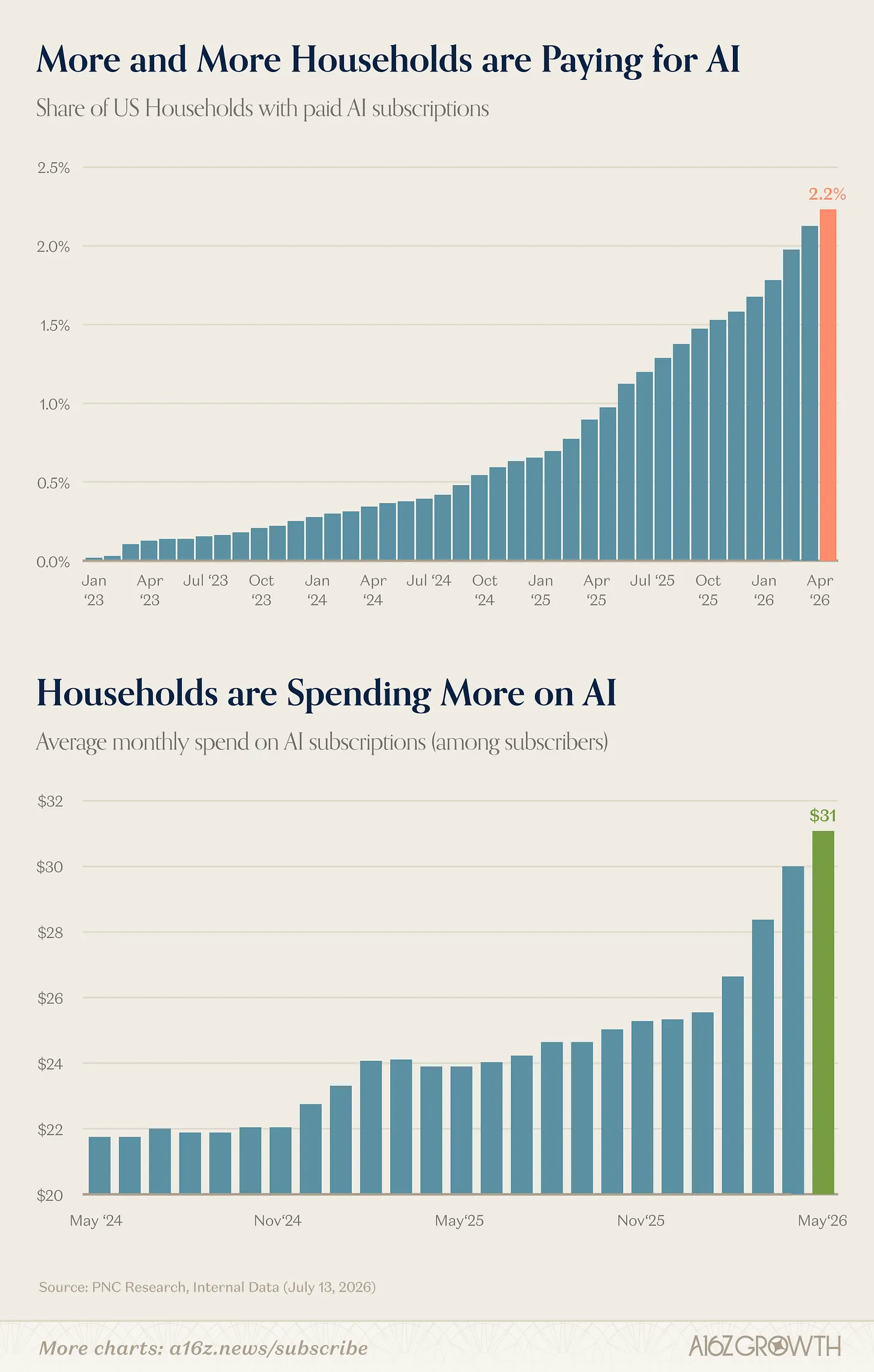
Only 2.2% of consumers were paying for AI services as of May, spending an average $31 per month, highlighting weak monetization despite renewed enthusiasm around consumer agents such as Meta's Muse and OpenAI's Dots. At a Netflix-scale 325 million subscribers and roughly $34 monthly spend, annual revenue would reach about $11B—less than one-third of OpenAI's operating costs. The article argues that high inference and training costs constrain consumer-AI profitability, reinforcing major labs' pivot toward enterprise contracts; OpenAI's enterprise bookings have reportedly doubled since July.
Analysis
The investable distinction is not consumer engagement but incremental inference economics. META can subsidize a high-usage assistant through ad-ranking improvements, retention, and first-party intent data; a standalone consumer agent must recover variable compute, support, and payment costs from a narrow subscription base or transaction take rate. This makes META structurally advantaged versus private consumer-agent peers, while also creating a near-term risk that investors capitalize engagement headlines before management can quantify ad-load, conversion, or compute-return benefits.
Over the next 1-3 months, META’s multiple is more likely to respond to disclosures on AI-driven ad pricing, conversion lift, and capex discipline than consumer-assistant adoption metrics. The key negative second-order effect is that popular agent features can raise query volume faster than monetizable output, worsening gross-margin leverage if inference efficiency does not improve. Watch for AI capex guidance rising without a commensurate improvement in Reels/Feed engagement, ad conversion, or cost-per-inference trends; that combination would reopen the "AI spend versus ROI" debate and pressure the stock.
The consensus may overstate the threat to subscription incumbents such as NFLX. Consumer AI competes for discretionary wallet share, but at low paid penetration it is not yet a material budget substitution event; the more immediate overlap is time spent and content discovery. For banks, BAC and PNC are not direct beneficiaries of consumer-agent enthusiasm, but agent-led commerce could eventually increase fraud, chargebacks, and identity-verification spend before it creates meaningful payments volume—an unfavorable 6-18 month operational asymmetry.
Private consumer-agent valuations should be treated as optionality rather than evidence of durable unit economics. A transaction-fee model can work only where the agent owns high-intent demand and can demonstrate incremental conversion rather than merely disintermediating existing travel, restaurant, or subscription channels; incumbent marketplaces and payment networks will resist margin transfer.
AllMind Terminal
AI-powered research, real-time alerts, and portfolio analytics for institutional investors.
Request TrialMarket Sentiment
Overall Sentiment
mildly negative
Sentiment Score
-0.18
Ticker Sentiment
Key Decisions for Investors
- Maintain/establish a 3-6 month long META versus a basket of unlisted consumer-AI proxies where applicable; META offers monetization pathways beyond subscription revenue. Add only after evidence of AI ad-conversion lift or inference-efficiency gains, and reduce if 2027 capex expectations rise while ad-revenue estimates remain flat.
- Do not position long NFLX on a consumer-AI substitution thesis. Instead, monitor U.S. consumer subscription churn and engagement data over the next two earnings cycles; a measurable acceleration in churn without content-driven explanation would be the first actionable signal.
- For META, use a defined-risk hedge around earnings: own downside puts 5-10% out of the money if the position is sized for AI upside. The principal risk is a capex/inference-cost reset rather than weak consumer adoption, with downside likely concentrated in the first guidance revision.
- Avoid extrapolating private consumer-agent valuation marks into public AI beneficiaries until disclosed metrics show paid conversion, transaction take rate, repeat usage, and contribution margin after inference costs. Treat those disclosures as a watch item, not a catalyst, for META.
More News
- FTC is investigating OpenAI, Anthropic and other AI companies over product risks
- AI market needs to make $6 trillion a year by 2031 to fund its infrastructure habit
- Stock Market Indexes Rally on Inflation Data, Though the Dow Sat It Out
- Higher interest rates can be scary for stocks — but it's not that simple
- The Fed's main inflation measure will be released Wednesday. Here's what to expect
- ElevenLabs’ valuation doubles to $22 billion on surging AI voice-agent demand
From AllMind Research
- Anthropic IPO Preview: Valuation, Timing, and What to Watch
- Shein After the IPO: Venue, Valuation, and What Must Be Proved
- What AI Research Tools Should a Small Hedge Fund Buy First?
- AI Financial Research Benchmarks: What the Scores Mean
- State of M&A and Private Markets, June 2026: A $4.9 Trillion Rebound, Underwritten on Money That Never Got Cheaper