
The National Police Association Investigates Who Was Behind Illinois Laws Targeting Federal Officers
Source: PR Newswire
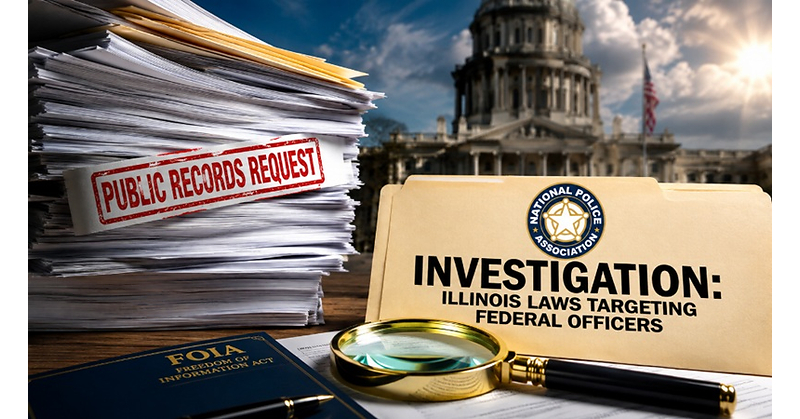
The National Police Association launched FOIA requests into the drafting and planned enforcement of Illinois' Bivens Act and Court Access, Safety, and Participation Act, which it says expand civil-liability exposure for federal immigration officers. The requests target communications from the offices of Gov. J.B. Pritzker, Attorney General Kwame Raoul and the Illinois Senate, including contacts with advocacy groups, lawyers and lobbyists. The laws cited can allow punitive damages tied to officers' operational practices and impose an additional $10,000 in statutory damages for certain courthouse-area arrests.
Analysis
This is advocacy-driven process news rather than a verified change in enforcement economics. A records request has no direct implication for public-company earnings, and the most likely near-term market effect is nil; the relevant litigation, injunction, and federal pre-emption timetable would run over months rather than days.
The investable transmission channel is narrow: if state-level restrictions materially raise operating costs or reduce detention/removal capacity, private detention and government-services contractors could face contract-utilization uncertainty, while immigration-focused legal-service spending is too fragmented and immaterial for listed-equity impact. GEO Group (GEO) and CoreCivic (CXW) are the closest liquid proxies, but their earnings remain much more sensitive to federal detention appropriations, facility contract awards, occupancy, financing costs, and administration policy than to Illinois-specific civil-liability provisions.
Consensus should avoid extrapolating political rhetoric into a nationwide operating constraint. Federal supremacy challenges could limit implementation before material damages accrue; conversely, a sustained state-by-state replication of similar statutes would create a longer-dated legal-cost and operational-friction overhang for immigration-enforcement vendors. The key falsifiers are actual court rulings on pre-emption, disclosed federal agency policy changes, and any contract-level commentary from GEO/CXW—not FOIA document production.
AllMind Terminal
AI-powered research, real-time alerts, and portfolio analytics for institutional investors.
Request TrialMarket Sentiment
Overall Sentiment
mildly negative
Sentiment Score
-0.20
Key Decisions for Investors
- No immediate trade: treat this as a legal-policy watch item, not an earnings catalyst, given the low direct market impact and absence of listed-company exposure.
- Monitor GEO and CXW over the next 1-3 months for Illinois-specific contract, occupancy, insurance, or legal-reserve disclosures; initiate no directional position solely on this development.
- Set an alert for a federal injunction or merits ruling on pre-emption. A ruling limiting state enforcement would remove the modest policy overhang for GEO/CXW; an adverse ruling combined with evidence of similar legislation in large states would justify reassessing a relative short versus broader government-services exposure.
More News
- What next for France as riots rattle markets? Three questions facing investors ahead of more protests
- Looters hit 3,000 French businesses. Within hours, the haul was trending on Vinted under the riot’s date
- Vertex reports positive IgAN trial data, FDA decision due Nov. 30
- Brazil’s Lula and Bolsonaro debate policy proposals before run-off
- US-Iran war, then and now: How the landscape has changed since February
- With earnings in rearview mirror, SpaceX-Tesla merger chatter takes center stage