
How $80 Billion LPG Trade Became a Barometer for Iran War Energy Shock
Source: Bloomberg
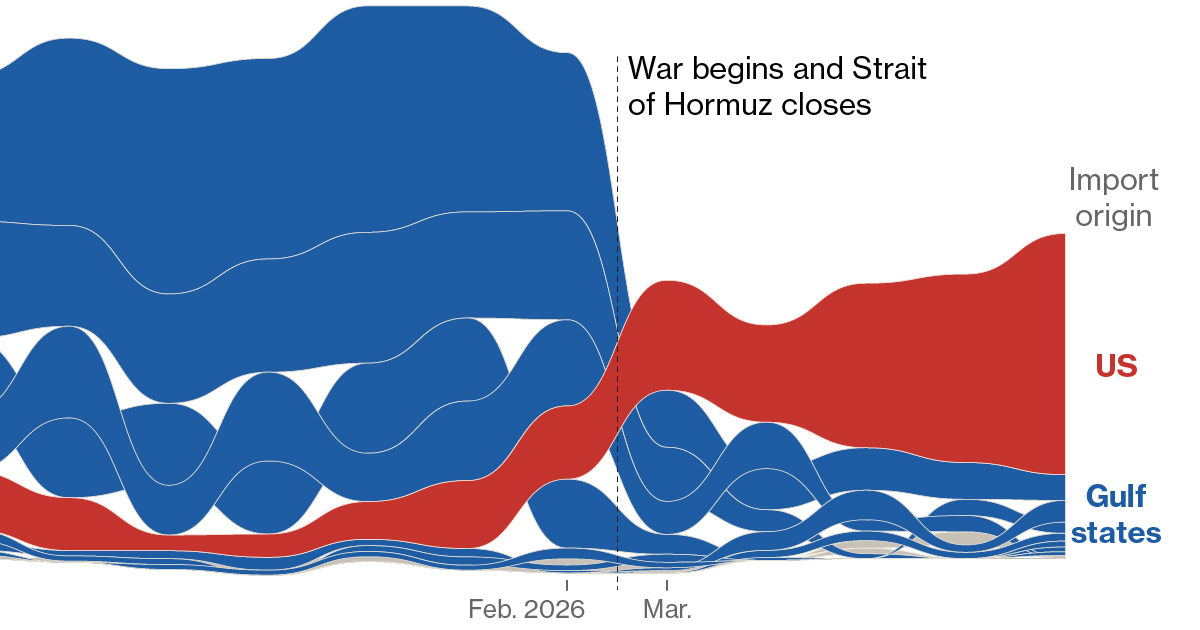
US- and Israeli strikes on Iran have cut LPG flows through the Strait of Hormuz by nearly 80%, forcing India to reroute and lengthen cargo routes (e.g., a US LPG voyage reaching Haldia in 48 days, ~7x slower than Persian Gulf supply). Freight and input costs rose sharply—said to add ~30% to freight alone—and Saudi LPG contract prices rose 46% between February and June; state refiners’ combined April–June loss was reported at 181.5 billion rupees due in part to selling below market costs. While shortages have eased somewhat, industrial demand fell and energy costs are still elevated (e.g., industrial users citing 35–40% higher cycle energy costs and near-67% peak), implying ongoing cost pressure and potential knock-on effects for inflation and margins.
Analysis
The cleanest winners are the toll collectors on the new route structure, not the commodity itself. Longer voyages and chokepoint congestion push value from producers to VLGC owners, export-terminal operators, and canal economics; that favors names with exposure to tonne-miles and storage turns rather than outright crude beta. The clearest losers are the Indian state refiners and downstream industrial users: if retail pricing stays politically capped, the margin bleed migrates from the household subsidy line into refinery P&L, while higher input costs keep forcing small manufacturers to de-stock, switch fuels, or shut capacity.
The second-order effect is a slower-burn inflation tax, not a one-day energy spike. Over the next 1-3 months, the key catalyst is whether freight, queue times, and inventories stay tight enough to preserve the rerouting premium; over 6-18 months, the bigger question is whether Indian refiners have permanently re-optimized yields at the expense of higher-value coproducts, which would leave a lasting drag on petrochemical export economics and support substitute fuels and piped gas adoption. That makes this more attractive as a relative-value trade than as a directional long on energy.
Contrarian view: the market may be underestimating how much of the shock is structural. Even partial normalization in the Strait will not instantly unwind higher working capital, longer transit, and storage constraints in India, so the profit pool can persist after headline tensions ease. What would falsify the thesis is a quick collapse in VLGC spot rates, visible improvement in Panama congestion, or a sharp reduction in Indian subsidy losses and industrial demand within the next quarter, which would signal the system has already absorbed the rerouting penalty.
AllMind Terminal
AI-powered research, real-time alerts, and portfolio analytics for institutional investors.
Request TrialMarket Sentiment
Overall Sentiment
mildly negative
Sentiment Score
-0.35
Key Decisions for Investors
- Long LPG (Dorian LPG) on any 5-7% pullback; 1-3 month catalyst is continued vessel scarcity and elevated tonne-mile demand. Risk/reward is attractive if freight stays tight, but cut the trade if spot VLGC rates roll over or Hormuz flows normalize.
- Short IOC / BPCL / HPCL basket on strength for a 1-2 month horizon. The trade works if subsidy leakage and product-mix damage remain in the next earnings print; cover if the government allows material retail price increases or refinery margin guidance inflects up.
- Pair long OKE or WMB versus short INDA/EPI for a 3-month relative-value expression of higher U.S. NGL export utilization versus Indian inflation drag. Falsifier: a sustained easing in shipping congestion or a sudden rebound in India industrial energy demand.
- If using options, prefer LPG call spreads over outright shares for the next earnings cycle. The upside is a freight rerating; the main risk is that the market already discounts the congestion premium.
More News
- Brian Sullivan: Why the 'real' price of oil is likely $30-$40 higher than where it is now
- Treasuries Soar as Tech Slump Threatens Growth
- Latest Oil Market News and Analysis for Oct. 16
- Blackstone President Jon Gray Bets Big on AI Boom
- Suddenly, Wall Street is worried that the U.S. economy is more ‘vulnerable’ than it looks
- Ukraine to resume strikes on Russian refineries, shattering hopes of an 'energy ceasefire'
From AllMind Research
- Anthropic IPO Preview: Valuation, Timing, and What to Watch
- Shein After the IPO: Venue, Valuation, and What Must Be Proved
- What AI Research Tools Should a Small Hedge Fund Buy First?
- AI Portfolio Monitoring: Build an Alert Policy Analysts Can Audit
- The Great Divergence: North American Banking at the Crossroads of Monetary Policy and Agentic AI (Q4 2025 Bank Earnings)