
La technologie FanWall de LONGWELL EC permet de réduire de 38 % la consommation énergétique des ventilateurs CRAH des centres de données IA de nouvelle génération
Source: PR Newswire
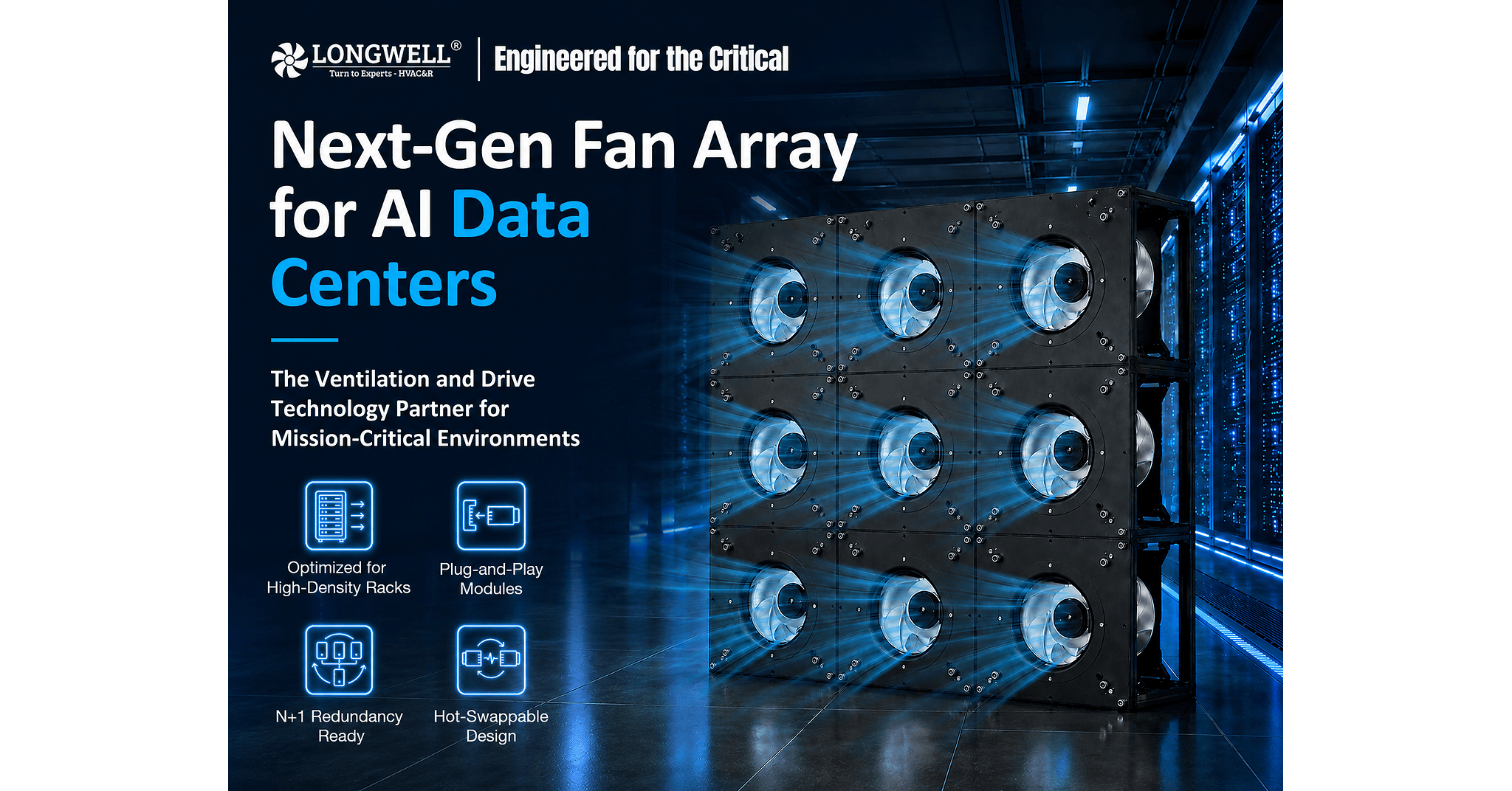
LONGWELL annonce que sa plateforme de ventilateurs FanWall (LWBE3G) réduit de 38% la consommation énergétique des ventilateurs CRAH, avec une baisse de 6,5 dB(A) et une amélioration de l’indicateur d’efficacité énergétique CRAH de 1,42 à 1,28. Le déploiement est présenté comme accéléré (validation des spécifications à la production en série en 90 jours, vs 14-20 mois côté fournisseur européen), et le déploiement client inclut une première commande de 1 500 unités, puis plus de 80 000 unités livrées en 2025 via un accord-cadre 2025-2027 (minimum 60 000/an). La densité thermique par rack pour les sites IA passe de 15–20 kW à 60–100 kW en deux ans, justifiant des solutions visant >100 kW.
Analysis
This is less a single-vendor story than a confirmation that AI thermal design is becoming a hard constraint on deployed compute per MW. The economic winner is the infrastructure layer that sits closest to the bottleneck: power distribution, controls, and precision cooling vendors that are already qualified at hyperscalers and colos. That argues for a relative tailwind to Vertiv and Eaton, while more generalized HVAC names should see less benefit unless they can prove exposure to high-density racks and recurring retrofit demand.
The second-order effect is that lower cooling overhead can actually increase total capex, not reduce it. If operators can push more racks into the same power envelope, they may accelerate deployments and spend more on upstream electrical gear, liquid-cooling readiness, and monitoring software; the bottleneck shifts rather than disappears. The main risk window is 1-3 months, when the market may overtrade the efficiency headline, versus 6-18 months when procurement data and backlog convert into revenue and margin.
The contrarian read is that this is not a broad-air-cooling collapse thesis; it is a qualification win at one project that still depends on operating point, installation, and reliability. The real tell will be whether public peers show faster design wins, higher mix from data-center cooling, and improved gross margin—not just press-release language. If the next round of hyperscaler capex guides does not reaccelerate, the stock-level impact should fade quickly.
AllMind Terminal
AI-powered research, real-time alerts, and portfolio analytics for institutional investors.
Request TrialMarket Sentiment
Overall Sentiment
mildly positive
Sentiment Score
0.25
Key Decisions for Investors
- Long VRT / short CARR as a 1-3 month relative-value pair: VRT has cleaner exposure to AI data-center thermal bottlenecks, while CARR is more levered to legacy HVAC; target 8-12% spread compression, stop if VRT backlog or margins miss.
- Add ETN on weakness over the next 2-4 weeks: if higher-density racks are the real constraint, electrical distribution and protection should capture more durable spend than the cooling component itself; better 6-18 month risk/reward than a pure HVAC bet.
- Do not short hyperscaler capex on this news; use any weakness in MSFT/AMZN/GOOGL as a buy-the-dip signal only if next guidance still implies rising AI infrastructure spend, because efficiency gains can expand rather than shrink total deployment economics.
- Set an alert for Vertiv's next earnings call: thesis is falsified if data-center order growth does not accelerate or if management cites qualification delays / design churn, which would imply the 'AI cooling' theme is still more marketing than revenue.
More News
- CoreWeave credit default swaps hit distress levels as investors sour on AI debt
- Brian Sullivan: Why the 'real' price of oil is likely $30-$40 higher than where it is now
- Treasuries Soar as Tech Slump Threatens Growth
- Penske Automotive agrees to be taken private by Penske, Mitsui
- Faraday Copper completes acquisition of BHP’s San Manuel project
- Latest Oil Market News and Analysis for Oct. 16