
Water Electrolysis Market to Reach USD 12.66 Billion by 2034, Growing at a 6.1% CAGR Report by Maximize Market Research
Source: PR Newswire
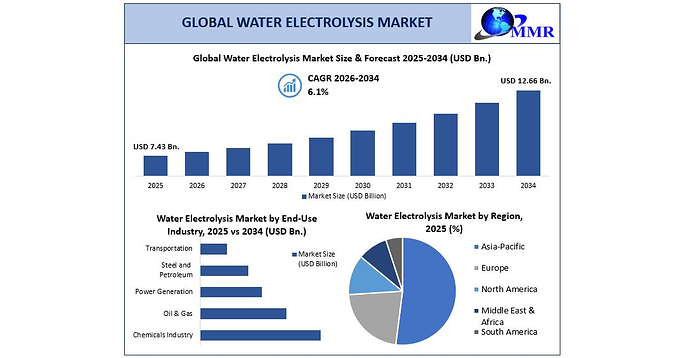
The global water-electrolysis market is forecast to grow from $7.43 billion in 2025 to $12.66 billion by 2034, a 6.1% CAGR, as low-emissions hydrogen demand and industrial decarbonization support larger commercial installations. Installed electrolysis capacity more than doubled to above 4 GW in 2025, while more than 2.5 GW is under construction; Asia-Pacific led deployment, with China accounting for nearly three-quarters of new installations. The outlook is tempered by substantial overcapacity—nearly 38 GW of annual manufacturing capacity versus roughly 4 GW of output—and falling final investment decisions, which dropped below 0.8 million tonnes per year in 2025.
Analysis
The investable signal is not sector demand growth but a utilization and pricing problem: electrolyzer nameplate capacity is dramatically ahead of deliveries, so incremental order wins are unlikely to translate into broad earnings upgrades until projects reach FID and customer financing closes. This favors scaled incumbents with service, integration and balance-sheet support—Siemens Energy (ENR), BASF (BAS) and thyssenkrupp nucera (NCH2)—over pure-play manufacturers whose valuations still require a sharp conversion of announced pipelines into backlog.
PEM’s technical advantages do not automatically imply superior equity returns. PEM vendors face greater exposure to iridium/PGM inputs, while alkaline suppliers face Chinese equipment-price deflation; both dynamics can prevent gross-margin recovery even as installed MW rise. Regional assembly announcements should be viewed primarily as bid-qualification and local-content tools, not evidence of demand: the relevant KPI over the next 1-3 months is disclosed firm backlog, advance payments and gross-margin guidance—not manufacturing-capacity additions.
The contrarian view is that the market may be underestimating the beneficiaries outside electrolyzer OEMs. Industrial users with credible internal hydrogen consumption can monetize subsidies and reduce carbon-compliance exposure without relying on a merchant-hydrogen market; BAS is a cleaner expression than speculative equipment names. Over 6-18 months, low-cost Chinese alkaline equipment should pressure European pure-play pricing and shift value toward engineering, power sourcing, compression/storage and long-term service contracts.
Catalysts are quarterly order intake, project FIDs before 2027, EU/US subsidy-rule clarity, and renewable-power-price declines. The thesis fails if FIDs accelerate materially while OEMs demonstrate sustained pricing discipline and rising utilization; conversely, another leg down in FIDs or order cancellations would expose fixed-cost absorption risks at ITM, NEL and PLUG.
AllMind Terminal
AI-powered research, real-time alerts, and portfolio analytics for institutional investors.
Request TrialMarket Sentiment
Overall Sentiment
mildly positive
Sentiment Score
0.24
Ticker Sentiment
Key Decisions for Investors
- Prefer a 6-12 month long BAS / short PLUG pair: BAS has an internal industrial decarbonization pathway and diversified cash flows, while PLUG remains highly exposed to project financing, execution and cash-burn risk. Reassess if PLUG delivers two consecutive quarters of positive gross margin with funded backlog growth.
- Maintain NCH2 as the preferred listed electrolyzer watch-list long, but enter only following a quarterly order-intake inflection and confirmed margin guidance; target a 12-month 2:1 reward/risk versus a stop on material backlog decline or renewed full-year margin cut.
- Avoid chasing ITM and NEL on localization or grant headlines. A tactical long is justified only after disclosed customer deposits/FIDs convert to backlog; absent that evidence, use rallies into results to reduce exposure because utilization-driven margin dilution remains the base case over the next 1-3 months.
- For diversified clean-energy exposure, favor ENR over pure-play electrolyzer OEMs over 6-18 months: grid equipment and power-system investment provide earnings support if hydrogen deployment slips. Thesis risk is a broad renewable capex slowdown or a material deterioration in ENR’s grid-equipment execution.
- Set an alert for European and North American hydrogen-project FIDs and for PGM-price moves. A sustained iridium/PGM spike would impair PEM economics; a meaningful FID acceleration combined with falling renewable-power prices would be the trigger to upgrade ITM/NEL from watch-list to tactical longs.
More News
- Europe’s winter energy crunch may already be underway. Two U.S. stocks that may benefit
- Jim Cramer's top 10 things to watch in the stock market Thursday
- Trump says US may ask Europe to release diesel reserves
- Latest Oil Market News and Analysis for Oct. 2
- Oil holds gains as U.S. weighs more Middle East military presence
- Nvidia Faces Questions Over China AI Chip Smuggling Cases