
Huawei dévoile une architecture cible de réseau étendu (WAN) intelligent destinée aux FAI
Source: PR Newswire
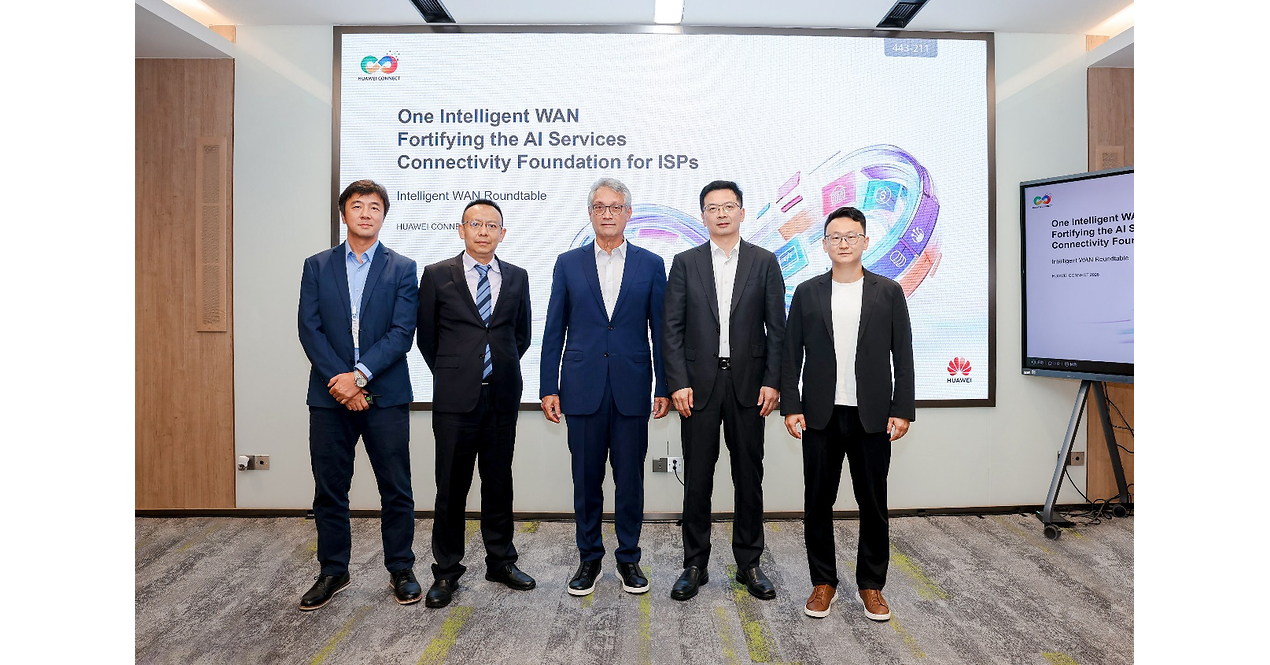
Huawei unveiled its Intelligent WAN target architecture for internet service providers at HUAWEI CONNECT 2026 in Shanghai, positioning converged IP/optical networks, service monetization and AI-driven operations as foundations for AI services. The company said ISPs can use edge nodes, compute capacity and APIs to shift from selling bandwidth toward AI services, while tools such as Network Digital Map and AI assistants could reduce OPEX and improve network maintenance efficiency. The announcement is strategic product positioning rather than a disclosed contract, revenue contribution or financial guidance update.
Analysis
The investable implication is not a near-term revenue event for Huawei, but a potential shift in ISP capex mix: more spend on coherent optical transport, routing automation and edge interconnect, offset by less value assigned to undifferentiated backbone capacity. Outside China, Huawei's restricted addressable market means the cleanest beneficiaries of an AI-driven WAN upgrade cycle are Nokia (NOK), Ciena (CIEN), Cisco (CSCO) and Arista (ANET), provided operators convert AI-traffic expectations into funded 2027 budgets. The key second-order risk is that AI inference remains concentrated in hyperscale data centers; if traffic is largely handled inside cloud backbones, retail ISPs gain limited pricing power despite higher network investment.
Near term, this is promotional/vendor-led commentary rather than independently verifiable demand, so it should not alter earnings estimates. Over the next 1-3 months, watch carrier capex guidance, optical-order commentary and evidence that upstream traffic growth is producing premium SLA or edge-compute revenue rather than simply higher transit costs. Over 6-18 months, software-defined service assurance could favor vendors with installed-base software attach and recurring support revenue, but it also raises gross-margin risk for carriers if competitive markets prevent them from passing through latency, resiliency and power costs.
Contrarian view: consensus may overstate the monetization opportunity for access providers. AI agents can increase traffic, but traffic growth has historically been monetized primarily by cloud platforms and equipment suppliers, while connectivity providers absorb much of the capex. The thesis is falsified positively if major carriers explicitly disclose AI-network service revenue or sustained ARPU uplift; it is falsified negatively for equipment longs if 2027 capex plans remain flat despite elevated AI traffic metrics.
AllMind Terminal
AI-powered research, real-time alerts, and portfolio analytics for institutional investors.
Request TrialMarket Sentiment
Overall Sentiment
mildly positive
Sentiment Score
0.30
Key Decisions for Investors
- No directional position solely on this release; create a 1-3 month watchlist around CIEN, NOK, CSCO and ANET for carrier earnings calls that quantify AI-related optical, routing or automation orders.
- If CIEN reports accelerating cloud-and-service-provider optical backlog while maintaining gross-margin guidance, initiate a 6-12 month long versus short LUMN: CIEN captures equipment/content growth, while LUMN remains exposed to carrier capex and balance-sheet execution. Exit if CIEN backlog growth decelerates for two consecutive quarters or LUMN secures material contracted AI-network revenue.
- Prefer CSCO or NOK over pure ISP exposure for a 6-18 month WAN automation theme, as software, services and installed-base upgrades can cushion lumpy hardware demand; size only after FY2027 carrier capex visibility improves.
- Use ANET as a higher-beta confirmation signal rather than a direct WAN expression: sustained strength in AI back-end networking orders would support the broader interconnect thesis, while a hyperscaler digestion cycle would argue against extrapolating ISP AI-capex demand.
More News
- All Iranian airlines to be 'shut down' from Wednesday, Bessent tells CNBC
- Taiwan benchmark Taiex rises to record intraday high as tech stocks advance
- AMD joins the $1 trillion club as chip rally surges - our AI Strategy saw it early
- Jamie Dimon says hyperscaler AI spending could hit $1 trillion next year
- Factbox-Key issues for this week’s Trump-Xi summit in Washington
- Here's who we know is going to the Trump-Xi dinner so far
From AllMind Research
- Anthropic IPO Preview: Valuation, Timing, and What to Watch
- Shein After the IPO: Venue, Valuation, and What Must Be Proved
- What AI Research Tools Should a Small Hedge Fund Buy First?
- AI Financial Research Benchmarks: What the Scores Mean
- State of M&A and Private Markets, June 2026: A $4.9 Trillion Rebound, Underwritten on Money That Never Got Cheaper