
Tudor Gold Expands Treaty Creek's Perfectstorm Zone Copper-Gold Porphyry System and Potential for Broader Gold-dominant Epithermal System
Source: feeds.newsfilecorp.com
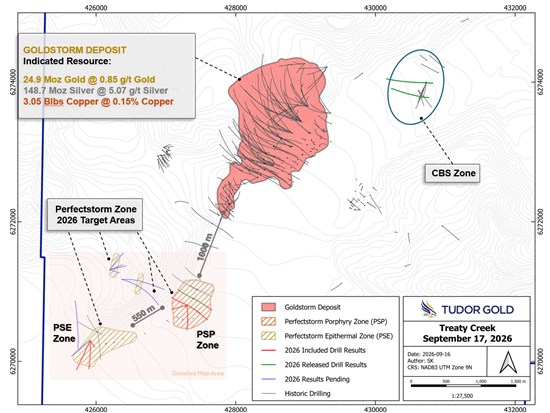
Tudor Gold reported ten drill holes at its 80%-owned Treaty Creek Perfectstorm Zone that expanded the PSP copper-gold-silver-molybdenum porphyry system and supported continuity of near-surface gold-dominant mineralization. Highlights included 0.98 g/t gold and 9.39 g/t silver over 101.0 m in PS-26-23, including 2.01 g/t gold and 32.15 g/t silver over 25.5 m, and 1.12 g/t gold and 7.04 g/t silver over 66.7 m in PS-26-28, including 44.38 g/t gold and 440 g/t silver over 0.8 m. The system remains open in all directions, with two rigs continuing drilling and follow-up results pending from four near-surface holes.
Analysis
This is not yet a valuation-changing result for Tudor: the key uncertainty is geometry, true width, continuity and metallurgy rather than headline grades. A potentially large, low-grade porphyry plus discontinuous high-grade overprint can add strategic optionality, but it also raises future capex, permitting and processing complexity; the market should not credit contained-metal growth until a coherent resource model and mine plan establish recoverable value.
The more relevant read-through is for Seabridge Gold (SEA), whose district-scale KSM land position gains incremental strategic scarcity if the corridor proves to host multiple mineralizing centers. That said, Perfectstorm remains too early-stage to alter SEA NAV or improve KSM financing odds in the next 1-3 months. Newmont (NEM) has no meaningful earnings sensitivity: adjacent exploration success can reinforce Golden Triangle prospectivity, but does not solve the region's infrastructure, jurisdictional, or development-return constraints.
Near term, junior-explorer liquidity can produce an outsized reaction in TUD relative to fundamental value, particularly if retail investors extrapolate narrow high-grade intervals. Over 6-18 months, the decisive catalyst is whether follow-up shallow drilling demonstrates broad, repeatable mineralization and whether the underground-access permit and economic study convert a giant resource into a financeable project. The thesis is falsified by step-out holes showing weak continuity, an unfavorable strip/underground development profile, permitting delay, or equity issuance at a material discount.
Contrarian view: district adjacency is more likely to help a consolidator's bargaining power than create immediate takeover value for Tudor. Any acquirer would require resource conversion, engineering evidence and a clear path to infrastructure sharing; until then, the asset's scale can be a funding liability in a risk-off junior-mining market.
AllMind Terminal
AI-powered research, real-time alerts, and portfolio analytics for institutional investors.
Request TrialMarket Sentiment
Overall Sentiment
moderately positive
Sentiment Score
0.48
Key Decisions for Investors
- No directional NEM trade: monitor only. Require evidence of a district-level land or infrastructure response before attributing any NAV impact; NEM is too diversified for this exploration result to matter.
- Place SEA on an event-driven watchlist rather than buy on this release. Reassess a long position after Tudor publishes follow-up shallow-hole assays or a resource update that demonstrates continuity; upside would come from renewed Golden Triangle consolidation speculation, while KSM permitting/financing slippage remains the dominant risk.
- For junior-mining exposure, avoid chasing an initial TUD liquidity spike. Consider only a small, tightly risk-managed position after assay-volume confirmation and disclosure of cash runway/drill budget; exit on failed step-outs or a discounted financing, as dilution risk likely outweighs near-term discovery optionality.
- Use GDXJ, rather than NEM, as the liquid sector proxy if sustained gold-price strength and improved risk appetite create a broader re-rating in discovery-stage developers over the next 3-6 months; this company-specific release alone is insufficient catalyst.
More News
- Italy to deploy warships to protect shipping through Bab al-Mandeb
- Oil prices fall as Saudi supply hopes outweigh fresh Houthi strikes
- Oil prices fall for 3rd day as supply concerns ease, diplomacy in focus
- Oil Traders Stymied by Iran War Stalemate: Evening Briefing Americas
- Saudi Pivots Oil Routes After Pipeline Attack
- This AI-picked stock jumps 18% on Amazon’s $8 billion power deal
From AllMind Research
- Anthropic IPO Preview: Valuation, Timing, and What to Watch
- Shein After the IPO: Venue, Valuation, and What Must Be Proved
- What AI Research Tools Should a Small Hedge Fund Buy First?
- 2026 Global Markets Outlook: Asset Allocation After the Great Disconnect
- Fintool Alternatives After the Microsoft Acquisition