
Global Engineering Plastics Market to Reach USD 300 Bn. by 2034 at 7.4% CAGR as EV Lightweighting, Advanced Electronics and High-Performance Polymer Demand Accelerate Growth Maximize Market Research
Source: PR Newswire
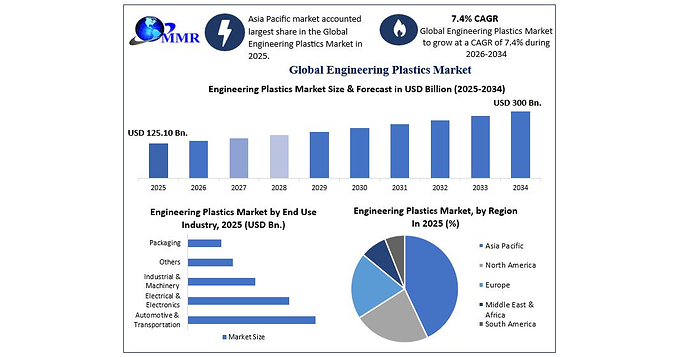
Maximize Market Research forecasts the global engineering plastics market to grow from $125.1 billion in 2025 to nearly $300 billion by 2034, implying a 7.4% CAGR for 2026-34. Growth is expected to be driven by EV lightweighting, electronics, 5G, renewable-energy systems and industrial automation, with Asia-Pacific remaining the largest regional market. Demand for recycled and bio-based polymers is increasing, although petrochemical feedstock volatility, high specialty-polymer costs and tighter environmental regulations remain constraints.
Analysis
This is not a near-term earnings catalyst: the underlying forecast is third-party market research rather than a demand order, capacity award, or guidance revision. The investable read is that volume growth alone will not differentiate suppliers; the economic profit pool should migrate toward application-qualified, flame-retardant and recycled grades, where switching costs and customer validation cycles support price/mix. BASF (BAS), Syensqo (SYENS), Solvay (SOLB), Victrex (VCT) and EMS-Chemie (EMSN) have greater exposure to these defensible specialty niches than commodity-heavy resin producers such as Dow (DOW), LyondellBasell (LYB), or Braskem (BAK).
Over the next 1-3 months, the relevant catalysts are auto/EV production revisions, electronics orders and petrochemical feedstock moves—not broad market-growth projections. A weaker oil/naphtha complex initially expands polymer spreads for integrated producers, but it can also compress selling prices and expose excess global commodity-resin capacity. For specialty suppliers, the more consequential risk is qualification failure: recycled-content mandates can create demand, but inconsistent feedstock quality, certification costs and lower yields may dilute margins before premium pricing is established.
The consensus extrapolates EV unit growth into material demand, but battery architectures may reduce resin content per vehicle in certain applications as OEMs adopt structural packs, aluminum enclosures, or lower-cost localized compounds. Conversely, the underappreciated 6-18 month opportunity is grid, data-center and industrial-automation electrification, which is less dependent on consumer EV demand and consumes higher-value insulation, connector and thermal-management materials. Treat this as a thematic screen for upcoming earnings and capex disclosures rather than a reason to chase the group today.
AllMind Terminal
AI-powered research, real-time alerts, and portfolio analytics for institutional investors.
Request TrialMarket Sentiment
Overall Sentiment
mildly positive
Sentiment Score
0.38
Ticker Sentiment
Key Decisions for Investors
- Maintain a watchlist long on BAS and SYENS for 6-18 months; initiate only following evidence of specialty-volume acceleration or raised mix guidance. Thesis is falsified by two consecutive quarters of flat specialty EBITDA or material price concessions despite volume growth.
- Consider a 3-6 month pair trade: long VCT / short LYB, sized modestly. VCT offers higher exposure to qualification-driven high-performance polymers, while LYB remains more exposed to commodity polyolefin oversupply; exit if European industrial production deteriorates further or LYB's olefin spreads widen materially.
- Do not add directional exposure to DOW, BAK, HUN or EMN on this item alone. Set alerts for naphtha/oil feedstock changes, Chinese resin-export pricing and announced Asian capacity additions; these variables matter more for their 2027 margin outlook than long-dated demand forecasts.
- For AVNT and CE, review the next earnings call for engineered-material segment volumes, automotive/electrical end-market commentary and recycled-content pricing. A positive trade requires independently disclosed order or margin evidence, not market-size projections.
More News
- Germany's RAG Foundation could sell entire Evonik stake
- Greer urges G20 to back Trump tariff agenda, takes aim at China
- Tencent leases 100,000 chips from Oracle for $7 bln- FT
- California Gov. Gavin Newsom bans AI 'robo bosses' in landmark state law, reversing his earlier veto
- RAM supply set to worsen, says Micron, as CEO celebrates ‘much higher’ prices
- Why is Nidec stock plunging today?
From AllMind Research
- Anthropic IPO Preview: Valuation, Timing, and What to Watch
- Shein After the IPO: Venue, Valuation, and What Must Be Proved
- What AI Research Tools Should a Small Hedge Fund Buy First?
- What a Concept From Nature Tells Us About How C-Suite Executives Actually Think About AI
- How to Track Earnings Call Sentiment Across Companies