
What a Concept From Nature Tells Us About How C-Suite Executives Actually Think About AI
A founder's read of how executives talk about AI when the cameras are off, seen through the birth-death process: no neutral state, and why sequencing beats speed.

Published September 3, 2026
In this article
Executives in financial services describe the same tension when they talk about AI in private. Moving too slowly could leave the firm behind, and moving quickly without the right foundations creates an expensive mess with their name on it. A concept I first met in quantitative finance, the birth-death process, explains why the tension has no easy resolution. A system that moves one state at a time cannot skip states, and a competitive market has no stationary state to rest in. The job of the C-suite is to manage the sequence.
One of the best parts of founding AllMind has been the chance to speak candidly with senior leaders across financial services: executives at hedge funds, quant firms, investment banks, private equity firms and large corporates. Those conversations give an unusual view into how the C-suite thinks about AI when the cameras are off and the unknowns have to be said out loud. I hear what excites them, what concerns them and, most of all, what they are afraid of getting wrong. This is a perspective piece built on those conversations. It is not a survey, and every number in it comes from published research linked beside the claim. I run AllMind, which sells software that sits inside the sequence described below, so read the argument with that stake in view.
There Is No Neutral Position
A birth-death process describes a system that moves incrementally from one state to another. A "birth" increases the state by one, while a "death" decreases it by one. The system cannot jump from state one to state ten without passing through the states in between. In the standard formulation it is a continuous-time Markov chain whose only transitions are to the neighboring states, which is why it appears in queueing theory, demography and epidemiology. It is also one of the cleanest ways to reason about how a system gets built, because capability accumulates one state at a time.
I first encountered it through the limit order book. Cont, Stoikov and Talreja's model of order book dynamics, published in Operations Research in 2010, treats the queue of orders at each price as a birth-death process. A new limit order is a birth. A cancellation, or a market order that consumes the queue, is a death. The shape of the book, and the probability that the price moves up before it moves down, falls out of the balance between the two rates.
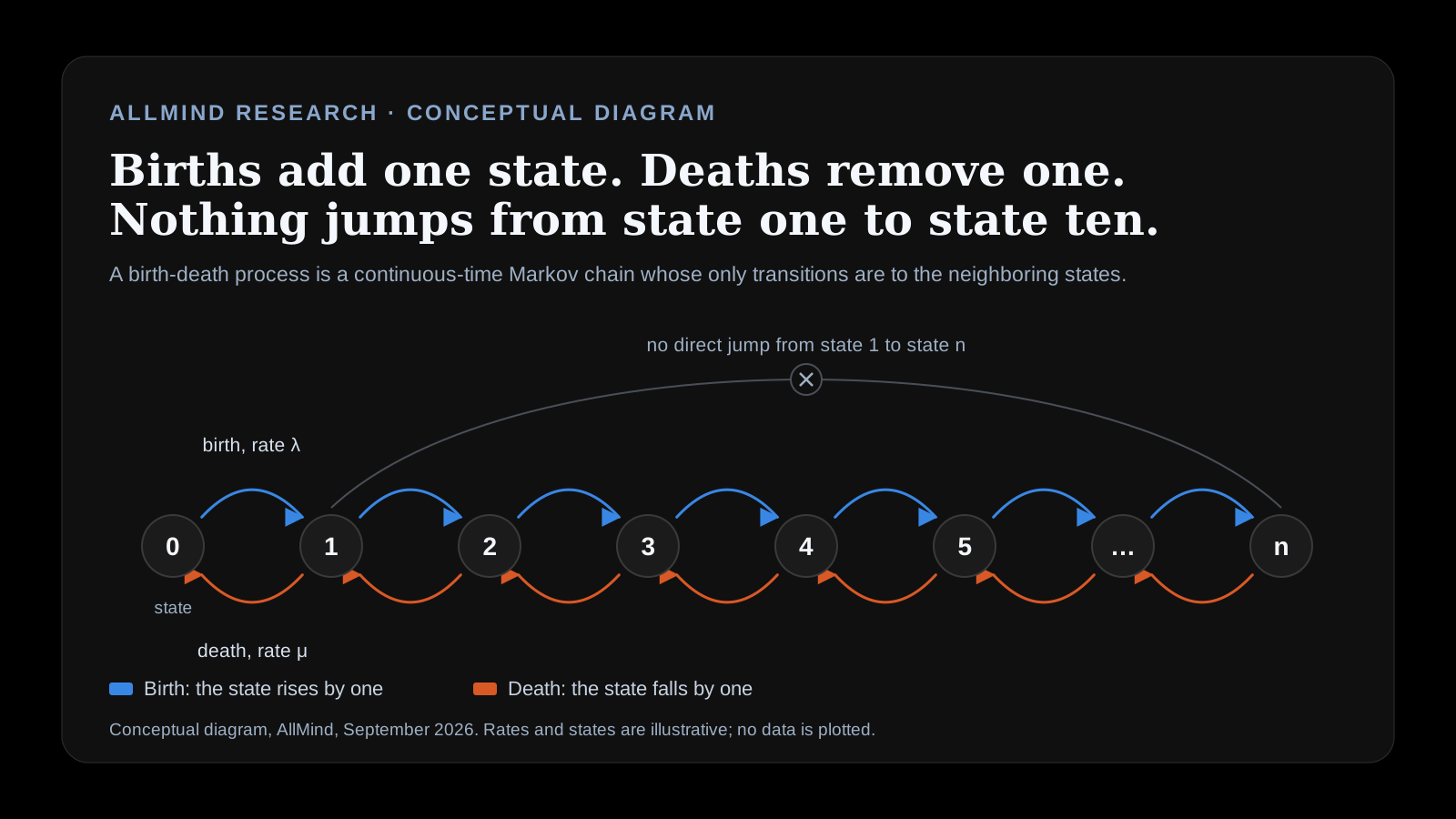
Under the right conditions, a birth-death process reaches a stationary distribution, where births and deaths balance in a way that makes the system stable. The condition is precise: the birth rates cannot outrun the death rates indefinitely, or the chain drifts upward and never settles, which is what the ergodicity conditions on the ratio of the rates encode. Increasingly, executives feel that there is no equivalent stationary state when it comes to AI. Standing still no longer feels like standing still. It feels like moving backward.
An organization may not have deteriorated internally, but its competitive position can still decline. If competitors are improving their processes and restructuring teams to give employees increasingly capable systems, then maintaining the status quo becomes a relative disadvantage.
This is the fear underneath many of the conversations I have with executives. It is not that AI will replace their company overnight. It is that other organizations will make a better sequence of decisions and gradually become faster, cheaper and more intelligent. That creates a difficult decision-making problem. Do too little, and the organization risks falling behind. Do too much without the necessary infrastructure, and it risks creating chaos.
Why Activity Is Easy to Mistake for Progress
When doing nothing feels dangerous, organizations naturally start maximizing the number of births. They launch another AI initiative, buy another tool, automate another process, or deploy another "AI agent" that someone on the team built by vibe-coding their existing workflow. Before long, AI strategy becomes a scoreboard of activity rather than outcomes. How many copilots have we deployed? How many workflows have we automated? How many employees are using AI? How many internal agents have we built? How many tokens is each person consuming?
The problem is that none of these metrics tell you whether the organization is becoming better. Activity gets mistaken for progress, experimentation for strategy, and adoption for value creation. Eventually, companies find themselves running faster without knowing whether they are moving in the right direction at all.
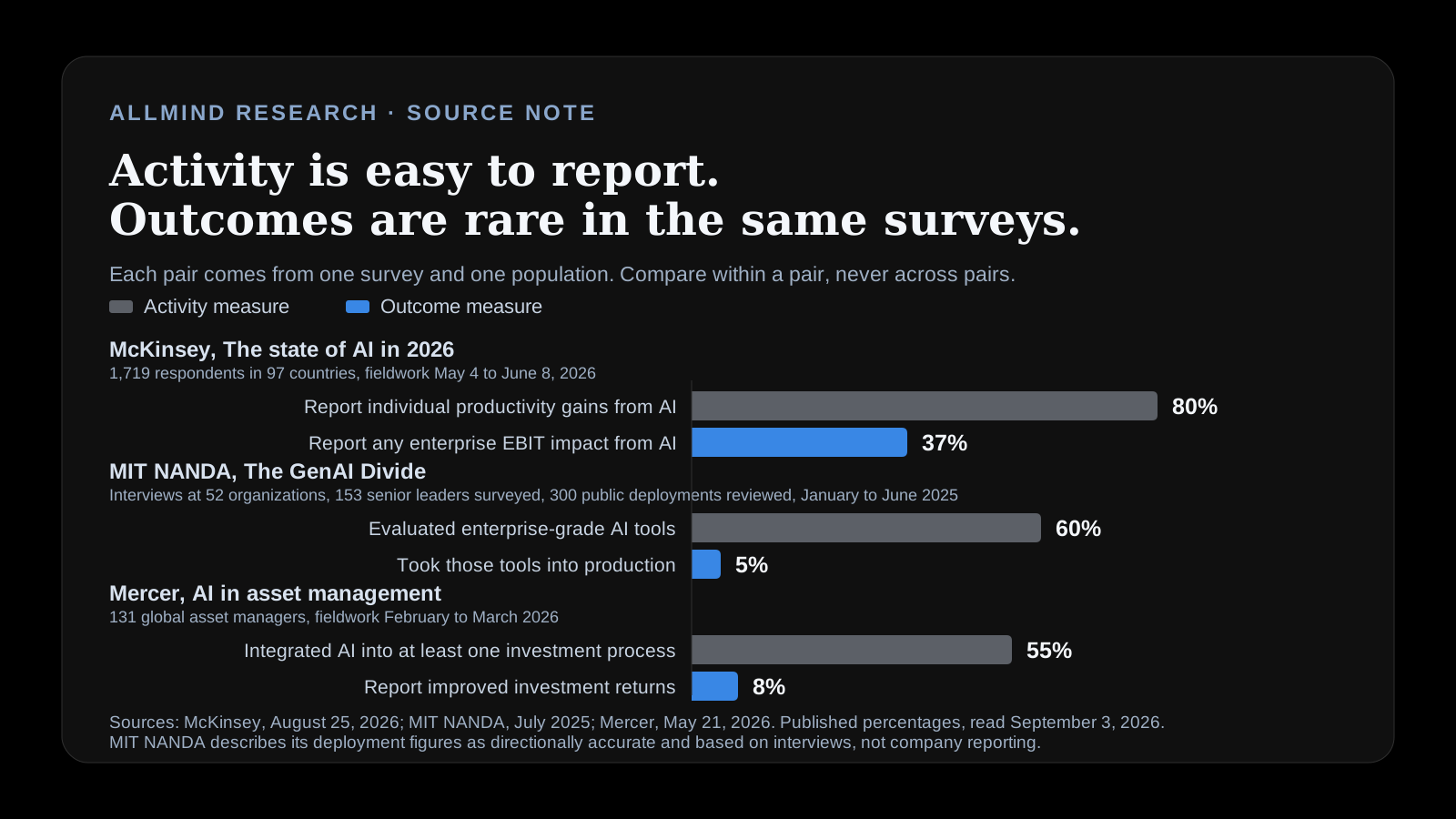
The published surveys describe the same gap, each inside its own population. LinkedIn's research on 1,252 C-suite leaders in the US, UK and India, reported by Fortune on June 18, 2026, found 78% saying they are moving faster on AI than they can effectively measure. McKinsey's State of AI survey published August 25, 2026, with 1,719 respondents, has 80% reporting individual productivity gains and 37% reporting any enterprise EBIT impact, flat on the prior year. About 6% qualify as high performers.
MIT NANDA's GenAI Divide report from July 2025 found that 60% of organizations had evaluated enterprise-grade AI tools, 20% had piloted them and 5% had taken them into production. That funnel is how the report reaches its headline that 95% of organizations are getting zero return. In our own industry, Mercer's survey of 131 asset managers found that 55% had integrated AI into at least one investment process while 8% reported improved returns. Our audited reading of those surveys keeps each percentage beside its population and its exact question.
| Survey and population | Activity measure | Outcome measure | Source and date |
|---|---|---|---|
| McKinsey, 1,719 respondents in 97 countries, fieldwork May 4 to June 8, 2026 | 80% report individual productivity gains from AI | 37% report any enterprise EBIT impact; about 6% are high performers | McKinsey, August 25, 2026 |
| MIT NANDA, interviews at 52 organizations, 153 senior leaders surveyed and 300 public deployments reviewed, January to June 2025 | 60% evaluated enterprise-grade AI tools | 5% took them into production; the report calls the figures directionally accurate and interview based | MIT NANDA, July 2025 |
| Mercer, 131 global asset managers, fieldwork February to March 2026 | 55% integrated AI into at least one investment process | 8% report improved investment returns | Mercer, May 21, 2026 |
Every new AI capability creates dependencies around it. It needs access to reliable data, appropriate permissions, the knowledge of relationships between data and systems, integrations with existing systems, evaluation frameworks, monitoring, governance, infrastructure, maintenance and clear ownership. This is an old lesson in machine learning. Google's engineers wrote in Hidden Technical Debt in Machine Learning Systems, presented at NeurIPS in 2015, that model code is a small fraction of a real system and that the data dependencies and configuration around it carry "massive ongoing maintenance costs" for as long as the system runs. Gartner made the same point about the current wave when it predicted in February 2025 that through 2026 organizations would abandon 60% of AI projects that are not supported by AI-ready data.
If those things are not built alongside the capability, what looks like progress may simply create more complexity. A pilot that cannot access trusted information, cannot be evaluated and has no clear owner is not yet an operating capability. It is a demonstration with a maintenance burden.
This is where many companies get caught. Executives feel pressure to move, so AI is added throughout the organization without reconsidering how the organization itself works. The old workflows, software, approval processes and reporting structures remain in place, with a new layer of AI sitting on top of them.
In the language of the birth-death process, there are plenty of births but almost no deaths.
Real Transformation Requires Subtraction
The goal of AI adoption should not be to preserve every existing process while adding more technology around it. It should be to improve how work gets done.
If AI can reduce a process from five manual steps to one, the objective should not be to keep the five original steps and add an AI tool as a sixth. If an agent can continuously monitor information that an employee previously had to collect manually, the old monitoring process should eventually disappear. If a unified intelligence layer can replace several disconnected systems, maintaining all of them indefinitely defeats much of the purpose.
This is where the harder executive decision begins. The question is not only what AI the organization should add. It is also what the organization is now willing to remove. Additions are relatively easy to announce. Retiring an established process, vendor, responsibility or organizational habit is much more uncomfortable. Existing systems have owners, budgets and internal constituencies. Even obviously inefficient workflows often survive because people understand them and have built their roles around them.
There is a cognitive reason as well as a political one. Across eight experiments published in Nature on April 7, 2021, Adams, Converse, Hales and Klotz found that people systematically overlook subtractive changes. When a task did not cue participants to consider removing something, they searched for things to add, and the bias grew under cognitive load. An executive team running an AI program at speed, with no prompt to subtract, is the textbook case.
The firms that get value seem to behave differently. BCG's survey of 1,000 executives published on October 24, 2024 found that only 26% of companies had built the capabilities to move beyond proofs of concept. The leaders among them pursued about half as many opportunities as their peers and put 70% of their AI effort into people and processes. McKinsey's 2026 survey reports that nearly three-quarters of its high performers had fundamentally redesigned workflows because of AI, up from 55% a year earlier.
Without these deaths, organizations accumulate technological and operational debt. AI becomes another layer that employees must manage rather than a force that simplifies how they work.
The companies that benefit most from AI will therefore not be the ones that deploy the largest number of tools. They will be the ones that allow useful capabilities to replace obsolete processes and then redirect people, capital and attention toward higher-value work. The goal is not to maximize births. It is to build an organization in which valuable capabilities can survive and compound while outdated processes are deliberately allowed to die.
A simple discipline keeps the ledger honest: write every birth next to the death it should cause, and name the sign that the death never happened. The pairs below are drawn from the research workflows this essay is about. They are illustrations, not measured results.
| The capability being added (birth) | What it should retire (death) | Sign that the death never happened |
|---|---|---|
| An agent that watches filings, transcripts and news for a coverage list | The manual morning sweep and the spreadsheet where it was logged | The analyst still runs the sweep to check the agent, so the desk carries both |
| A research system that answers questions across licensed data and internal documents | Two or three single-purpose subscriptions and the copy-and-paste steps between them | Renewal notices arrive for all of them and nobody owns the decision to cancel |
| A drafting assistant for memos and one-pagers | The template-filling stage and the review pass that only checked formatting | Review time is unchanged because the reviewer re-reads everything from scratch |
| A model-update workflow that pulls reported numbers into the spreadsheet | Hand-keying from the filing and the reconciliation step it required | The hand-keyed version survives as the official one |
Organizations Cannot Skip States
There is another lesson from the birth-death process that matters: systems move through states. An organization with fragmented data, unclear ownership and heavily manual workflows cannot suddenly become fully agentic because it purchased an enterprise license to the latest AI platform. There are intermediate states that must be passed through.
First, the relevant information has to become accessible. Then it has to be structured, connected and governed. AI systems need to retrieve it reliably and respect the permissions surrounding it. Their outputs need to be evaluated and monitored. Only then can individual workflows be automated with confidence. Once those workflows are reliable, they can begin interacting with one another. After those foundations exist, it becomes realistic to give agents greater autonomy across the organization.
| State | What has to be true before moving on | What breaks when it is skipped |
|---|---|---|
| 1. Accessible information | The documents, data and models the work depends on can be reached by a system, with their identity intact | Agents answer from whatever they can reach, which is usually the public web |
| 2. Structured, connected and governed | Entities, relationships and permissions are defined once and shared, and every dataset has a named owner | Two systems disagree about which company or which period a number belongs to |
| 3. Reliable retrieval within permissions | Every output can show its source, and a user sees only what they are entitled to see | A restricted document surfaces in the wrong hands, or a citation cannot be reopened |
| 4. Evaluated and monitored outputs | Accuracy is measured against a known answer set, and drift is watched over time | Trust is asserted instead of earned, and the first public error ends the program |
| 5. Individual workflows automated | One bounded job runs end to end with an owner and a stopping condition | Automating an undefined job produces plausible output that nobody can check |
| 6. Workflows interacting | Reliable jobs hand results to each other through defined interfaces | Errors compound across steps faster than a person can catch them |
| 7. Broader agent autonomy | The organization can detect a wrong action and roll it back | Autonomy is granted before the ability to notice a wrong action exists |
This does not mean that every company must follow a slow, perfectly linear transformation plan. Several parts of the system can be developed in parallel, and some organizations will move through the sequence much faster than others. But the underlying dependencies cannot simply be wished away.
A company cannot compensate for unreliable data by purchasing a more powerful model. It cannot solve unclear ownership by deploying more agents. It cannot create trust by skipping evaluation. Each capability depends on the state that came before it. Trying to jump from state one to state ten may create the appearance of speed, but it often produces systems that fail the moment they encounter the complexity of the real organization.
Gartner's forecast for the current wave reads like a description of skipped states. In June 2025 it predicted that more than 40% of agentic AI projects would be canceled by the end of 2027, citing escalating costs, unclear business value and inadequate risk controls. Its analyst described most of them as "early stage experiments or proof of concepts that are mostly driven by hype and are often misapplied."
MIT NANDA's interviewees gave more specific reasons: brittle workflows, a lack of contextual learning, and misalignment with day-to-day operations. Those are states two through four in the table above.
For a research desk, each state has a concrete form:
- Making internal research searchable is state one.
- A financial ontology is most of state two. We built AllMind's ontology for states two and three because those are the states most firms try to skip.
- The acceptance checklist for a research agent is how state five is passed rather than assumed.
- A compliance and recordkeeping baseline sits underneath all of them.
The C-Suite's Job Is to Manage the Transition
This is why I increasingly believe the job of the C-suite is not to predict exactly what AI will look like five years from now. No executive can know with confidence which models, interfaces or vendors will dominate that far into the future.
The more important job is to manage the transition between states.
Leadership has to determine which capabilities should be added, which existing processes should be removed and which foundations must be in place before the next capability can be introduced. It also has to recognize when the organization is trying to skip a state simply because executives are afraid of appearing too slow.
The best leaders I speak with are not necessarily the ones moving fastest. They are the ones thinking most clearly about sequencing. They understand that moving slowly in the wrong areas can be dangerous, but moving quickly without the necessary foundations can be equally destructive. Their objective is not to produce the largest possible portfolio of AI initiatives. It is to make a series of decisions that leave the organization in a stronger state each time.
That distinction matters because AI adoption is not a single technology purchase. It is an ongoing redesign of how information moves, how decisions are made and how work is organized. For a small fund the same logic shows up as a purchase order, which is why our buying sequence for small hedge funds puts records and licenses before models.
The Real Fear Is Getting the Sequence Wrong
In a traditional birth-death process, equilibrium can represent stability. In a competitive market, however, there is no true stationary state. Every organization exists relative to the organizations around it. If competitors are improving their decision-making, automating workflows, reducing costs and learning faster while your organization preserves the status quo, remaining unchanged internally does not mean you have remained unchanged competitively. Your relative state has declined.
That is why I do not think the deepest concern executives have about AI is that it will suddenly replace their company. The more realistic fear is that they will make the wrong sequence of decisions while everyone else continues moving.
Doing too little creates stagnation. Adding capabilities without the necessary foundations creates disorder. Adding AI without retiring anything creates complexity. And trying to skip intermediate states creates fragile systems that look impressive in a demonstration but fail to change how the organization operates.
The central question for executives is therefore not simply "How quickly can we adopt AI?" It is: how do we ensure that the right capabilities are being created, obsolete processes are being removed and every transition leaves the organization stronger than it was before?
The companies that answer that question well will not merely have more AI. They will have built organizations that are better able to absorb new capabilities, adapt to change and improve continuously. In a birth-death process, equilibrium may mean stability. In a market being reshaped by AI, stability is temporary, and standing still may be the riskiest state of all.
If you are in the middle of this transition, I would rather compare notes on which state your firm is in than show you a demo. We start every AllMind engagement by mapping the desk's current state, and we say so when a firm is trying to skip one.
Sources and methodology
This essay first appeared on my LinkedIn on September 3, 2026 and is republished here with the evidence links added. Its basis is private conversations with senior leaders across financial services; no firm is named, no conversation is quoted, and nothing here is a survey result unless it is linked to one. The survey figures are the publishers' own percentages, read on September 3, 2026, with each number's population and question kept beside it. Both figures are AllMind editorial figures: the first is a conceptual diagram with no data, and the second plots only the published figures listed in the table above.
- Birth-death process: the Wikipedia entry for the definition and the ergodicity conditions; Cont, Stoikov and Talreja, "A stochastic model for order book dynamics," Operations Research 58(3), 549 to 563, 2010, read as the authors' working paper.
- Activity and outcomes, surveys: McKinsey, "The state of AI in 2026," August 25, 2026. Its page timed out for our automated reader on September 3, so the figures were checked against two independent write-ups of the same report. Mercer, May 21, 2026, and Fortune's report of LinkedIn's C-suite research, June 18, 2026.
- Activity and outcomes, the pilot funnel: MIT NANDA, "The GenAI Divide: State of AI in Business 2025," July 2025, read as the v0.1 PDF. It describes its deployment figures as "directionally accurate based on individual interviews rather than official company reporting."
- Dependencies and data readiness: Sculley et al., "Hidden Technical Debt in Machine Learning Systems," NeurIPS 2015; Gartner press release of February 26, 2025, which blocks automated access, with the prediction's wording confirmed in CIO.com on February 25, 2026.
- Subtraction: Adams, Converse, Hales and Klotz, "People systematically overlook subtractive changes," Nature 592, 258 to 261, April 7, 2021; BCG press release, October 24, 2024.
- Skipped states: Gartner press release of June 25, 2025, which also blocks automated access, with the prediction and the analyst quote confirmed in CIO.com on February 18, 2026.
What I could not verify: McKinsey's primary page itself, which did not load for our reader on the day of writing; the Gartner press-release pages, which returned an access error; and whether LinkedIn published its C-suite research beyond the Fortune report. None of the AllMind statements above are survey findings, and none should be read as a claim about any named firm.