
SpaceX's Trillion-Dollar Option: What If Starship Makes Orbital Data Centers Economically Viable?
Source: seekingalpha.com
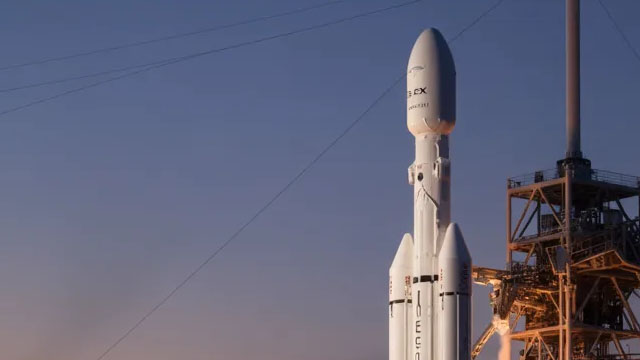
SpaceX's reusable Starship could materially reduce launch costs, enabling larger-scale satellite deployments and potentially AI data centers in orbit. The strategy could vertically integrate launch services, satellite manufacturing, communications and space-based computing, with solar power offering effectively zero marginal fuel cost. Key execution risks include orbital cooling constraints and hardware degradation in space.
Analysis
The investable implication is less the speculative orbital-compute narrative than a potential reduction in launch-cost barriers for the satellite ecosystem. Lower delivered-to-orbit costs would improve the economics of proliferated constellations, benefiting operators with scalable spectrum, ground infrastructure, and high-value connectivity demand; ASTS, IRDM and GSAT are more direct public read-throughs than conventional data-center names. Conversely, cheaper access to orbit could compress the scarcity premium embedded in incumbent satellite capacity and pressure legacy GEO operators whose economics rely on limited launch cadence and long asset lives.
The market is likely to overcapitalize the compute angle before a credible revenue pool exists. Power generation is not the binding constraint: heat rejection, radiation hardening, servicing, network backhaul, and launch-insurance economics can make orbital compute structurally more expensive than terrestrial AI clusters for years. The nearer second-order beneficiary could be defense and government communications spending, where resilience and latency-insensitive processing justify a premium; RKLB is better positioned than most public peers to capture higher launch cadence and spacecraft-manufacturing demand, though its valuation is sensitive to execution rather than the long-dated AI narrative.
Over the next 1-3 months, any enthusiasm is likely to flow through thematic proxies with limited fundamental revision, especially SPCX if its actual holdings and liquidity provide meaningful exposure. Over 6-18 months, the thesis requires independently observable evidence: repeatable heavy-lift cadence, disclosed payload pricing, satellite replacement-cycle reductions, and signed government or commercial contracts. Falsification would be launch delays, payload-cost reductions failing to translate into customer pricing, or terrestrial GPU power/cooling costs falling faster than space-system costs.
AllMind Terminal
AI-powered research, real-time alerts, and portfolio analytics for institutional investors.
Request TrialMarket Sentiment
Overall Sentiment
mildly positive
Sentiment Score
0.35
Ticker Sentiment
Key Decisions for Investors
- Do not establish a directional SPCX position solely on the orbital-AI thesis; first verify underlying holdings, concentration, AUM and daily liquidity. Treat any near-term move as sentiment-driven unless constituent-level earnings exposure can be identified.
- Watch-list long RKLB on evidence of contracted launch cadence or spacecraft backlog conversion over the next 2-4 quarters; use a 5-7% portfolio-risk stop because further launch delays or negative gross-margin guidance would invalidate the operating-leverage thesis.
- Prefer a selective basket of ASTS and IRDM over broad AI-infrastructure exposure for a 6-18 month horizon, sized small and paired against an equal-dollar short in a high-multiple terrestrial AI-infrastructure proxy only after confirming contract/backlog catalysts. The intended payoff is satellite-connectivity rerating without paying for unproven orbital compute revenue.
- Avoid chasing VRT, ETN or conventional data-center REITs on this development: the plausible medium-term effect is competitive optionality, not a near-term reduction in terrestrial AI power demand. Reassess only if a funded orbital-compute customer contract specifies compute capacity, network architecture and delivered cost.
More News
- Anthropic warns government attitudes may hurt customer ties, IPO prospectus shows: Reuters
- Broadcom, Amazon Test Limits of Investor Demand for AI Buildout
- Nasdaq Index: Record High as Weak Payrolls Cut Rate-Hike Bets and Yields Fall
- Google has been playing catch up with OpenAI and Anthropic. Does its new flagship model really compete at the frontier?
- When pre-IPO shares are too good to be true
- SpaceX stock rises 6% as Musk targets 250kW Nvidia AI system power
From AllMind Research
- Anthropic IPO Preview: Valuation, Timing, and What to Watch
- Shein After the IPO: Venue, Valuation, and What Must Be Proved
- What AI Research Tools Should a Small Hedge Fund Buy First?
- AI Tools for Family Offices: A Stack by Decision Type
- Reading Conviction in the Tape: What Level 3 Order Book Data Really Tells Discretionary PMs