
AmeriTrust Solutions Expands Point-of-Care Medicaid Application Support to All 50 States
Source: PR Newswire
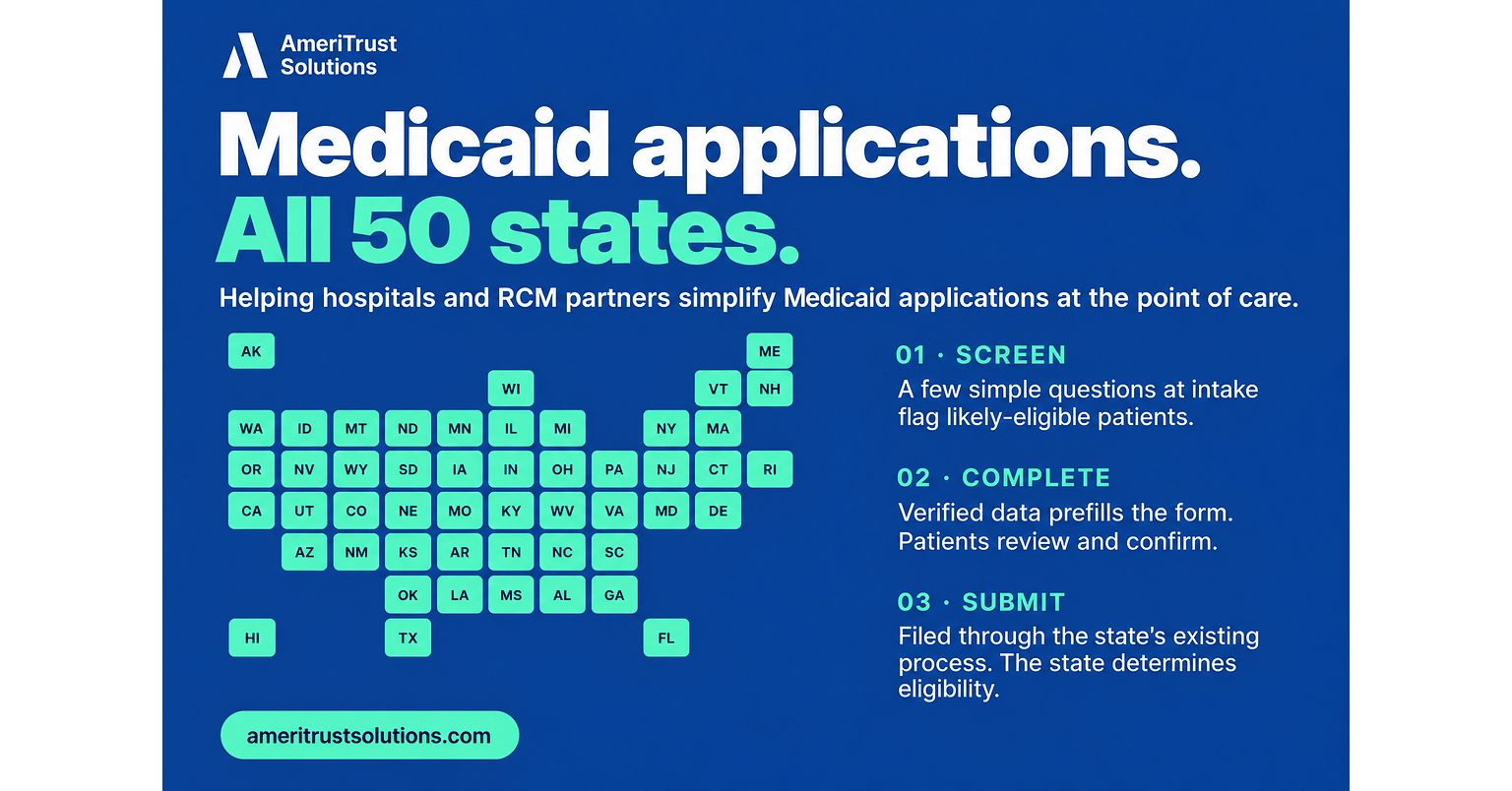
AmeriTrust Solutions announced its Medicaid application platform is available in all 50 U.S. states, offering hospitals and revenue cycle management partners a way to help eligible patients submit applications alongside existing workflows, without a major IT project. The company says hospitals may begin pursuing Medicaid reimbursement within weeks, depending on state eligibility decisions and claims processing. The release cites $42.7 billion in uncompensated care provided by U.S. community hospitals in 2020.
Analysis
The economic upside is a conversion problem, not a software-launch story: value accrues only if the tool materially raises completed applications, those applicants qualify, and claims are paid. For hospitals, converting otherwise-unpaid care into Medicaid reimbursement can help cash collection, but it may also replace self-pay or charity exposure with lower-rate Medicaid revenue; the net benefit depends on eligibility, denial rates, and incremental workflow cost. Safety-net and rural hospitals have the clearest potential sensitivity, though deployment claims are not evidence of adoption or realized collections.
The contrarian risk is that policy tightening under H.R.1 could increase application activity while reducing approval rates or adding renewal friction. That would raise administrative workload without a commensurate reimbursement gain. Meanwhile, established RCM vendors can bundle enrollment assistance into broader contracts, limiting standalone pricing power and raising the bar for AmeriTrust to prove workflow integration and measurable lift. The cited uncompensated-care figure is historical and does not establish the current addressable market.
Near term, this is not a sufficiently verified signal for a public-equity trade. Over 1–3 months, watch for named hospital deployments and disclosed application-to-approval and paid-claim conversion. Over 6–18 months, the key test is whether state-by-state policy changes and renewal requirements produce persistent reimbursement gains rather than a temporary intake bump. A thesis based on hospital benefit weakens if approvals or collections fail to improve, or if implementation burden offsets recovered revenue.
AllMind Terminal
AI-powered research, real-time alerts, and portfolio analytics for institutional investors.
Request TrialMarket Sentiment
Overall Sentiment
mildly positive
Sentiment Score
0.25
Key Decisions for Investors
- No immediate trade on the launch announcement: AmeriTrust is not identified as a listed company in the supplied data, and adoption, pricing, and conversion outcomes are undisclosed.
- Watch hospital operators with meaningful safety-net or rural exposure for evidence of improved Medicaid collections, not application volume alone. Verify payer mix, approval rates, denial rates, days-to-cash, and whether recovered payments are incremental to existing enrollment efforts before expressing a long view.
- Treat established RCM providers as potential competitive beneficiaries if they add comparable enrollment workflows, but do not assume revenue materiality without product disclosure or customer wins; bundling could commoditize a standalone offering.
- Reassess after H.R.1 implementation details and initial state-level data. Falsifiers include declining application approval or paid-claim conversion, rising processing delays, or hospital disclosures that administrative costs offset recovered reimbursement.
More News
- Asia stocks fall as AI rout batters S.Korea; Japan spooked by strong CPI
- SK Hynix shares slide after chipmaker scraps Solidigm IPO plans
- Why is SK Hynix stock sliding today?
- Apple’s iPhone Duo Hits Stores in Face of Short Supply and High Demand
- Gold Holds Near Three-Month Low as AI Jitters Fuel Volatility
- OpenAI nears up to $30 billion funding round at $1.25 trillion valuation led by UAE investors