
Intersignal Demonstrates Cross-Network Context Continuity Between Local AI Models
Source: PR Newswire
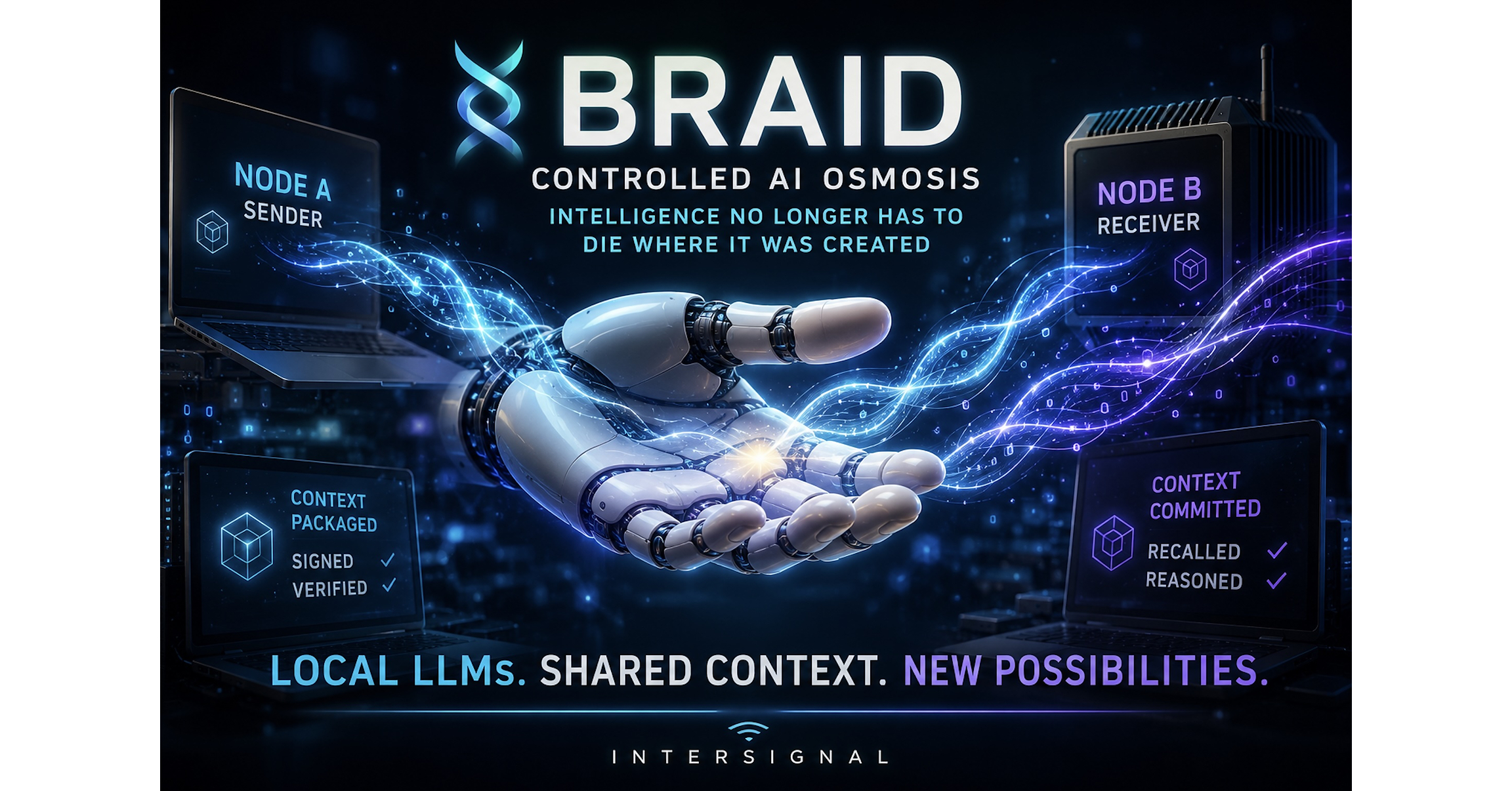
Intersignal announced a successful physical demonstration of Braid 1.6, showing authenticated “Semantic Capsule” context transfer where a second local model corrected a prior wrong decision after receiving signed situational facts and rules. The system avoids transferring model weights or hidden states, instead using receiver-controlled commitment to verify and store context for later local reasoning. The company also opened Braid Founding Membership at $99/year (core LAN software remains free), suggesting early commercialization but with limited immediate market impact.
Analysis
This reads more like an architectural proof than an investable product launch. The important market implication is not model quality; it is whether a portable, signed context layer becomes an enterprise control point for AI workflows. If that happens, value migrates away from proprietary “memory” features inside large model platforms and toward middleware that can authenticate, route, audit, and revoke context across devices.
Near term, the likely winners are edge/endpoint compute, private inference stacks, and security vendors that can sell identity, provenance, and policy enforcement around local AI. The subtle loser is any cloud AI provider whose moat depends on users staying inside one vendor’s session state; interoperability reduces switching costs and makes model choice more fungible. That said, this is still an early hobbyist-to-early-adopter signal, not evidence of material demand, so the revenue impact is probably measured in quarters-to-years, not days.
The main risk is that enterprise adoption stalls on trust rather than capability: signed context still needs revocation, DLP, audit trails, and admin controls before regulated users care. A faster cloud-native answer from MSFT/GOOGL/AMZN could also neutralize the thesis by bundling equivalent memory/state services into existing platforms. The contrarian read is that the real bottleneck may be workflow interoperability, not model intelligence; if true, the economic prize is in data governance and orchestration, not the model layer itself.
AllMind Terminal
AI-powered research, real-time alerts, and portfolio analytics for institutional investors.
Request TrialMarket Sentiment
Overall Sentiment
mildly positive
Sentiment Score
0.25
Key Decisions for Investors
- No immediate equity trade; treat this as a watch item until there is evidence of paid enterprise deployments or audited security controls. Reassess only if adoption moves beyond hobbyist usage in the next 1-2 quarters.
- Build a small thematic watch basket in CIBR and PANW for a 6-12 month horizon: if local AI context transport gains traction, the need for provenance, identity, and policy enforcement should raise attach rates for security vendors.
- Avoid chasing MSFT/GOOGL downside on this release alone; the better short would require proof that their AI session-state lock-in is actually being displaced. Set an alert if one of them announces native cross-device context portability.
- If you want an asymmetric proxy trade, consider a modest long in endpoint/edge compute beneficiaries such as DELL or HPE on any confirmation of enterprise pilots; local-first AI increases demand for on-prem and workstation inference, but only after real deployments appear.
- Falsifier: if no enterprise-grade feature set or third-party integrations emerge within 1-3 months, assume the signal is non-monetizable and fade any thematic upside in privacy/AI-infrastructure names.
More News
- CoreWeave credit default swaps hit distress levels as investors sour on AI debt
- Treasuries Soar as Tech Slump Threatens Growth
- Blackstone President Jon Gray Bets Big on AI Boom
- Suddenly, Wall Street is worried that the U.S. economy is more ‘vulnerable’ than it looks
- Ukraine to resume strikes on Russian refineries, shattering hopes of an 'energy ceasefire'
- AI Selloff Deepens in Asia as Funding Fears Mount