
Huawei Digital Power prezentuje na IDEE 2026 przeznaczone do różnych zastosowań rozwiązania wykorzystujące formowanie sieci i AI
Source: PR Newswire
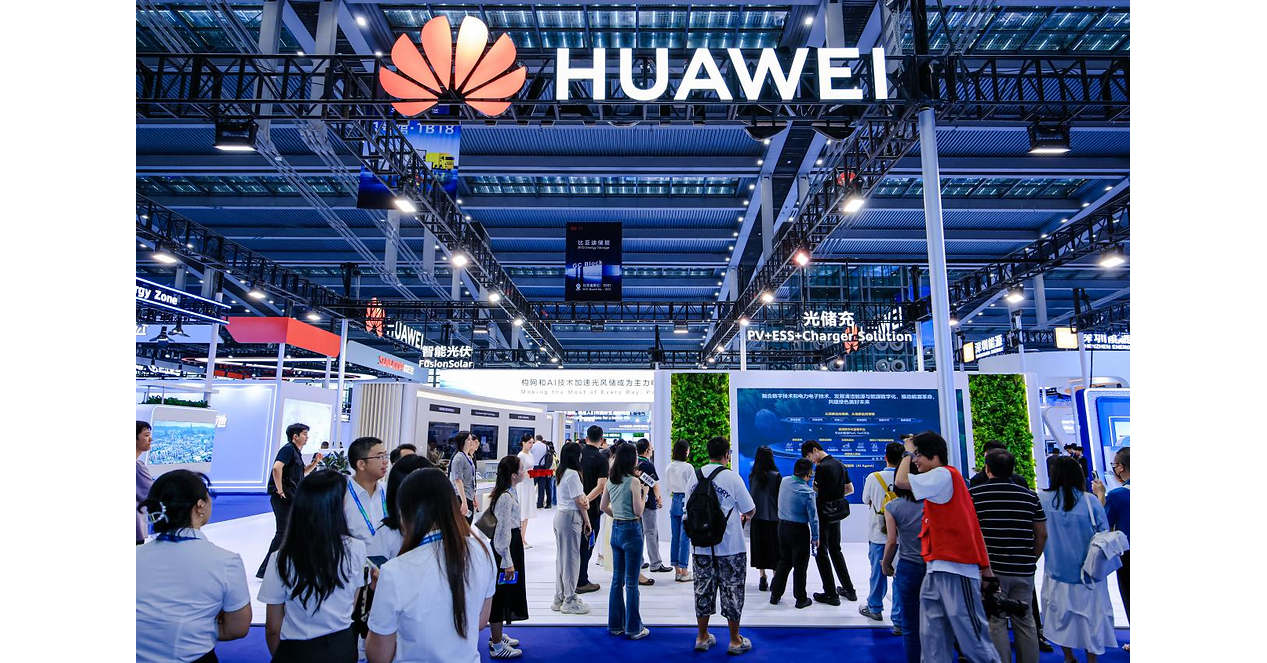
Huawei Digital Power unveiled grid-forming and AI-enabled renewable-energy, storage, microgrid, EV-charging and AI data-center solutions at IDEE 2026. Its Smart String Grid Forming ESS supports a 12.5 MW/50 MWh configuration, while the C&I Hybrid Cooling ESS delivers 91.8% round-trip efficiency and 100% depth of discharge. Huawei said its AI-scheduled FusionCharge PV+ESS charging platform can increase station revenue by more than 15%, and its Smart I-V Curve Diagnosis became the first industry solution to receive China General Certification Center's L5 certification.
Analysis
This is more strategically relevant for grid-scale storage and inverter competition than for Huawei itself, which is not investable in public markets. If grid-forming capabilities become a tender prerequisite in weak-grid renewable markets, the pricing power shifts from commoditized PV hardware toward controls, power electronics and software-enabled O&M; that raises competitive pressure on Sungrow (300274.SZ), Sineng (300827.SZ) and, at the premium end, Fluence (FLNC) and Wärtsilä (WRT1V.HE). The near-term financial impact is unverified: product-level efficiency and revenue claims should not be capitalized until they appear in awarded projects, backlog conversion, and gross-margin data.
The more investable second-order angle is AI data-center power architecture. Grid-interactive UPS, battery storage and liquid cooling can expand the addressable content per megawatt for Eaton (ETN), Vertiv (VRT) and Schneider Electric (SU.PA), but Huawei's bundled offering could constrain pricing in markets where it remains eligible, especially China, the Middle East, Latin America and parts of Africa. Over 6-18 months, data-center operators facing interconnection delays may increasingly procure behind-the-meter storage and microgrid capability; this favors suppliers with bankable field performance and local service networks rather than vendors with only technical specifications.
Consensus may overread a trade-show launch as immediate share capture. Grid-forming equipment has long utility qualification cycles, and the binding constraint is often grid-code certification, project financing, warranty underwriting and local procurement rules—not inverter features. Conversely, the risk to incumbents is underappreciated if grid instability and AI-load growth cause developers to standardize grid-forming requirements before the next large storage procurement cycle.
Key falsifiers are evidence that storage tenders continue to select on upfront price alone, a slowdown in AI data-center power orders, or meaningful restrictions on Huawei's ability to supply targeted export markets. The practical catalyst window is 1-3 months for announced framework wins and 6-12 months for tender specifications, backlog, and margin evidence.
AllMind Terminal
AI-powered research, real-time alerts, and portfolio analytics for institutional investors.
Request TrialMarket Sentiment
Overall Sentiment
mildly positive
Sentiment Score
0.38
Key Decisions for Investors
- No directional trade on the announcement alone; establish an alert for utility-scale ESS or inverter framework awards in China, GCC, Latin America and Africa that explicitly require grid-forming functionality. Treat repeated Huawei wins as a negative read-through for FLNC and premium inverter margins, not as a standalone signal.
- Maintain a 6-12 month overweight bias in ETN and VRT versus FLNC: AI-related power-density and cooling spend has clearer public-market earnings transmission, while FLNC remains more exposed to storage project timing and competitive pricing. Reassess if ETN/VRT order growth decelerates materially or valuation expands without corresponding backlog upgrades.
- Watch a relative-value short thesis in FLNC only if disclosed backlog conversion weakens while Chinese vendors win export ESS tenders on price; use a long ETN or VRT hedge to isolate storage-vendor execution risk. Do not initiate without tender, pricing, and regional revenue data.
- Monitor Sungrow (300274.SZ) quarterly for grid-forming storage mix, overseas gross margin and receivables. A sustained mix upgrade with stable receivables would indicate that the category is monetizing rather than merely adding cost and could invalidate a broad bearish view on Chinese power-electronics margins.
More News
- Wall Street’s Nasdaq hits all-time high as AI frenzy gathers pace
- Oil falls on increased Gulf supply and hopes for US-Iran talks
- Data-Center Bet Makes ESDS One of India’s Best New Listings
- Dollar holds near 2-month high as markets weigh rate hikes, Iran diplomacy
- Asia stocks ride tech wave higher, oil stays subdued
- South Korean solar stocks jump as curbs on Chinese sector expected to remain in place