
AI boom risks widening divide between rich and poor nations as major study from Ayre Think Tank reveals $360 billion divide
Source: PR Newswire
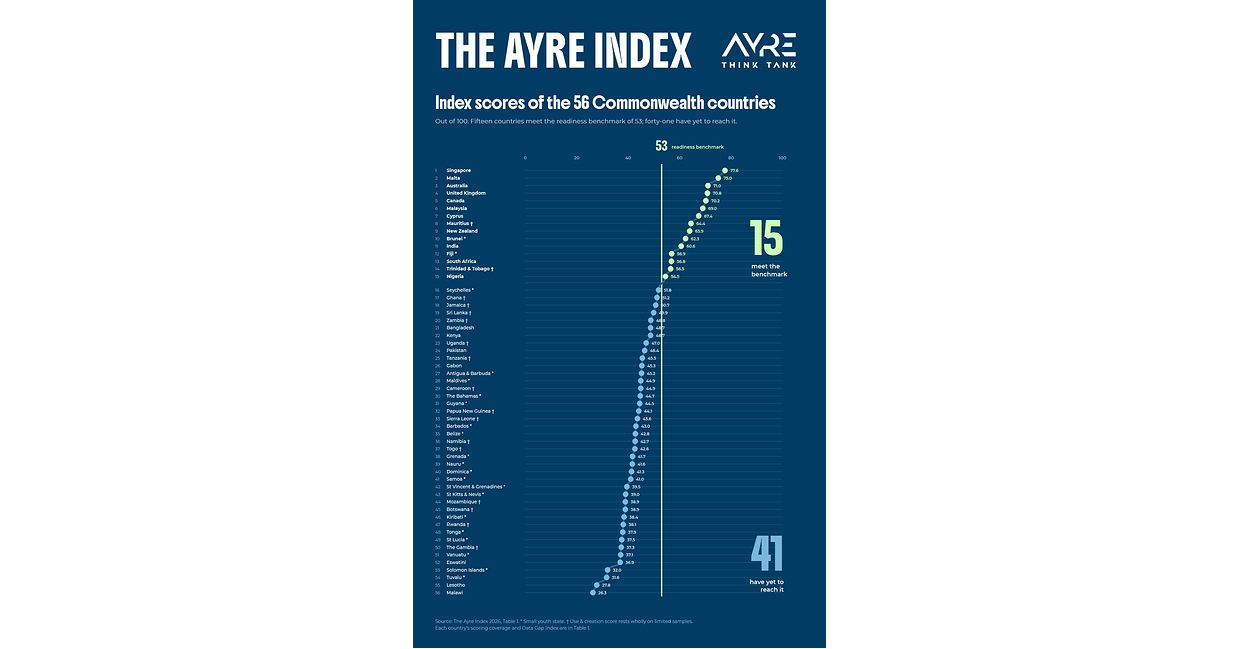
A study estimates a $360 billion gap in potential 10-year economic gains between 15 Commonwealth countries meeting its youth AI-readiness benchmark ($389.2 billion combined) and 41 countries that do not ($29.2 billion). The index covers 732 million people aged 15–29 across 56 member states and warns that connectivity alone is insufficient; skills, employment pathways and support for entrepreneurs will shape who benefits. It also highlights weak comparable data and persistent barriers, including youth unemployment of 46.3% in South Africa.
Analysis
The investable signal is a constraint on AI adoption, not evidence of a near-term demand shock. Network coverage alone may not monetize: low device affordability, unreliable power, weak digital skills and few employment pathways can leave telecom and cloud capacity underused. That argues against treating emerging-market population size or AI enthusiasm as a proxy for near-term revenue. It also shifts potential value toward firms that can bundle access, training and workflow tools—not simply sell infrastructure—though the study does not establish which providers can capture that value.
The 10-year economic scenarios are not company earnings forecasts. The index’s limited comparable data and modeled outcomes make country rankings a weak basis for repricing public equities. Near term, the likely market impact is modest; over 1–3 months, watch for government budgets, procurement and telecom investment plans that convert readiness gaps into funded programs. Over 6–18 months, power reliability, affordable connectivity and measurable paid AI usage matter more than coverage or survey enthusiasm.
Contrarian angle: the readiness gap may be overstated as a predictor of who captures AI value. Low readiness can create catch-up opportunities, but only where financing and institutions support adoption. Until that conversion is visible, avoid paying for a broad “AI in emerging markets” theme.
AllMind Terminal
AI-powered research, real-time alerts, and portfolio analytics for institutional investors.
Request TrialMarket Sentiment
Overall Sentiment
mildly negative
Sentiment Score
-0.20
Key Decisions for Investors
- No immediate position on this study alone; its long-horizon modeled GDP effects do not provide a near-term earnings catalyst.
- Treat telecom and digital-infrastructure exposure in lower-readiness markets as conditional: verify power availability, affordability, utilization and ARPU trends before assuming coverage expansion lifts returns.
- For a 1–3 month watchlist, track funded public-sector digital-skills and connectivity programs, procurement awards, and operator capex guidance; announcements without budgets or adoption metrics are not a catalyst.
- Revisit a selective catch-up thesis only if paid AI usage and business formation improve alongside electricity and internet access. Falsify it if spending is delayed or usage fails to translate into revenue; the study alone does not support a quantified target or options trade.
More News
- Magnificent 7 loses $1 trillion. The most eye-popping stats from Thursday's tech stock plunge
- Tech stocks are suffering their biggest selloff since Covid, as investors see premature end to AI datacenter boom
- Wall Street’s best post-midterm rally in 44 years lasted just one day—then $3 trillion vanished as chip stocks plunged over AI fears
- How Wall Street's postelection rally got obliterated — and what's next
- Elon Musk's Tesla and SpaceX lose over $420 billion in combined market cap after midterms
- AI stocks plunge after election, driving down US markets