
Democrats Return to Washington Eager to Flip House and Take on Trump
Source: Bloomberg
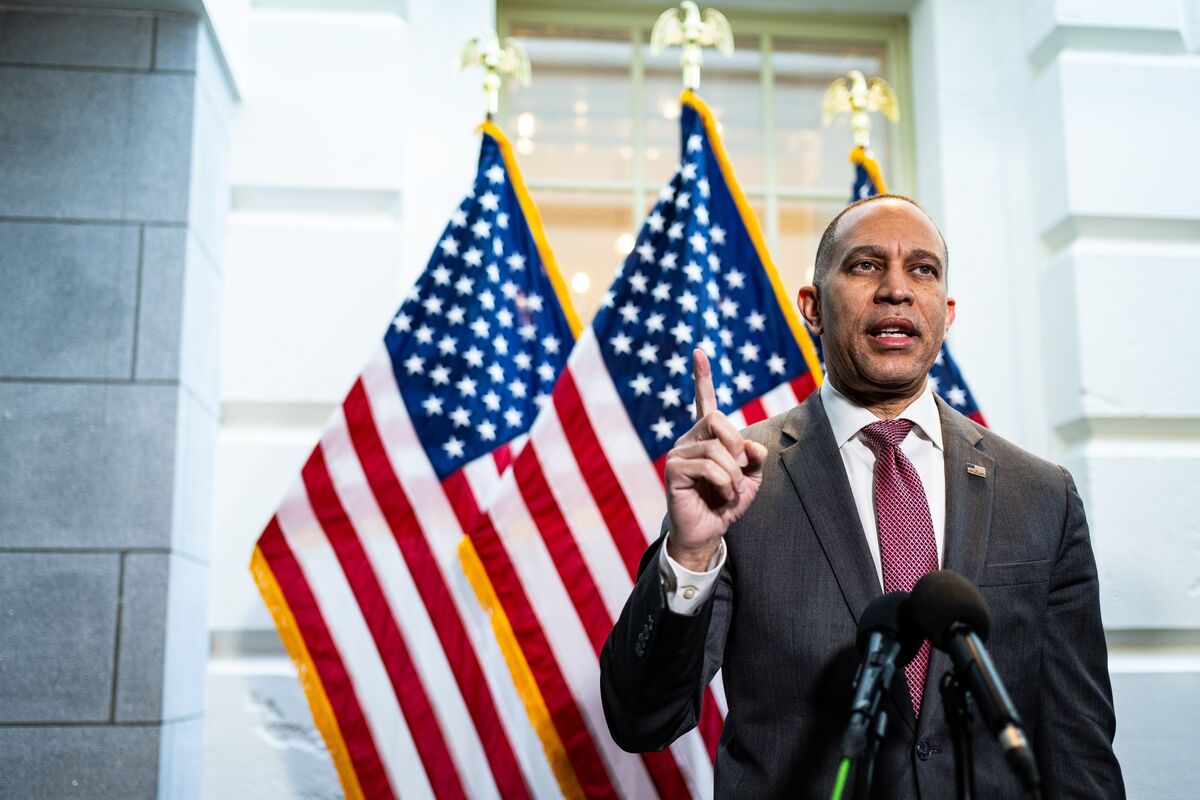
Reporting notes Democrats are entering the final stretch of an effort to flip the House, with Trump-related fundraising and ad spending ramping up nationwide. It also flags renewed US-Iran fighting and Ontario’s Premier making remarks about “Lake America,” but provides no specific economic or market-impact figures.
Analysis
This is more of a flow and positioning story than a first-order earnings event. The immediate winner set is the political-ad supply chain: local broadcasters, CTV, and the digital ad duopoly should capture incremental spend as campaigns accelerate, but the revenue bump is short-duration and often partially pre-booked, so the market usually overstates the net impact on full-year fundamentals. The cleaner trade is on names with concentrated political inventory and operating leverage, not on the broad market.
The bigger second-order effect is policy optionality, but that only matters if the House flip probability becomes durable. A Democratic House would mainly change oversight intensity, subpoena risk, and headline volatility for healthcare, platforms, energy, and large-cap industrials; it does not automatically translate into legislation without the Senate. That means any valuation impact should be modest until polling confirms a real shift — otherwise you get a lot of noise and not much beta.
Contrarian view: consensus tends to overtrade the partisan headline and undertrade the actual spend cycle. If the race tightens into the final month, ad inventory inflation can help META/GOOGL/ROKU and local-TV proxies, while if momentum fades, those tailwinds vanish quickly and the “policy risk” premium in regulated sectors should unwind. The falsifier is polling: if House odds revert before early voting, this becomes a non-event for portfolios.
AllMind Terminal
AI-powered research, real-time alerts, and portfolio analytics for institutional investors.
Request TrialMarket Sentiment
Overall Sentiment
neutral
Sentiment Score
-0.05
Key Decisions for Investors
- No broad index trade yet; wait for credible polling to show a sustained Democratic House probability above 60% before taking any policy-beta position.
- Tactical long basket: NXST / TGNA / FOXA vs SPY for the next 4-8 weeks; target 5-10% upside if political CPMs re-accelerate, with a tight stop if ad-tracking data disappoints.
- If campaign spend shifts decisively into digital, rotate into META / GOOGL call spreads for election-season optionality; use 1-2 month tenor to avoid paying for post-election decay.
- Set a watchlist short on policy-sensitive healthcare/managed-care names via XLV or UNH only if House-flip odds stay elevated into October; otherwise the regulatory premium is likely to mean-revert.
More News
- Brian Sullivan: Why the 'real' price of oil is likely $30-$40 higher than where it is now
- Latest Oil Market News and Analysis for Oct. 16
- How the Houthis are helping Iran turn Saudi Arabia into a pressure point
- Ukraine to resume strikes on Russian refineries, shattering hopes of an 'energy ceasefire'
- Chevron CEO warns oil buffers that cushioned the Iran war shock have been ‘drained’—and diesel relief may not come until 2027
- International Energy Agency to release more than 20 million barrels of diesel as soon as possible