
Envision Energy Unveils EN-252/16.7 Offshore Wind Turbine to Deliver High Performance and Reliability in High-Wind Environments
Source: PR Newswire
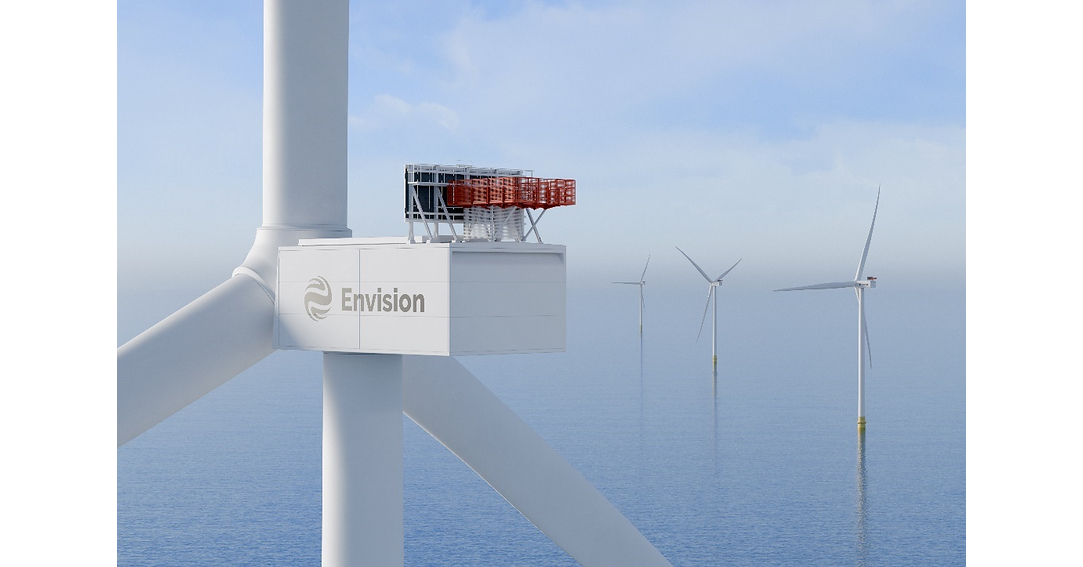
Envision Energy launched its EN-252/16.7 offshore wind turbine, rated at 16.7 MW and designed for high-wind international offshore projects. For a gigawatt-scale wind farm, the company estimates 1-2% higher annual energy production, roughly 10% fewer turbines, and a 2-4% reduction in levelized cost of energy versus currently available turbines. The platform adds grid-forming, black-start and energy-storage integration capabilities, alongside Galileo AI monitoring that can identify potential faults about one to six months in advance.
Analysis
This is principally a procurement-cost signal rather than an immediately monetizable public-equity catalyst: fewer units per project can lower foundations, array-cable, installation-vessel and maintenance complexity, but it also concentrates execution risk into a smaller number of very large machines. The likely near-term beneficiaries are offshore developers with uncontracted late-stage projects and strong balance sheets—ORSTED.CO, RWE.DE and EDPR.LS—if turbine competition translates into lower EPC bids; fixed-price legacy projects receive little benefit. Installation and service providers such as CADLR.OL and Deme’s parent group CFE.BR face a mixed outcome: lower turbine counts reduce repetitive installation days, while higher lift capacity and weather-window requirements raise vessel scarcity premiums.
The competitive implication is more important than the launch itself. Vestas (VWS.CO), Siemens Energy (ENR.DE) and GE Vernova (GE) must defend pricing and warranty terms in a market where developers have been constrained by a shallow qualified-supplier base. A credible additional supplier could reduce OEM bargaining power over the next 12-24 months, but European bankability, local-content compliance, certification, service-network depth and financing acceptance remain the gating items; prototype claims and accelerated testing are not substitutes for multi-year field availability data.
Consensus may over-credit a headline LCOE benefit. Turbine availability and warranty reserves dominate the realized economics of next-generation offshore equipment: a 1% availability shortfall can erase much of the modeled energy-production uplift, particularly when power-price capture is weak during windy periods. The more constructive contrarian angle is that grid-forming and backup-power capability may have greater value than nameplate scale in constrained European grids, potentially improving project financing terms once utilities and lenders validate it. Monitor awards, certification milestones, warranty structure and financing-bank acceptance over the next 6-18 months rather than treating the launch as evidence of share gains.
AllMind Terminal
AI-powered research, real-time alerts, and portfolio analytics for institutional investors.
Request TrialMarket Sentiment
Overall Sentiment
moderately positive
Sentiment Score
0.48
Key Decisions for Investors
- No directional position solely on this launch; set an alert for a named European project award, third-party certification and disclosed warranty/availability guarantees. Those are the first evidence that can affect VWS.CO, ENR.DE or GE order-pricing assumptions within 1-3 months.
- Watch-list pair for a 6-18 month catalyst path: long ORSTED.CO or RWE.DE / short VWS.CO only if Envision secures a financeable European order and OEM bid data show price pressure. Target a 10-15% relative move; exit if Vestas maintains order intake and service-margin guidance or the entrant lacks certification/financing acceptance.
- Avoid treating reduced turbine count as unambiguously bullish for CADLR.OL or CFE.BR. Add only if contract terms demonstrate higher crane/vessel day-rates offset lower unit volumes; otherwise large-turbine adoption risks volume pressure on installation activity.
- For GE and ENR.DE, monitor warranty provisions and offshore-service margin at the next two earnings releases. Any reserve build or lower-margin backlog tied to competitive bidding would be a cleaner short catalyst than the product announcement; absence of margin deterioration falsifies the competitive-pressure thesis.
More News
- SEBI Allows Portfolio Managers to Invest Overseas, Short Equity Options
- Trump, Xi Address AI, Taiwan During State Visit
- Oracle Japan shares surge 7% after record fiscal first quarter, bucking selloff of U.S. parent
- China's Xi urges U.S. to cooperate on AI
- Trump Hosts China’s Xi With Trade, AI, Taiwan in Focus
- Here’s the Tesla Semi… again