
Seoul National University of Science and Technology Develops AI Framework to Test and Improve Vision-System Robustness
Source: PR Newswire
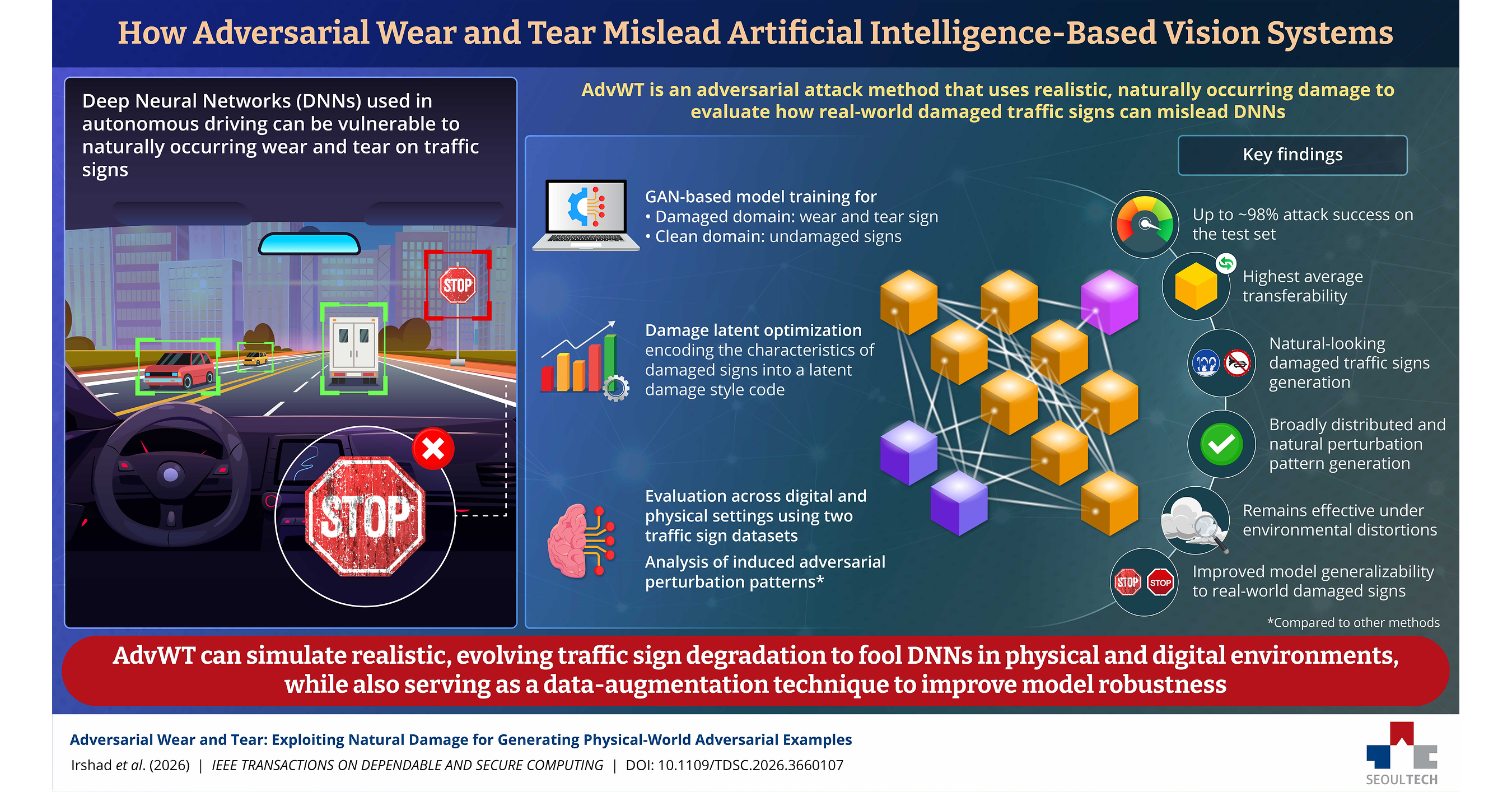
Researchers from SEOULTECH developed AdvWT, a framework that uses realistic wear-and-tear patterns (e.g., fading, cracks, corrosion) as an adversarial signal to test AI vision systems. Across two traffic-sign datasets and eight recognition architectures, AdvWT achieved near-perfect attack success on lightweight CNNs (e.g., ResNet-18, MobileNet) and stayed effective on transformer-based models, with strong transferability across architectures. In physical tests with printed speed-limit signs, the adversarial effect persisted after printing and recapturing in varied indoor/outdoor conditions, while training with AdvWT-generated damaged signs improved generalization to real-world damaged signs.
Analysis
The immediate market read is not about the research itself; it is about the widening gap between benchmark AI performance and deployable, edge-case robustness. That gap is a tailwind for verification, simulation, sensor-fusion, and test-instrumentation vendors, while pressuring pure-play autonomy narratives that depend on flawless camera-only or perception-led performance. In practice, the first-order loser is not hardware but valuation multiples for companies selling "near-autonomy" timelines without a credible safety-case stack.
Over the next 1-3 months, expect this to show up less in earnings revisions than in language around validation spend, red-teaming, and certification cycles. Any OEM or robotaxi operator that is forced to add synthetic-data generation, scenario libraries, and model monitoring raises unit economics but also creates a durable recurring revenue lane for tools that can prove robustness. The second-order winner set is broader than automotive: industrial robotics, warehouse automation, and defense autonomy all face the same physical-world brittleness, which should support names tied to testing and industrial AI assurance.
Contrarian view: the consensus may overreact by treating this as a drag on autonomy adoption, when the more likely outcome is higher gross margin for the software/tooling layer and slower commercialization for the application layer. The key falsifier is management commentary showing no incremental spend on validation or no delays in deployment roadmaps; absent that, this is a structural budget shift, not a headline-driven de-risking event. Six to eighteen months out, the real beneficiary should be the "picks-and-shovels" stack for model verification, not the apps that claim perfect real-world generalization.
AllMind Terminal
AI-powered research, real-time alerts, and portfolio analytics for institutional investors.
Request TrialMarket Sentiment
Overall Sentiment
mildly positive
Sentiment Score
0.20
Key Decisions for Investors
- Long ANSS / KEYS on a 3-12 month horizon as a basket expressing rising AI validation and simulation spend; use a modest starter position because the catalyst is budget reallocation, not a near-term earnings step-up.
- Avoid chasing small-cap autonomy/software names with weak disclosure around safety-case testing; if any of MBLY, LAZR, or similar names trade up on "AI robustness" narratives without evidence of higher validation spend, fade the move.
- Pair trade: long software/test infrastructure vs short autonomy application beta (e.g., long ANSS, short MBLY) to isolate the rising cost of proving robustness; thesis breaks if MBLY shows accelerating OEM design wins and improved margin without higher validation expense.
- Set an alert for any OEM or robotaxi earnings call that mentions synthetic data, scenario libraries, or edge-case testing budgets increasing by >10%; that would confirm the structural spend shift and justify adding to verification-tool beneficiaries.
More News
- CoreWeave credit default swaps hit distress levels as investors sour on AI debt
- Treasuries Soar as Tech Slump Threatens Growth
- Blackstone President Jon Gray Bets Big on AI Boom
- Suddenly, Wall Street is worried that the U.S. economy is more ‘vulnerable’ than it looks
- Ukraine to resume strikes on Russian refineries, shattering hopes of an 'energy ceasefire'
- AI Selloff Deepens in Asia as Funding Fears Mount
From AllMind Research
- Anthropic IPO Preview: Valuation, Timing, and What to Watch
- Shein After the IPO: Venue, Valuation, and What Must Be Proved
- What AI Research Tools Should a Small Hedge Fund Buy First?
- 2026 Global Markets Outlook: Asset Allocation After the Great Disconnect
- Fintool Alternatives After the Microsoft Acquisition