
Xynova Dexterous Hands: Programmable Dexterity for the Physical World
Source: PR Newswire
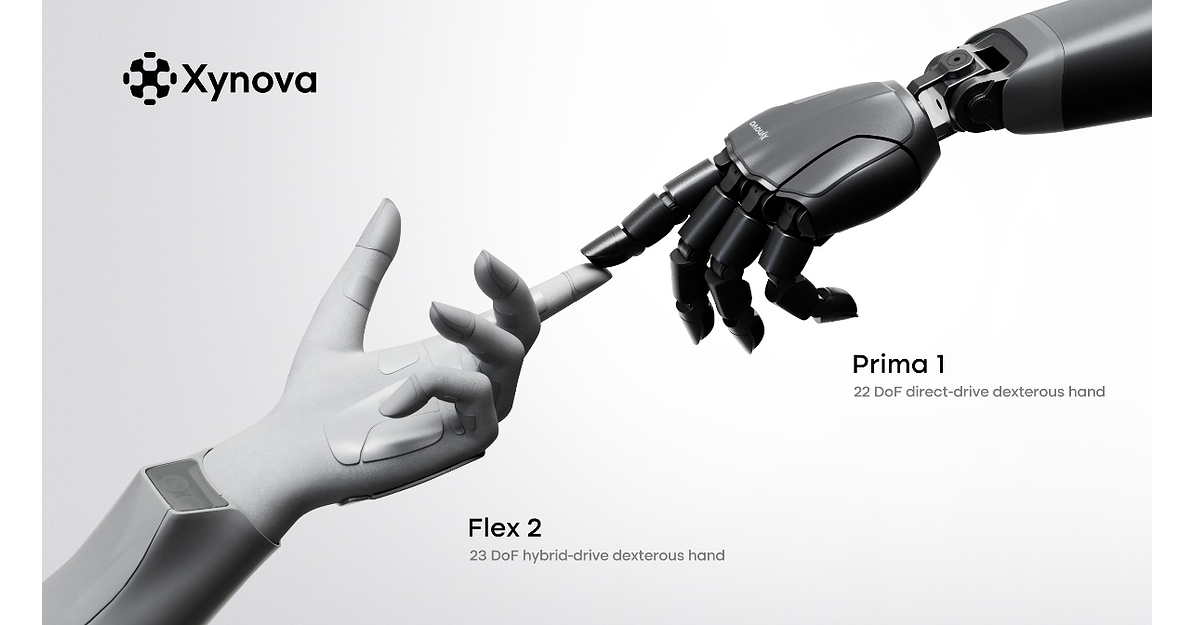
China-based robotics startup Xynova, founded in 2024, says it reached unicorn status in under two years and has raised RMB 1.5 billion (about $220 million) from investors including CATL, Xiaomi, JD.com and Meituan. The company launched the 23-DoF, 400-gram Flex 2 hybrid-drive hand and the 22-DoF direct-drive Prima 1, targeting industrial deployment and embodied-AI research respectively. Xynova has commissioned a 5,400-square-meter Hangzhou manufacturing facility and reports substantial orders from global embodied-AI developers, though no revenue or order values were disclosed.
Analysis
This is more strategically relevant to humanoid-robotics valuations than to the named public equities. If dexterous manipulation remains the binding constraint, value capture should migrate from robot assemblers toward specialized actuator, sensor, reducer and control-stack suppliers; investors should resist extrapolating prototype specifications into near-term revenue until field reliability, unit cost, and customer reorder data are disclosed. The private-company framing also means its claimed order momentum is not independently investable or yet verifiable.
JD’s potential upside is indirect: warehouse and last-meter automation offer a high-frequency testbed where successful manipulation can lower labor intensity and expand throughput per square meter. That benefit is likely a 6-18 month optionality rather than an earnings catalyst over the next quarter, because integration, safety validation and task-specific software typically dominate component procurement timelines. AAPL has no identifiable economic linkage from the disclosed information; treating this as an Apple robotics signal would be narrative-driven rather than fundamental.
The contrarian read is that better hands may initially pressure humanoid-platform economics rather than accelerate them: higher-DoF systems add bill-of-materials cost, calibration burden and service requirements, delaying gross-margin inflection for OEMs. The near-term catalyst is third-party demonstrations at IROS followed by named-customer deployments; the thesis fails if disclosed pilots do not convert to repeat orders or if simpler end-effectors continue to win on uptime and total cost of ownership.
AllMind Terminal
AI-powered research, real-time alerts, and portfolio analytics for institutional investors.
Request TrialMarket Sentiment
Overall Sentiment
moderately positive
Sentiment Score
0.62
Ticker Sentiment
Key Decisions for Investors
- No immediate AAPL trade: maintain a zero-information stance until Apple discloses a robotics product, supplier relationship, or capital commitment. This item does not alter FY27 revenue or margin estimates.
- Maintain JD as a 6-18 month automation optionality watch, not a catalyst long. Add only if JD reports measurable fulfillment-center productivity gains, robotics capex commitments, or a commercial deployment; falsify on rising fulfillment costs without throughput improvement.
- For China humanoid-robotics exposure, avoid paying premium multiples solely for dexterity demonstrations. Build a watchlist around UBTECH (9880 HK) and relevant automation/component suppliers, with entry contingent on independently reported production orders, gross-margin trajectory, and warranty/uptime data.
- Set an event-driven alert for post-IROS customer announcements and for any disclosed strategic procurement by JD, Xiaomi (1810 HK), or CATL (300750 CH). A named volume contract with delivery schedule would be the first data point supporting a component-bottleneck trade.
More News
- Meta announces new lightweight virtual reality glasses to one-up Apple’s Vision Pro
- How Meta took the lead in the race for the post-smartphone world
- Meta's standoff with Amazon over Muse could be a sign of things to come
- Meta introduces camera-free AI glasses
- Meta debuts new handheld device dedicated to using Muse
- Meta debuts no-camera smart glasses and virtual reality spectacles
From AllMind Research
- Anthropic IPO Preview: Valuation, Timing, and What to Watch
- Shein After the IPO: Venue, Valuation, and What Must Be Proved
- What AI Research Tools Should a Small Hedge Fund Buy First?
- Best AI Stock Research Tools for Professional Investors
- Weekly Update: Adding Live MBO Level 3 Data - Liquidity Heatmap, OFI Charts, and More