

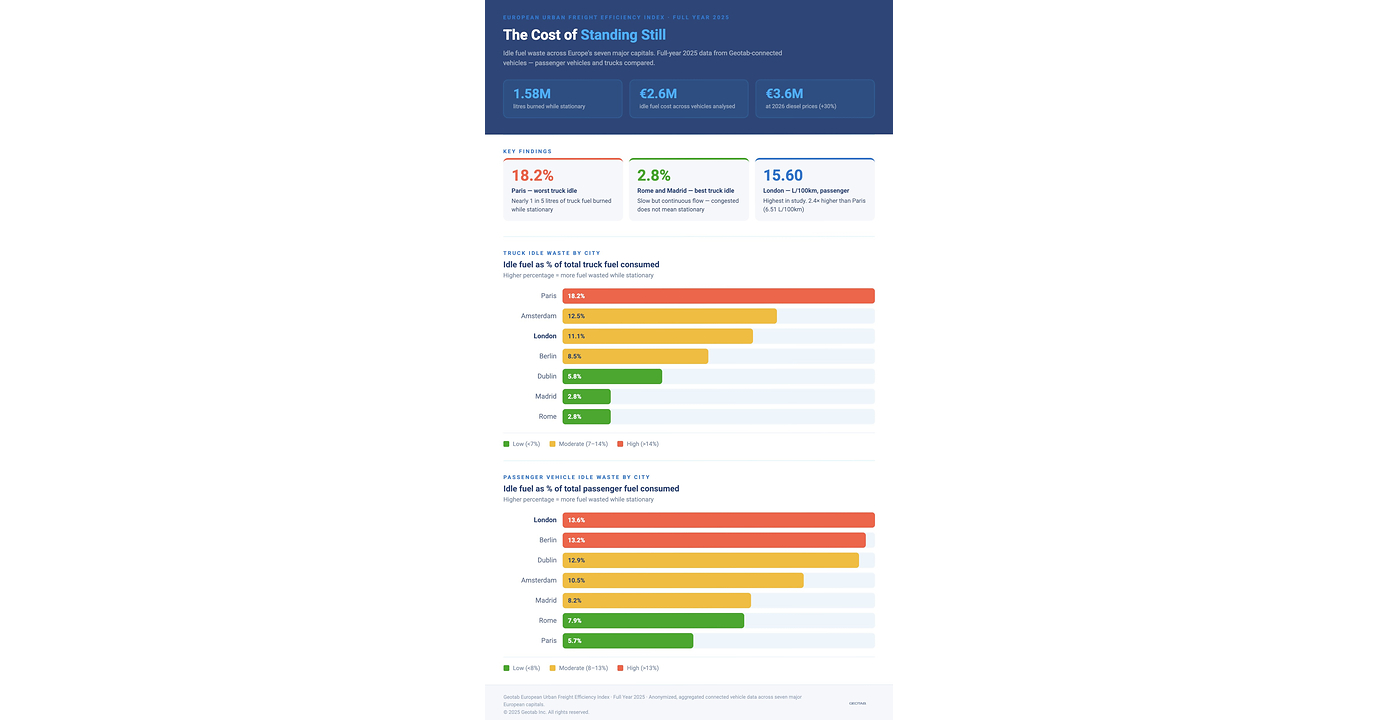
Geotab reports that Geotab-connected vehicles burned 1.58 million litres of fuel while idling in traffic across Europe’s major capitals during 2025, costing fleets about €2.6 million (based on 2025 average fuel prices). With diesel above €2/litre in 1H26 (up ~30% y/y, attributed to Middle East geopolitical instability), the same idle waste would cost ~€3.6 million. London is ranked 6th/7 in the Urban Freight Efficiency Index, with passenger fuel consumption at 15.60L/100km and 13.6% of passenger fuel burned while stationary—though the report notes congestion costs don’t always track congestion time.
The immediate market read-through is not about congestion itself; it is about who carries the incremental diesel bill before pricing power catches up. Urban parcel, delivery, and municipal fleets have the worst operating leverage here because idle time is a pure margin leak, while logistics players with strong fuel surcharges and route-optimization software can offset part of the shock. The second-order loser is any OEM/supplier mix tied to high-utilization ICE commercial vehicles if fleet managers respond by cutting miles, delaying replacements, or spec'ing smaller electrified vehicles.
The more interesting implication is that fuel inflation and stop-start traffic interact multiplicatively: a 30% higher diesel price widens the gap between efficient and inefficient operating models, so the spread between best-in-class and laggards should show up first in gross margin, then in guidance. That makes software-enabled fleet efficiency a steadier beneficiary than outright freight volume, because the value proposition improves when fuel is expensive and route variability is high. Public proxies worth watching are Samsara (IOT) and Trimble (TRMB) on the enablement side, versus UPS (UPS), FedEx (FDX), and commercial vehicle suppliers such as CVGI on the cost-exposed side.
Catalyst timing is mostly 1-3 months for commentary in fleet earnings and 6-18 months for capex re-optimization. The thesis breaks if diesel retreats sharply, congestion metrics normalize, or carriers successfully pass through surcharges without volume loss. The contrarian point: investors often assume urban congestion is a generic negative for all fleets, but the real winner is the operator with the best telematics and dispatch discipline, not necessarily the fastest-moving freight network.
AI-powered research, real-time alerts, and portfolio analytics for institutional investors.
Request TrialOverall Sentiment
mildly negative
Sentiment Score
-0.12
Ticker Sentiment
