
Weather Shocks and Iran, Ukraine Wars Hit Grocery Bills
Source: Bloomberg
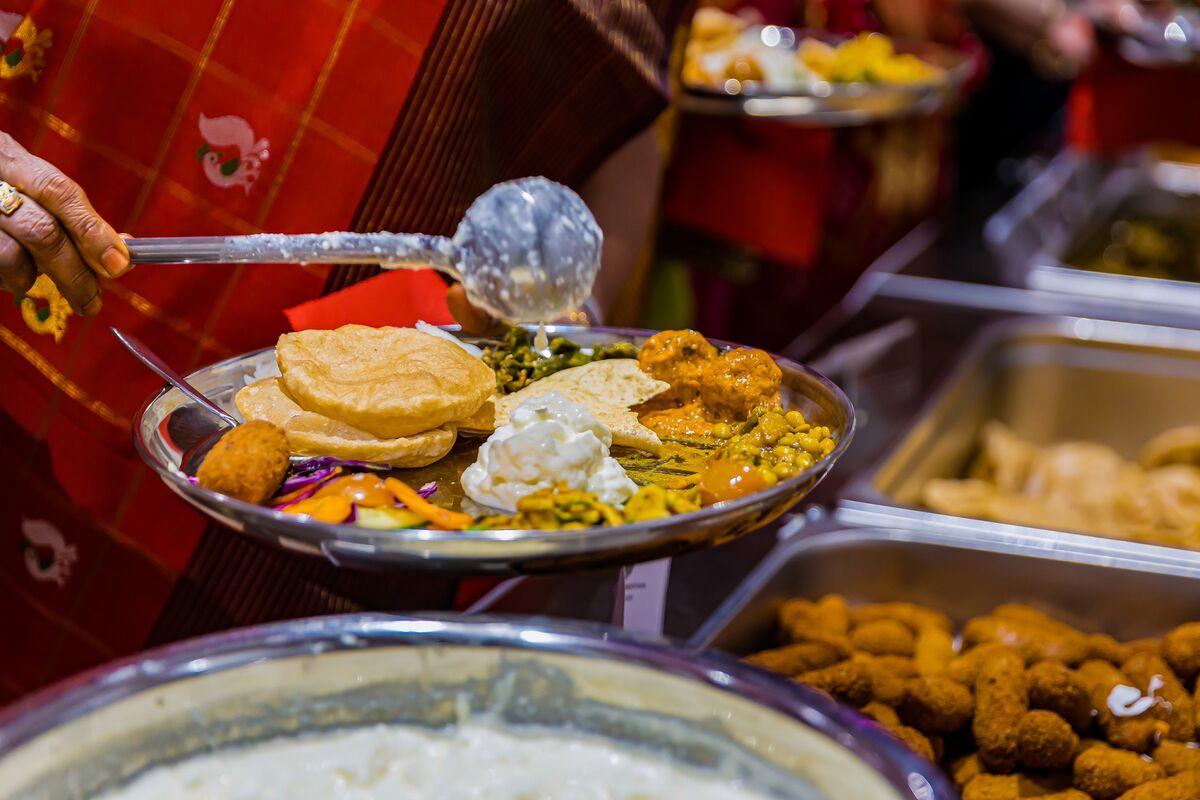
Weather shocks and war are increasing food-cost pressures in India, with the traditional thali platter serving as an indicator of rising prices across grains, pulses, vegetables and curries. The report highlights mounting grocery-bill inflation driven by climate-related supply disruptions and geopolitical pressures.
Analysis
The investable transmission is less the food-price spike itself than a likely extension of restrictive real rates in an economy where discretionary consumption depends heavily on rural purchasing power. A sustained food-led CPI surprise can delay RBI easing by one to two meetings, pressuring rate-sensitive Indian financials, autos and housing proxies before it materially affects headline FMCG revenues. INDA and EPI have meaningful exposure to banks and consumer cyclicals, making them cleaner macro hedges than attempting to trade individual agricultural commodities.
Within staples, pricing power is uneven: HUVR, NESTLEIND and BRITANNIA can pass through inflation with a lag, but volumes typically weaken when price/mix becomes the earnings lever. ITC is relatively insulated through cigarette cash generation and can benefit from higher agricultural trading activity, though that is not a reason to underwrite a broad food-inflation bull case. Restaurant, quick-service and mass-market packaged-food margins face the worst near-term setup because promotional intensity limits pass-through; listed Indian consumer names are also generally priced for benign input-cost normalization.
The contrarian point is that weather-driven vegetable inflation often mean-reverts faster than markets expect, while imported edible-oil and grain shocks are more persistent because they affect household budgets and fiscal subsidy risk. The thesis turns materially more bearish only if food inflation broadens into wages and core services over the next two to three CPI prints; absent that, a broad India-equity selloff would likely be an opportunity rather than a durable macro regime change.
AllMind Terminal
AI-powered research, real-time alerts, and portfolio analytics for institutional investors.
Request TrialMarket Sentiment
Overall Sentiment
mildly negative
Sentiment Score
-0.35
Key Decisions for Investors
- Use a 1-3 month tactical hedge: short INDA versus long a broad EM ex-India proxy only if the next CPI release shows food inflation broadening into core measures or RBI communication turns explicitly hawkish. Target 5-8% relative downside; cover if food inflation decelerates for two consecutive prints or RBI signals a near-term cut.
- Prefer ITC over HUVR/NESTLEIND/BRITANNIA on a 3-6 month relative basis: ITC's diversified cash flows should absorb volume pressure better than food-heavy staples reliant on repeated price increases. Invalidate if cigarette volume or pricing weakens materially, or if packaged-food input costs normalize faster than retail pricing.
- Avoid adding to Indian consumer-discretionary and QSR exposure until management commentary confirms both commodity-cost visibility and rural-volume resilience. A long consumer-staples trade is not attractive solely on inflation protection at current uncertainty; wait for evidence that gross-margin pressure is being passed through without volume erosion.
- Set an RBI/CPI alert rather than trade agricultural commodities directly: a sustained upside surprise across two monthly prints would increase odds of delayed easing and favor the INDA hedge; a rapid reversal in perishables without core spillover falsifies the broad equity-risk thesis.
More News
- Trump signs sweeping Russia sanctions over Ukraine war
- Bolivia’s Congress approves $1.9bn IMF loan amid protest threats
- Saudi Oil Cuts Tied to War Hit Europe: Evening Briefing Americas
- Trump says U.S. to build a 'large Military presence' in Greenland as part of a security deal with it and Denmark
- Kevin Warsh just revealed a huge change for the Fed. The press missed it
- UBS now expects AI capex to reach nearly $1tn this year and around $1.4tn by 2027
From AllMind Research
- Anthropic IPO Preview: Valuation, Timing, and What to Watch
- Shein After the IPO: Venue, Valuation, and What Must Be Proved
- What AI Research Tools Should a Small Hedge Fund Buy First?
- Weekly Update: New Reporting Features, UI Improvements, and Chat Optimizations
- Selecting an AI Research Platform for Institutional Investors