
Huawei Unveils New UnifiedBus Computing Architecture for SuperPoDs and Clusters
Source: PR Newswire
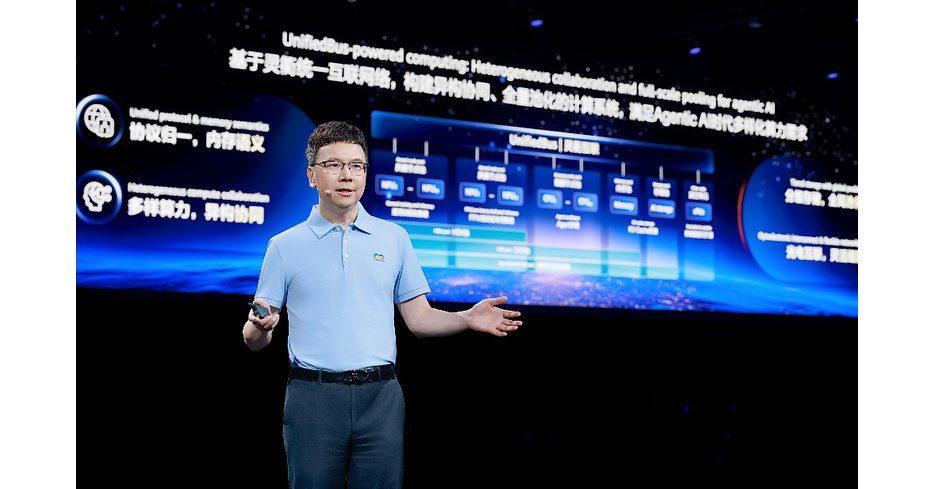
Huawei unveiled its UnifiedBus interconnect architecture and related products to scale AI computing from individual cabinets to clusters of up to 1 million NPUs. The company says the protocol raises interconnect bandwidth from roughly 100 GB/s to TB/s levels and cuts round-trip latency from 7 microseconds to 2 microseconds, while its LinkDevice supports 176 ports at 1.6 Tbit/s each. Huawei also launched an agentic-AI SuperCluster based on TaiShan 950 and Atlas 960 SuperPoDs, alongside smaller appliances intended to let SMEs run trillion-parameter models locally.
Analysis
The investable implication is less about a near-term Huawei revenue inflection than a potential reduction in the effective cost of Chinese AI training/inference at scale. If system-level pooling materially raises accelerator utilization, domestic customers can offset part of the performance gap versus NVIDIA hardware through lower idle capacity, memory offload, and improved fabric efficiency. That would strengthen the competitive position of China-exposed AI infrastructure beneficiaries—particularly optical-component, switching, server, storage, and power suppliers—while increasing the risk that NVIDIA’s China opportunity remains structurally capped even if export-control rules do not tighten further.
The second-order loser is the standalone high-bandwidth-memory and copper-cabling content per unit of deployed compute: a credible tiered-memory architecture can shift value toward networking, DDR/enterprise storage, and photonics. This is directionally supportive for Chinese optical interconnect and data-center supply chains, but the claimed performance gains are not independently benchmarked and may depend on software maturity, workload mix, and availability of Ascend accelerators. Near-term, this is principally a procurement and ecosystem signal; the relevant 1-3 month catalyst is customer design-win disclosure or third-party MLPerf-style results, while the 6-18 month question is whether developers port production workloads rather than merely test the platform.
Consensus may overread the announcement as evidence of immediate technological parity with NVIDIA. Cluster fabric is only one constraint: accelerator yields, compiler/toolchain reliability, networking software, and model-framework support determine realized utilization. The sharper contrarian risk is that a more efficient domestic stack expands total Chinese AI capex rather than simply displacing imported GPUs, benefiting local infrastructure vendors without materially reducing demand for permitted NVIDIA products; this thesis is falsified by weak Ascend shipments, delayed commercial deployments, or customer-reported utilization below claimed levels.
AllMind Terminal
AI-powered research, real-time alerts, and portfolio analytics for institutional investors.
Request TrialMarket Sentiment
Overall Sentiment
moderately positive
Sentiment Score
0.48
Key Decisions for Investors
- No immediate directional trade in unlisted Huawei; treat this as a 1-3 month watch catalyst rather than a revenue event. Build an alert for independently verified customer deployments, Ascend order commentary, and benchmarked utilization/latency results before underwriting a China AI-infrastructure rerating.
- Maintain a medium-term hedge on NVIDIA (NVDA) China-exposure assumptions rather than shorting outright: avoid assigning upside from a normalization in Chinese high-end accelerator demand until domestic fabric-plus-Ascend adoption data emerges. Falsifier: material easing of U.S. export rules or disclosed China revenue growth above management’s constrained-market assumptions.
- Screen China/Hong Kong-listed optical networking, enterprise-storage, DDR-memory, and AI-server suppliers for disclosed UnifiedBus design wins; only initiate longs after contract value, delivery timing, and gross-margin terms are identified. The likely value capture is in photonics and switching content, not the press-release architecture claim itself.
- For global AI hardware portfolios, watch a relative long optical interconnect / short copper-connectivity basket if commercial deployments validate reduced in-rack copper intensity. Use a 6-12 month horizon; exit if deployment architectures retain conventional cabling or if optical pricing compression absorbs the content uplift.
More News
- All Iranian airlines to be 'shut down' from Wednesday, Bessent tells CNBC
- Taiwan benchmark Taiex rises to record intraday high as tech stocks advance
- AMD joins the $1 trillion club as chip rally surges - our AI Strategy saw it early
- Jamie Dimon says hyperscaler AI spending could hit $1 trillion next year
- Factbox-Key issues for this week’s Trump-Xi summit in Washington
- Here's who we know is going to the Trump-Xi dinner so far
From AllMind Research
- Anthropic IPO Preview: Valuation, Timing, and What to Watch
- Shein After the IPO: Venue, Valuation, and What Must Be Proved
- What AI Research Tools Should a Small Hedge Fund Buy First?
- AI Research Systems for Hedge Funds: A Pilot Design
- Weekly Update: New Reporting Features, UI Improvements, and Chat Optimizations