
45% of Mid-Market Companies Have No Single Owner for How People and AI Work Together, Lever Talent Research Finds
Source: PR Newswire
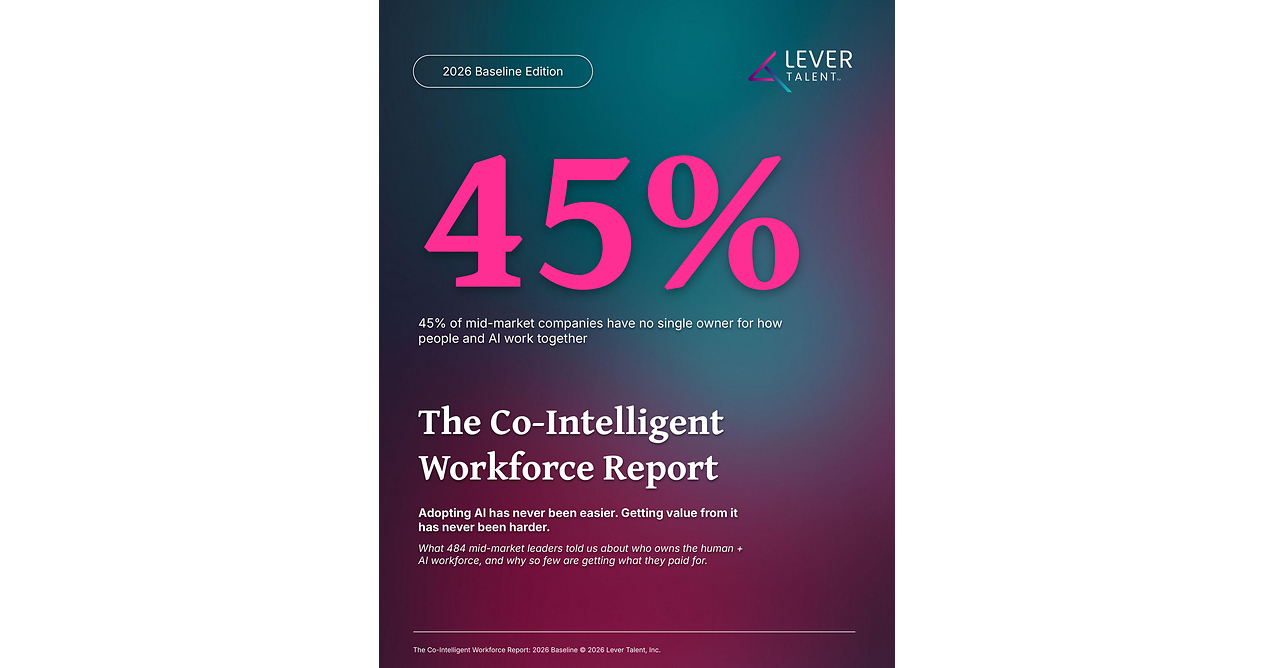
Lever Talent’s survey of 484 mid-market leaders found that 45% of companies have no single owner for how people and AI work together; 97% have adopted AI, but only 28% say it is extremely valuable. Companies with a primary owner of the human-AI mix were 2.5x as likely to report extreme AI value, while companies investing in technology, programs, and people reached that outcome 50% of the time versus 6% for technology-only investors. The findings describe associations, not cause and effect.
Analysis
The investable signal is a possible shift in AI budgets from licenses and compute toward implementation, workflow redesign, training, and controls—not evidence that AI demand is rolling over. If this pattern generalizes, it favors vendors and service providers able to connect AI deployment to measurable workflow outcomes, while making standalone usage or seat-growth metrics less persuasive. Microsoft, ServiceNow, Workday, and systems integrators could benefit only where they capture that orchestration layer; the survey does not establish which providers are winning or quantify spend.
Treat the reported associations cautiously: Lever Talent sells workforce-transformation services, commissioned the survey, and reports no causal test. The mid-market sample also does not establish behavior at large enterprises. Near term, this is weak evidence for a broad AI trade. Over 1–3 months, monitor earnings commentary for implementation and training budgets, AI productivity metrics, and customer conversion from pilots to production. Over 6–18 months, the structural risk is that buyers demand demonstrated labor or process savings before renewing or expanding AI contracts, pressuring vendors whose monetization depends on adoption alone. The thesis weakens if spending continues to rise without measurable workflow outcomes—or if vendors demonstrate value through independently verifiable customer results.
AllMind Terminal
AI-powered research, real-time alerts, and portfolio analytics for institutional investors.
Request TrialMarket Sentiment
Overall Sentiment
neutral
Sentiment Score
0.10
Key Decisions for Investors
- No directional trade from this release alone: it is a vendor-commissioned survey with self-reported outcomes, no causal evidence, and no company-level spending or financial data.
- Watch for budget-mix signals in upcoming software and consulting results: implementation services, training, workflow redesign, and governance demand versus incremental AI seats or consumption. Treat management anecdotes as unverified until tied to renewals, bookings, or disclosed customer outcomes.
- Build a relative-value watchlist rather than a position: compare AI platform vendors such as Microsoft and ServiceNow with implementation-heavy systems integrators. Consider a pair only if earnings show adoption monetization weakening while services demand strengthens; the article alone does not support sizing or entry.
- Falsify the budget-rotation thesis if software vendors sustain AI-related expansion through renewals and customer productivity evidence without a corresponding increase in implementation spend. Reassess if subsequent independent, representative research confirms the survey's pattern.
More News
- US tech stocks tumble as investors fret over AI spending
- Asian shares wobble as tech rout boosts bonds, dents rate hike bets
- Asia stocks fall as AI rout batters S.Korea; Japan spooked by strong CPI
- AI debt and French bonds face a stress test — why it may not be over
- Nasdaq 100 Drops as Oil Rise Fuels Risk-Off Mood
- SK Hynix shares slide after chipmaker scraps Solidigm IPO plans
From AllMind Research
- Anthropic IPO Preview: Valuation, Timing, and What to Watch
- Shein After the IPO: Venue, Valuation, and What Must Be Proved
- What AI Research Tools Should a Small Hedge Fund Buy First?
- Run Cost-Controlled Financial Research in AllMind Agent Studio
- State of Public Markets, June 2026: Higher for Longer Meets the AI Supercycle