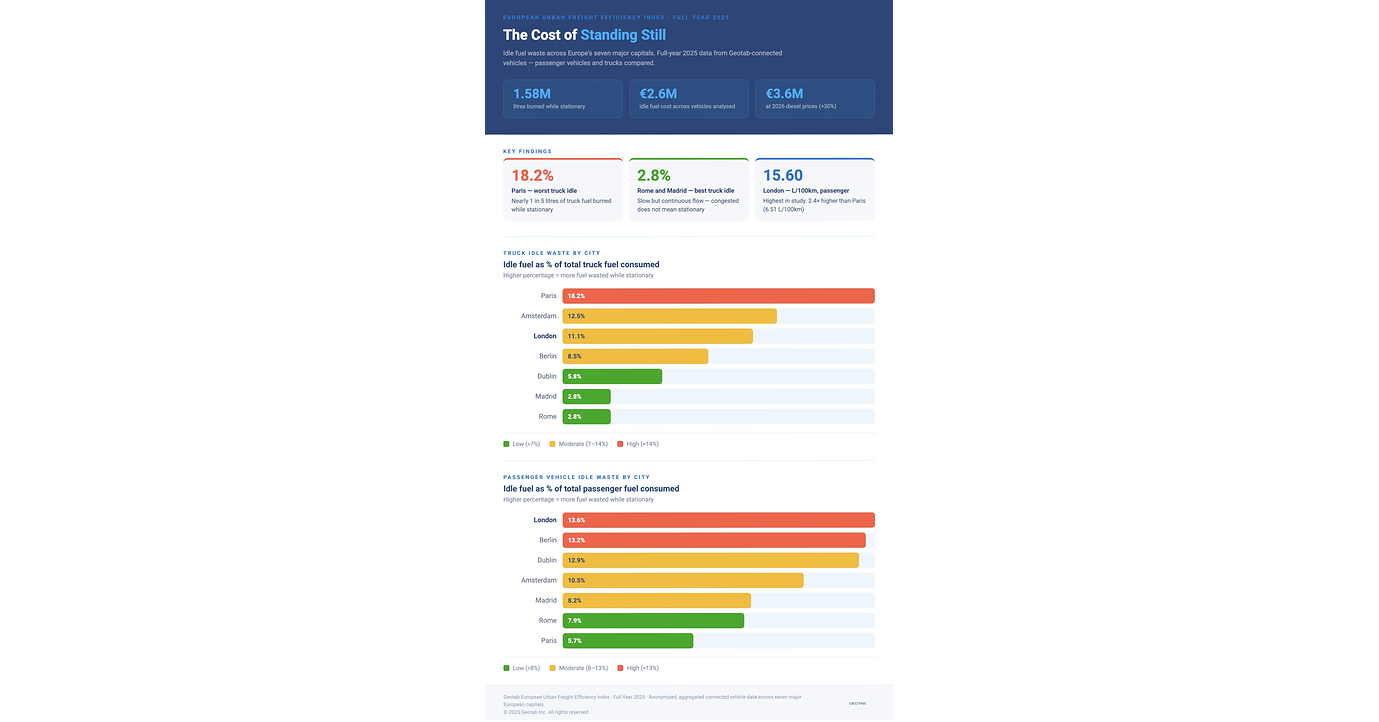
Geotab estima que en 2025 los vehículos conectados consumieron en ralentí más de 1,58 millones de litros de combustible, con un coste agregado de 2,6 millones de euros para las flotas analizadas. El estudio proyecta que, si el diésel (superando los 2€/litro en el 1S 2026) implica ~+30% de precio, el coste de ese mismo desperdicio subiría a ~3,6 millones de euros. Por ciudad, Berlín lidera (puntuación 61) pese a mayor congestión, mientras Madrid (25, última) mantiene costes de ralentí relativamente bajos: 2,8% en camiones y 8,2% en turismos, apoyado en que el tráfico rara vez se detiene por completo.
This is more useful as a pricing-sensitivity signal than a standalone demand catalyst. When diesel is elevated, fleet operators tend to fund software that can prove near-term payback; that supports telematics and routing analytics vendors with usage-based or subscription revenue, especially names like IOT and TRMB that sit closer to operating workflows than pure hardware. The second-order effect is budget reallocation: fleets often defer vehicle capex but accelerate spend on optimization tools because the ROI shows up inside one budgeting cycle.
The losers are not the congested cities per se, but carriers with dense urban route exposure and limited ability to reprice fuel or redesign networks, with UPS the cleanest large-cap proxy. The real mechanism is not average congestion, but stop-start intensity and idle time; that means Paris-style operating patterns are more damaging than headline traffic scores suggest, while slow-moving congestion can be less costly than frequent stoppage. If fuel spikes persist for months, expect a faster procurement cycle for fleet analytics; if diesel normalizes, the urgency fades quickly.
Contrarian view: the market may be overestimating how broad this benefit is because the data come from already-connected fleets, which are likely earlier adopters and may have already harvested the easiest savings. That limits the incremental upside for Geotab-adjacent peers unless they can show net-new seat expansion or better ARPU. The thesis is falsified if European diesel rolls back below ~€1.7/L, or if upcoming carrier guidance shows no change in fuel/operating expense despite continued congestion.
AI-powered research, real-time alerts, and portfolio analytics for institutional investors.
Request TrialOverall Sentiment
neutral
Sentiment Score
-0.10
