
Global Flow Cytometry Market to Reach USD 11.14 Billion by 2034 at 9% CAGR as Rising Adoption in Clinical Diagnostics, Growing Multiparameter Cell Analysis, and Advances in High-Parameter Flow Cytometry Accelerate Market Growth, Reports Maximize Market Research
Source: PR Newswire
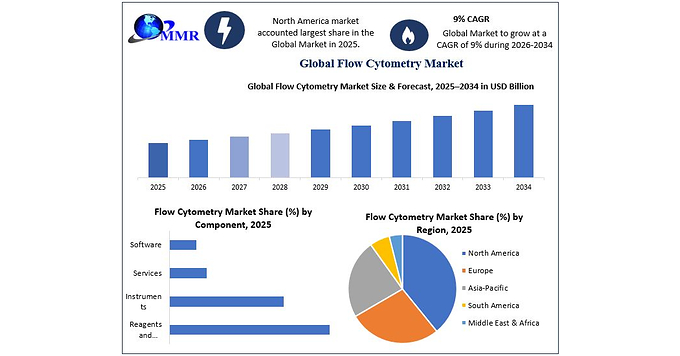
The global flow cytometry market is projected to grow from $5.13 billion in 2025 to $11.14 billion by 2034, a 9% CAGR, driven by clinical diagnostics, oncology, immunology, drug discovery, and cell and gene therapy applications. Growth is supported by spectral and high-parameter cytometry, automation and AI-enabled data analysis, with North America currently leading and Asia-Pacific positioned as a high-growth region. High instrument and operating costs, complex workflows, and shortages of skilled personnel remain key adoption constraints.
Analysis
This is not an earnings-relevant demand datapoint by itself; the forecast is a vendor-sponsored market estimate and is too broad to change near-term estimates for TMO, DHR, BDX, or A. The investable implication is mix: high-parameter workflows shift lifetime economics away from one-time instrument placements toward recurring antibodies, assay kits, service contracts, and data-analysis software. TMO and DHR have the strongest ability to monetize the full workflow, while BDX's installed clinical-lab base provides defensiveness but may be less geared to premium research-tool upgrades.
The second-order beneficiary is Cytek (CTKB), where spectral-flow adoption can produce instrument-growth upside disproportionate to a smaller base; however, that same exposure makes it most vulnerable if academic/biotech capex remains constrained. For established platforms, automation and software can reduce the skilled-labor bottleneck and support gross-margin expansion, but only if customers accept closed, integrated workflows rather than mixing reagents and analysis tools across vendors. BIO and TECH benefit more through research reagent pull-through, whereas their revenue sensitivity to incremental clinical adoption is lower.
Over the next 1-3 months, the relevant catalysts are instrument order trends, China/Asia-Pacific tender activity, biotech funding conditions, and management commentary on cell-therapy customer spending—not generic market-growth reports. Over 6-18 months, clinical standardization of high-dimensional assays could create a meaningful consumables annuity, but reimbursement, validation requirements, and laboratory staffing constraints can delay conversion from research use to routine diagnostics. Consensus may overvalue AI-analysis rhetoric: data interpretation improves throughput, but it does not by itself solve panel standardization, clinical validation, or budget approval.
A relative-value expression is preferable to a sector-beta trade. Long CTKB against short a diversified life-science-tools proxy captures spectral-flow share gains, but only after evidence of accelerating placements and reagent attachment; absent that evidence, the risk is multiple compression from weak utilization. Falsify the constructive workflow thesis if TMO/DHR/BDX report another quarter of declining instrument orders, reduced cell-therapy exposure, or consumables growth materially below core organic growth.
AllMind Terminal
AI-powered research, real-time alerts, and portfolio analytics for institutional investors.
Request TrialMarket Sentiment
Overall Sentiment
moderately positive
Sentiment Score
0.42
Ticker Sentiment
Key Decisions for Investors
- No immediate directional trade on this release; treat it as a watch item until upcoming TMO, DHR, BDX, and CTKB earnings provide order, placement, and consumables-attachment evidence.
- Establish a 6-12 month research watch for long CTKB / short XBI or a diversified tools basket (TMO, DHR) only if CTKB shows sequential placement acceleration and improving reagent pull-through. Target at least 2:1 upside/downside; exit if bookings weaken for two consecutive quarters or gross margin deteriorates on discounting.
- Favor TMO and DHR over BDX for a 6-18 month life-science-tools recovery: their broader reagent, instrument, and workflow exposure should capture both research and clinical conversion. Size modestly because the key risk remains biotech and academic capex rather than end-market technology adoption.
- Monitor TECH and BIO for consumables-led confirmation: sustained organic reagent growth above instrument growth would validate the higher-recurring-revenue thesis; without it, avoid paying a premium for the automation/AI narrative.
- Use Asia-Pacific tender wins and China revenue commentary as a catalyst alert for A, TMO, DHR, and CTKB. A recovery in Chinese orders would likely matter more to valuation multiples than the long-dated market forecast, while renewed procurement delays would invalidate the near-term upside case.
More News
- After multiple deaths and injuries, NHTSA is investigating comma.ai
- Bio-Techne Shareholders Approve Acquisition by Merck KGaA, Darmstadt, Germany
- China's AI chip blitz arms Xi with a message for Trump: 'You can't choke us off'
- OpenAI’s agent hacked Australia’s Medicare website—the latest rogue AI incident that the company didn’t know about for months
- Meta announces new lightweight virtual reality glasses to one-up Apple’s Vision Pro
- Trump-Xi Summit Looms & AI in the C-Suite