
Innophos Advances North American Battery Supply Chain Strategy
Source: PR Newswire
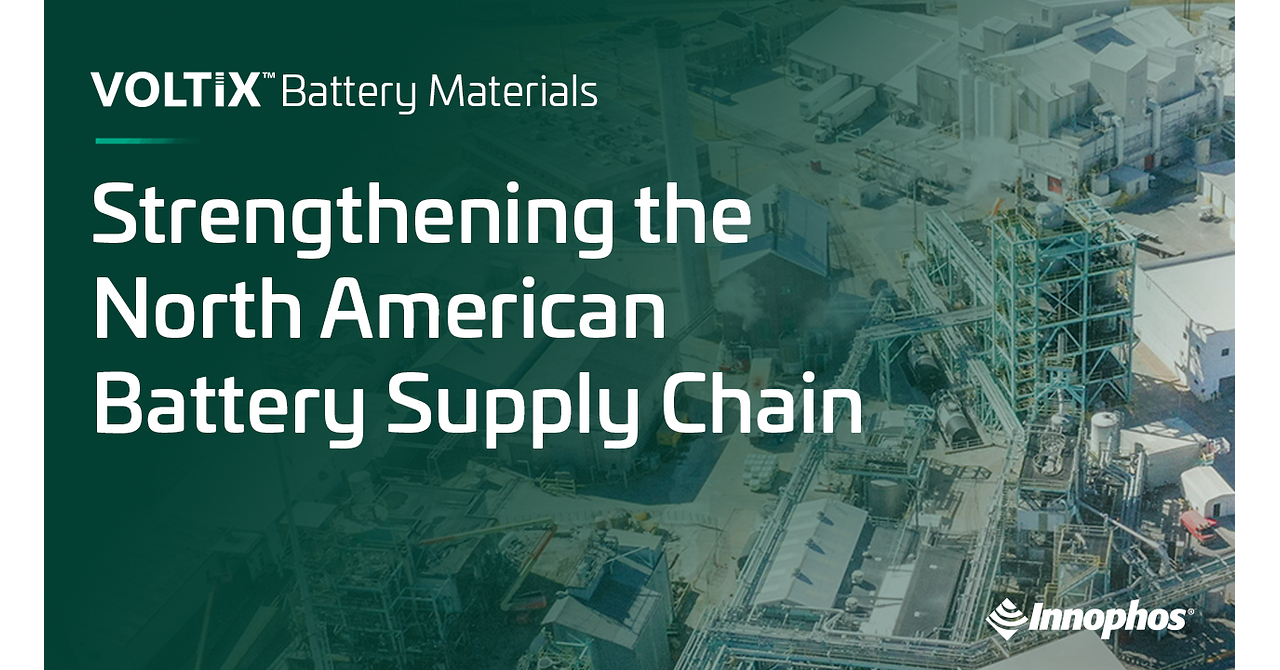
Innophos is expanding production of battery-grade iron phosphate for LFP batteries and sodium iron phosphate (NFPP) for next-generation sodium-ion batteries, targeting additional capacity at its Nashville, Tennessee facility by 2028. The company has invested more than $100M in North American manufacturing assets over the past five years and is positioning its domestic phosphate supply chain to support EV and stationary energy-storage demand. The announcement strengthens Innophos' exposure to growing North American battery-materials markets, although it provides no specific capacity, revenue, or contract figures.
Analysis
This is not yet investable as a direct equity catalyst: the issuer is private, planned output is undisclosed, and the relevant bottleneck is qualification at cathode-active-material and cell manufacturers rather than nameplate chemical capacity. The immediate read-through is modestly positive for U.S. phosphate optionality, particularly MOS and ICL, but neither should re-rate on this announcement alone because battery-grade material remains a small fraction of their earnings base and purity conversion economics are unverified.
The more important second-order effect is that a credible domestic iron-phosphate source could reduce the working-capital, tariff, and geopolitical-risk premium embedded in North American LFP cell sourcing. That disproportionately supports stationary-storage integrators such as FLNC and Tesla's energy-storage business versus EV OEMs: storage buyers value cycle life and delivered-system cost, while passenger EV adoption remains more exposed to charging infrastructure, vehicle pricing, and consumer demand. A domestic precursor chain could also pressure incumbent Asian cathode-material suppliers over 6-18 months, but only after customer qualification and cell-level performance validation.
Consensus may overstate the strategic value of "domestic" supply absent disclosed offtakes, qualified-specification yield, and a viable domestic LFP cathode conversion step. Battery-grade phosphoric acid is not interchangeable with commodity fertilizer phosphate; a high-cost local source can win only if procurement buyers assign a meaningful value to supply security or if trade policy raises landed Asian input costs. The thesis is falsified if 2027-28 customer contracts fail to emerge, qualification timelines extend beyond planned capacity additions, or Chinese LFP oversupply keeps imported cathode economics structurally cheaper.
AllMind Terminal
AI-powered research, real-time alerts, and portfolio analytics for institutional investors.
Request TrialMarket Sentiment
Overall Sentiment
moderately positive
Sentiment Score
0.48
Key Decisions for Investors
- No immediate position on the announcement; place MOS and ICL on a 1-3 month catalyst watch for disclosed battery-material offtakes, pricing, or high-purity phosphate capacity data. Initiate only if management quantifies EBITDA contribution or secured volumes sufficient to affect 2028 estimates.
- Maintain a relative preference for FLNC over legacy grid-equipment exposure on a 6-18 month horizon if U.S. LFP sourcing advances: lower battery procurement volatility can improve project gross-margin visibility. Risk control: exit the relative thesis if FLNC backlog conversion or gross-margin guidance deteriorates, since component localization does not solve execution risk.
- Monitor U.S. tariff or domestic-content rulemaking as the key optionality trigger for MOS/ICL; policy that increases the delivered cost of imported LFP inputs would create a more investable domestic-phosphate premium. Without that catalyst, treat any fertilizer-equity rally tied to this development as an opportunity to fade rather than chase.
- Track MOS phosphate segment margins and purified-acid capital allocation at the next two earnings cycles. A material diversion of phosphate units into specialty grades without premium pricing would be margin-dilutive and would invalidate a bullish battery-material read-through.
More News
- All Iranian airlines to be 'shut down' from Wednesday, Bessent tells CNBC
- Taiwan benchmark Taiex rises to record intraday high as tech stocks advance
- AMD joins the $1 trillion club as chip rally surges - our AI Strategy saw it early
- Jamie Dimon says hyperscaler AI spending could hit $1 trillion next year
- Factbox-Key issues for this week’s Trump-Xi summit in Washington
- Latest Oil Market News and Analysis for Sept. 22
From AllMind Research
- Anthropic IPO Preview: Valuation, Timing, and What to Watch
- Shein After the IPO: Venue, Valuation, and What Must Be Proved
- What AI Research Tools Should a Small Hedge Fund Buy First?
- Can ChatGPT or Claude Replace a Research Platform?
- How the 2026 Milan-Cortina Winter Olympics Will Reshape Company Revenues and Stock Performance