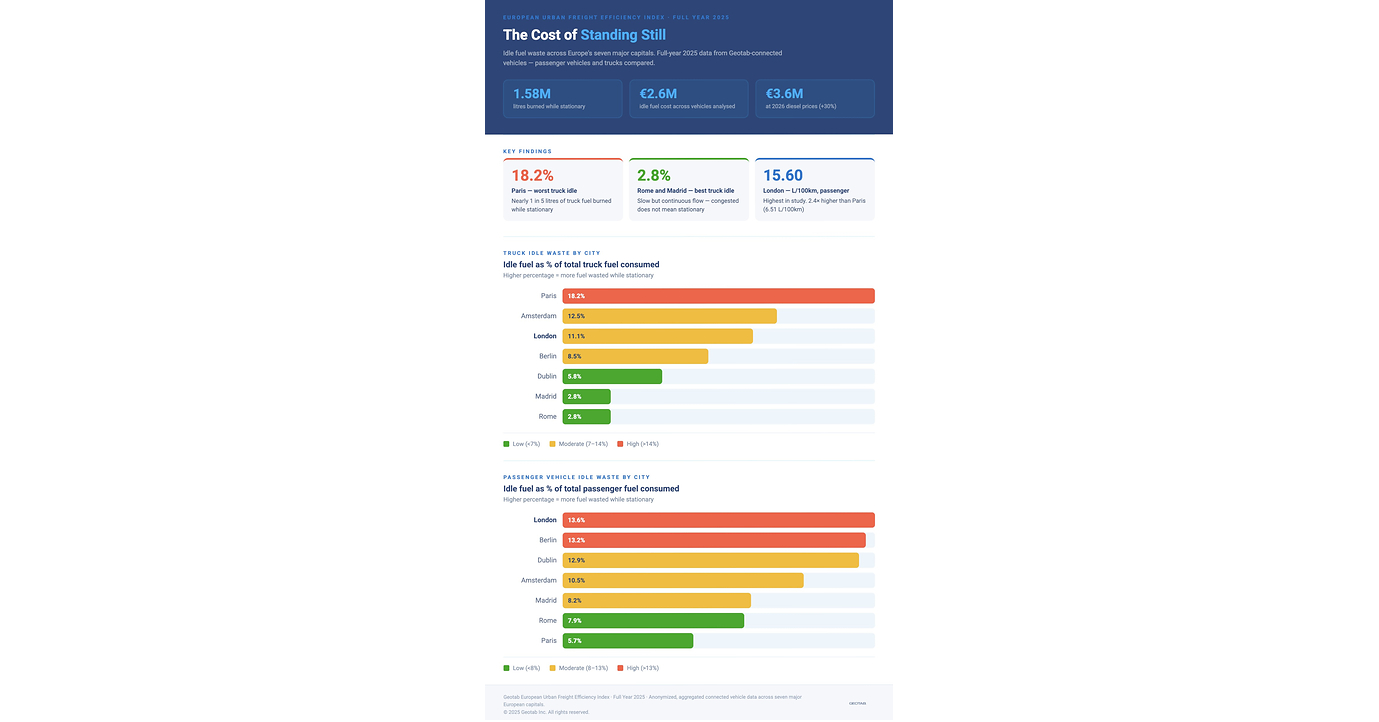
Geotab’s 2025 European urban freight efficiency index estimates that vehicles idling in major European cities consumed over 1.58 million liters of fuel, translating to roughly €2.6m in wasted fuel costs over twelve months (based on 2025 average prices). With European diesel rising above €2/liter in H1 2026 (+30% vs earlier levels attributed to Middle East geopolitical instability), the same idle-fuel losses would cost about €3.6m. The study highlights Paris as worst for heavy vehicles on idling losses (18.2%) and notes broader congestion-driven financial and emissions impacts.
The investable takeaway is not the congestion itself; it is the widening gap between operators who can measure idle-time leakage and those who cannot. That tends to shift spend toward telematics, route optimization, and fleet analytics, which is a better structural read-through for connected-operations vendors than for energy producers. The biggest second-order loser is any carrier with dense urban routes and limited pricing power, where fuel waste becomes a margin drag before it becomes a volume problem.
Near term, the market will likely treat this as noise unless diesel stays elevated for another quarter and procurement teams are forced to rewrite fleet budgets. The catalyst path is 1-3 months: fuel inflation plus city-specific congestion data should push fleet managers to review software budgets, while carriers with contract resets lagging spot fuel can see compressed EBITDA. Over 6-18 months, the more durable effect is a capex reallocation from pure hardware refresh to software that proves measurable idle reduction.
The contrarian point is that the sample likely overweights already-instrumented fleets, so the headline savings may flatter the incremental ROI of telemetry. If the best-run fleets are already seeing and managing this problem, the upside to new software adoption is smaller than the gross waste number implies. Falsifiers are simple: if EMEA fleet software commentary does not improve by the next two reporting cycles, or if diesel retraces materially below current levels, the thesis loses urgency.
AI-powered research, real-time alerts, and portfolio analytics for institutional investors.
Overall Sentiment
mildly negative
Sentiment Score
-0.25
